

안녕하세요 보스턴 임박사입니다.
지난번에 생물의학자이면서 Visual Artist인 Daniel Jay 교수에 대해서 글을 올린 적이 있는데요.
부러우면 지는거다 (23) – Daniel Jay at Tufts University – Art+Science
이번에 소개할 분은 순수한 Analytical Chemist로서 Art Painting Pigments 연구를 하는 연구원입니다.
Victor Gonzalez at PPSM as CNRS Fellow
Victor Gonzalez 박사는 2023년 10월 1일에 프랑스 파리에 위치한 PPSM에서 CNRS research fellow로 조인했습니다. 아래는 이 분이 인터뷰한 자기소개 및 연구내용입니다.
“I obtained my PhD thesis (Chemistry, Sorbonne U.) in 2016. This thesis was conducted at the Centre de Recherche et de Restauration des Musées de France (C2RMF), and focused on the study of structure/property relationships of ancient lead carbonate mineral pigments as markers of their synthesis route. I then worked on post-doctoral contracts in the Netherlands, first at the Materials Science and Engineering Department of TU Delft University, then at the Science Department of the Rijksmuseum. I was interested in the reactivity of inorganic lead pigments in an organic medium. I finally returned to France on a Marie Curie European Fellowship, hosted at the PPSM, where I worked on understanding the weathering mechanisms of modern pigments for two years before joining the CNRS as a research fellow.”
“My work focuses on the chemical study of ancient materials, in particular those making up historic paint layers. These layers are composite media, consisting of an organic binder in which organic and/or inorganic coloring materials are dispersed. Chemical mechanisms are active here, and can result in the formation of weathering products that can threaten the optical or physical integrity of the paint. My aim is to identify markers of the manufacturing processes and reactivity of ancient pictorial materials. To achieve this, I specialize in using multi-scale analytical methods to probe paintings. At the scale of a single work, I use instruments to chemically image the entire surface of a painting. At the scale of a paint layer, sometimes as fine as a hair, or micro-scale, I frequently use synchrotron radiation to study the chemical phenomena at play at the level of individual pigment grains.”
“The skills developed at PPSM, in photochemistry, functional molecule synthesis and instrumental development, represent a fantastic opportunity for me to take an innovative approach to the chemical study of heterogeneous systems such as historic paintings. For example, my aim is to use specific functional molecules as probes of certain key parameters in the evolution of paint layers over time, such as the concentration of certain metal ions. When I joined the laboratory, I initiated collaborations with colleagues specializing in the development of this type of molecule (Rémi Métivier, Isabelle Leray, Clémence Allain), hoping to create new links between photochemistry and the study of pictorial matter. What’s more, the “Ancient Materials” theme is still new at PPSM, so it’s very stimulating to be building this new theme alongside all my colleagues!”
“The PPSM environment is fundamentally interdisciplinary. By joining this laboratory, I hope to benefit from the wealth of expertise around me to help me advance my research. I’m convinced that building bridges between different research communities is fundamental to overcoming the analytical challenges I face. The Paris-Saclay ecosystem is ideal for benefiting from a wealth of know-how, for example with the forthcoming creation of the Centre Pompidou’s new conservation and creation center in Massy.”
Victor Gonzalez박사가 한 연구 중 두가지 연구내용이 알려져 있습니다.
첫번째 연구는 Rembrandt의 그림에 대한 연구입니다.
Rembrandt’s impasto: Maestro’s techniques – Science Daily 1/30/2019
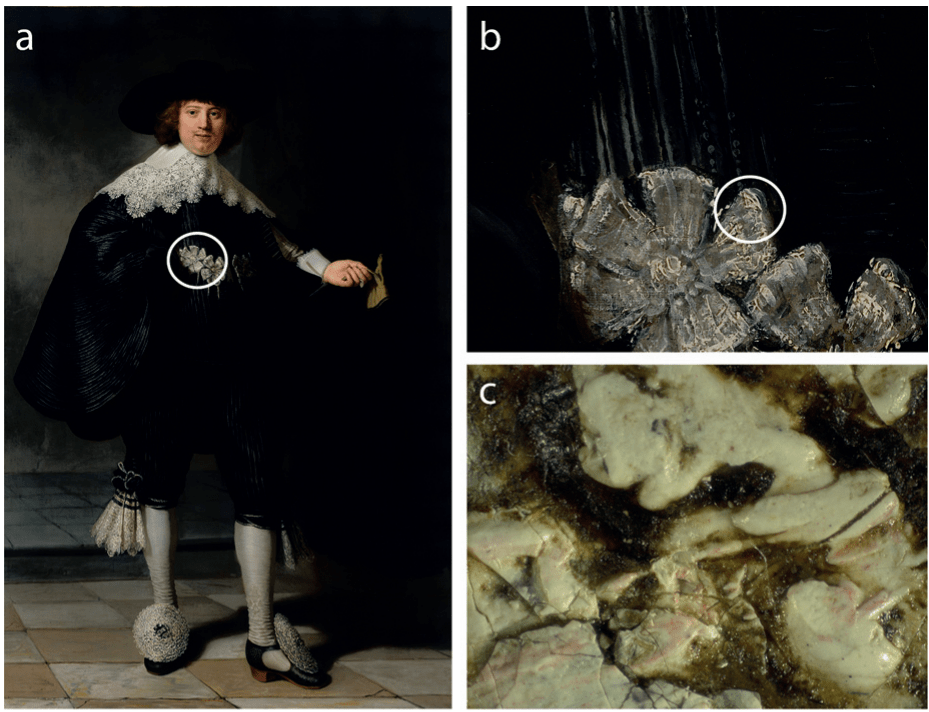
아래 그림은 Rijksmuseum에 있는 “The Portrait of Marten Soolmans (1634)”입니다.
“Based on historical texts, we believe that Rembrandt added lead oxide, or litharge, to the oil in this purpose, turning the mixture into a paste-like paint,” conservation expert Marine Cotte said.
Annelies van Loon of the Rijksmuseum said the next step was to look at more pictures by Rembrandt and his peers. “We are working with the hypothesis that Rembrandt might have used other recipes, and that is the reason why we will be studying samples from other paintings by Rembrandt and other 17th Dutch Masters, including Vermeer, Hals, and painters belonging to Rembrandt’s circle.”
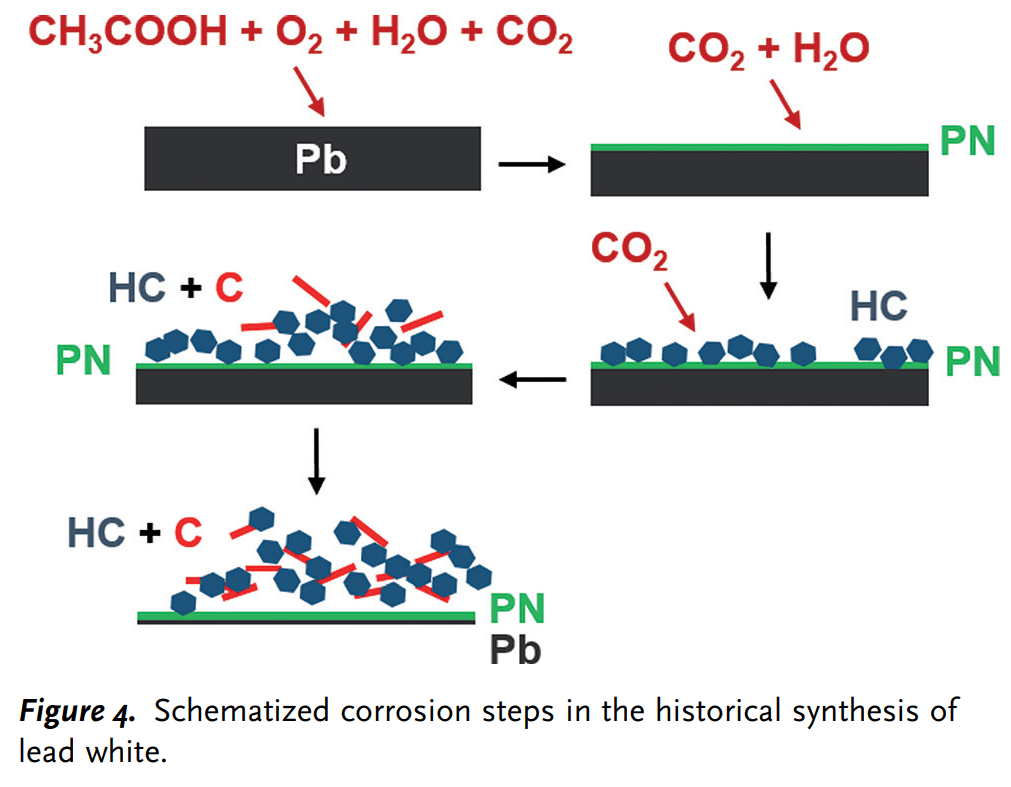
Plumbonacrite (PN)이라는 것인데 이것은 산화납 (PbO)으로 아래와 같이 만들어 졌다고 예상했습니다.
두번째 연구는 Leonardo da Vinci의 Monalisa에 대한 연구입니다.
Scientists Learn Another ‘Mona Lisa’ Secret – VOA 10/13/2023
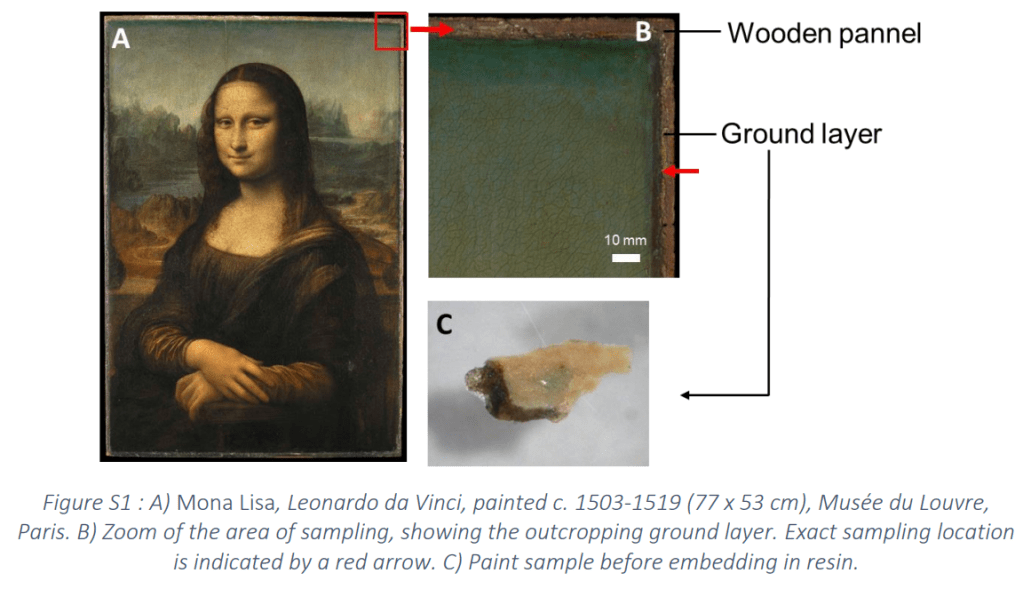
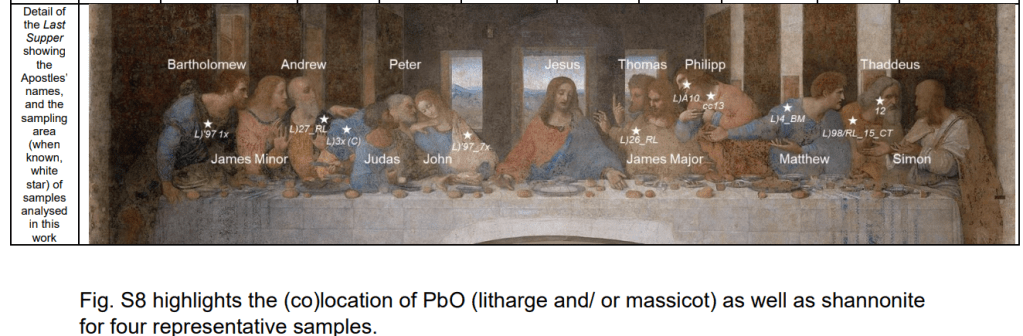
Monalisa의 우측상단 base layer와 최후의 만찬 (The Last Supper)를 연구했습니다.
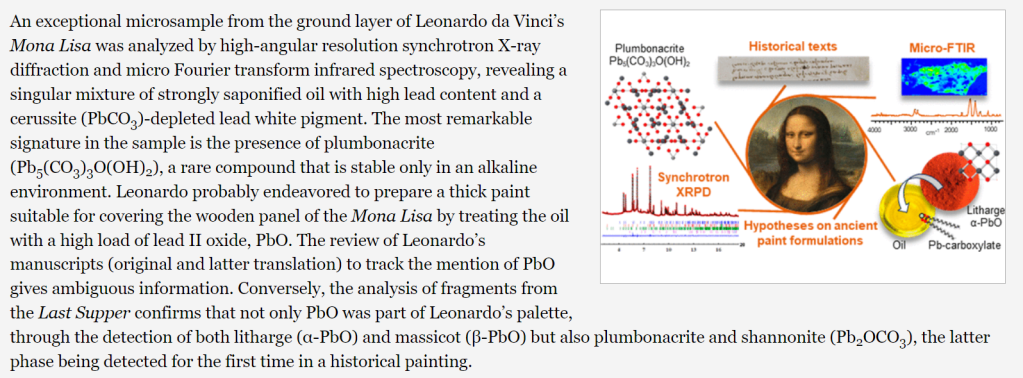
“He (Leonardo da Vinci) was someone who loved to experiment, and each of his paintings is completely different technically,” said Victor Gonzalez. He is the study’s lead writer and a chemist at France’s top research organization, the National Center for Scientific Research (CNRS). Gonzalez has studied the chemical makeup of several works by Leonardo, Rembrandt and other artists.
“In this case, it’s interesting to see that indeed there is a specific technique for the ground layer of Mona Lisa,” he said in an interview with The Associated Press.
Specifically, the researchers found a rare compound, plumbonacrite, in Leonardo’s first layer of paint. The discovery, Gonzalez said, confirmed that da Vinci most likely used lead oxide to thicken and help dry his paint.
Carmen Bambach, a specialist in Italian art at New York’s Metropolitan Museum of Art, called the research “very exciting.” Bambach, who was not involved in the study, said it shows “Leonardo’s spirit of passionate and constant experimentation as a painter,” she wrote in an email.
“Plumbonacrite is really a fingerprint of his recipe,” Gonzalez said. “It’s the first time we can actually chemically confirm it.”
Dutch artist Rembrandt may have used a similar mixture when he was painting in the 17th century. Gonzalez and other researchers have found plumbonacrite in his work, too.
“It tells us also that those recipes were passed on for centuries,” Gonzalez said. “It was a very good recipe.”
Leonardo is thought to have melted lead oxide powder, which has an orange color, in linseed or walnut oil to make it thicker and dry faster.
“What you will obtain is an oil that has a very nice golden color,” Gonzalez said. “It flows more like honey.”
저도 화학자로서 Visual Art 분야에서 일을 하고 싶은 마음이 있는데요. Victor Gonzalez 박사는 저의 Role Model로 삼아도 좋을 것 같습니다. 계속 좋은 연구를 기다립니다.
참고로 Mona Lisa는 여러 버전이 있습니다.
 BOSTON DR LIM