
출처: StatNews
안녕하세요 보스턴 임박사입니다.
Tome Biosciences는 보스턴 MIT의 Omar Abudayyeh 교수와 Jonathan Gootenberg 교수 연구실의 PGI
(Programmable Genomic Integration) 기술 플랫폼을 바탕으로 설립되었습니다.
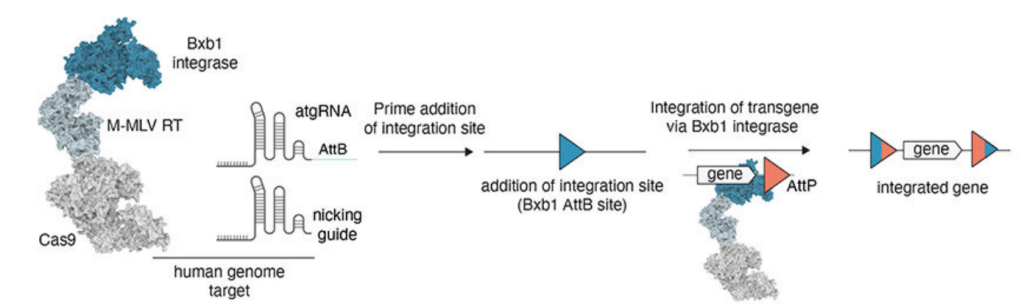
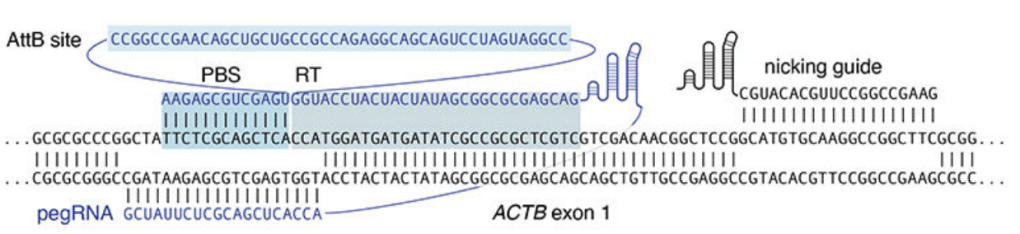
PASTE는 Programmable Addition via Site-specific Targeting Elements의 초성을 딴 이름으로 PASTE Platform을 이용해서 Liver Rare Disease와 Autoimmune Disease의 세포치료제 개발에 사용할 계획입니다.
PASTE Expands CRISPR Toolbox by Inserting Large Pieces of DNA – GEN Edge 11/28/2022
Now, a team from MIT describes a new tool called PASTE (programmable addition via site-specific targeting elements) which delivered genes as long as 36,000 DNA base pairs to several types of human cells (as well as to liver cells in mice). PASTE uses a CRISPR–Cas9 nickase fused to two enzymes—a reverse transcriptase and a serine integrase—for targeted genomic recruitment and integration of DNA.
In this study, the researchers showed that they could use PASTE to insert genes into several types of human cells, including liver cells, T cells, and lymphoblasts. They tested the delivery system with 13 different payload genes, including some that could be therapeutically useful, and were able to insert them into nine different locations in the genome.
The researchers are now further exploring the possibility of using this tool as a possible way to replace the defective cystic fibrosis gene. This technique could also be useful for treating blood diseases caused by faulty genes, such as hemophilia and G6PD deficiency, or Huntington’s disease, a neurological disorder caused by a defective gene that has too many gene repeats.
1년여의 Stealth mode 기간을 거쳐서 2023년 12월에 $213 Million Series A/B를 했습니다.
Earlier this week, Tome raised $213 million in Series A and B funding from investors including Andreessen Horowitz (a16z) Bio + Health, ARCH Venture Partners, GV, Longwood Fund, Polaris Partners, Bruker Corporation, FUJIFILM Corporation, and Alexandria Venture Investments. The funds will support Tome’s efforts to develop and commercialize programmable genomic integration (PGI) technology that was in-licensed from the Massachusetts Institute of Technology (MIT).
Tome’s portfolio includes integrase-mediated PGI (I-PGI), which utilizes proprietary integrases to precisely insert large sequences into the genome. I-PGI tech is based on the programmable addition via site-specific targeting elements (PASTE) approach to genome editing, first discovered at MIT by Tome’s co-founders Omar Abudayyeh, PhD, and Jonathan Gootenberg, PhD.
펀딩을 한지 1달도 채 되지 않아서 Shakked Halperin 박사의 Replace Therapeutics를 인수했습니다. Tome Biosciences는 DNA Writing을 하는데 Reverse Transcriptase를 쓰는 반면 Replace는 DNA Ligase를 사용하기 때문에 두 기술을 접목함으로써 PASTE platform 기술의 영역을 확장할 수 있는 장점이 있습니다.
Less than a month after launching with $213 million in funding, gene editing company Tome Biosciences has acquired a tiny Californian startup called Replace Therapeutics to expand its repertoire of DNA-altering tools. Tome will pay Replace $65 million in upfront and near-term milestone payments and up to $185 million total in stock and cash, the company told Endpoints News.
Replace was founded by Shakked Halperin, a former scientist at the Innovative Genomics Institute at UC Berkeley. Halperin’s first startup, Rewrite Therapeutics, was acquired for $45 million upfront by the CRISPR company Intellia Therapeutics in 2022 for its so-called DNA writing technologies, which use Cas enzymes to direct polymerases to make corrections, deletions and insertions to the genome.
At his newer startup, Replace, Halperin made a tool that uses Cas9 to make a nick in the genome’s double helix and uses an enzyme called a DNA ligase to stitch in a new piece of code tens to hundreds of letters long.
Kakkar said it’s too early for Tome to have established a drug program around the ligase technology, but he cited Huntington’s disease and a liver disorder called hemochromatosis as examples of conditions that could be potentially addressed with the approach.
He also thinks the tool could improve Tome’s original goal of inserting larger pieces of DNA with integrases. Tome currently relies on a reverse transcriptase to write a genetic landing pad, telling the integrase where to insert the therapeutic gene. The ligase approach provides an “alternative method of placing a beacon,” Kakkar said.
이제 막 시작하는 Tome Biosciences의 PASTE platform 기술은 아직 Animal PoC 정도밖에 되어 있지 않은 것으로 보이는데 NHP study를 지나서 Human clinical trials을 할 수 있을지 기대가 됩니다.
 BOSTON DR LIM