

(Picture: Steven M. Albelda, MD, PhD, Professor of University of Pennsylvania School of Medicine)

(Picture: Jonathan A. Epstein, MD, Professor of University of Pennsylvania School of Medicine)
안녕하세요 보스턴 임박사입니다.
In vivo CAR-T 치료제를 개발하는 회사 중에 Umoja Biopharma에 대해 블로그를 적은 적이 있습니다.
BIOTECH (60) – Umoja Biopharma’s in vivo CAR-T Platform
Penn Medicine의 Steven M. Albelda교수와 Jonathan A. Epstein 교수팀에서는 2019년 Nature에 CD8+ T cell을 이용해서 Cardiac Fibrosis를 치료할 수 있다는 가능성에 대해 논문을 발표했습니다.
그리고 2022년에는 Science에 노벨상 수상자인 Drew Weissman교수와 함께 CD5-targeted LNP-mRNA를 이용한 In Vivo CAR-T에 의해서 Cardiac Fibrosis를 치료할 수 있다는 것을 Mouse Proof of Concept Data로 발표했습니다.
(Picture: Drew Weissman, MD, PhD, Professor of University of Pennsylvania School of Medicine)
이러한 연구결과를 바탕으로 Novartis Venture Fund와 OrbiMed에 의해 2021년에 Capstan Therapeutics가 시작되었고 2022년에 Pfizer, BMS, Bayer, Eli Lilly 등이 함께 참여하여 총 $165 Million Series A를 했습니다.
Capstan Therapeutics의 특징은 Immune-targeted LNP를 Delivery System으로 사용한다는 것입니다.
Science 논문에서는 CD5-targeted LNP를 사용한 연구결과를 발표했고 2023년에 SITC 학회에서 발표를 했습니다.
Capstan Therapeutics Launches with $165M for Precise in Vivo Cell Engineering – Biospace 9/14/2022
Backed by industry giants, Capstan Therapeutics launched Wednesday with $165 million to combine the potency of cell therapy with the precision of genetic medicines against various difficult-to-treat diseases.
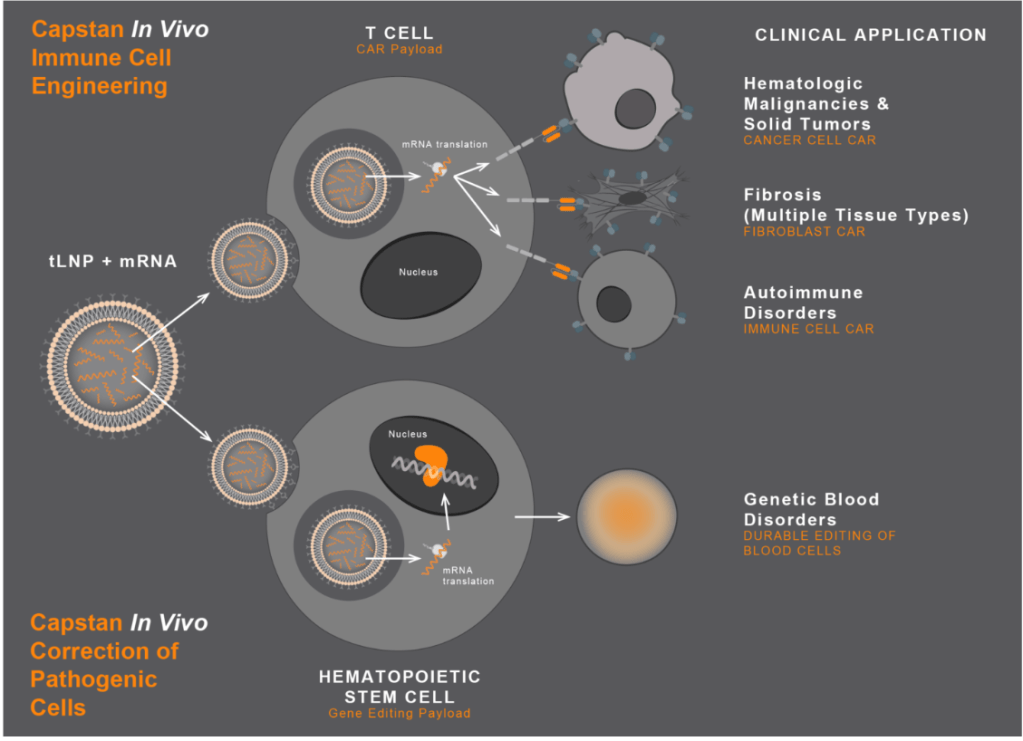
Capstan’s core technology is in vivo cell engineering. By injecting lipid nanoparticles targeted to immune cells, the biotech is looking to deliver a piece of mRNA that can induce the transformation of T lymphocytes into transient therapeutic CAR T cells inside the body. This approach can be applied to many therapeutic areas, such as cancer, blood disorders and autoimmune diseases.
The scientific basis for Capstan’s platform was first characterized in a study published in Science in January. The study tested the technology in mice with cardiac fibrosis–the scarring of heart tissue.
The research team, which included several Capstan founders, encased engineered mRNA in lipid nanoparticles designed to seek out the CD5 surface protein of T cells.
When injected in mice models, they found that these complexes could reprogram T lymphocytes into CAR T cells targeting the FAP protein, a fibrosis-related target. Cardiac function was eventually restored in the treated mice.
Capstan plans to use the proceeds from Wednesday’s launch to further develop this platform and its three modules: the targeted lipid nanoparticles, the targeting molecules to ensure specificity and the disease-related mRNA payload.
The company’s goal is to maximize the clinical promise of cell therapies by accomplishing the precise and in vivo engineering of cells.
Capstan is prioritizing diseases ripe for transforming the standard of care in terms of therapeutic targets. Initially, the company will leverage its already-demonstrated approach of producing therapeutic CAR T cells in vivo. Its goal is to make such treatments administrable in the outpatient setting.
Monogenic blood disorders are also in the company’s sights.
“We are conducting research across oncology, autoimmune disorders, fibrosis, as well as monogenic blood disorders and optimizing the components of our platform with the goal of nominating lead candidates and progressing towards IND-enabling activities,” Laura Shawver, president and CEO of Capstan, told BioSpace.
Backed by Industry and Scientific Heavy-Hitters
The promise of Capstan’s platform has earned it the support of several industry giants. The young company’s initial funding includes $102 million from a recently closed Series A financing round led by Pfizer Ventures. Leaps by Bayer, Eli Lilly and Company and Bristol Myers Squibb, among other investors, also participated.
The remaining $63 million came from Capstan’s seed funding, led by Novartis Venture Fund and Orbi Med.
Aside from industry backers, Capstan is also built on a solid scientific foundation. Among the company’s founders are Jonathan Epstein, M.D. and Haig Aghajanian, Ph.D., both experts in preclinical translation, as well as Carl June M.D. and Bruce Levine, Ph.D., leading figures in cell engineering.
Lending Capstan with their mRNA and lipid nanoparticle expertise are Drew Weissman, M.D., Ph.D. and Hamideh Parhiz, Pharm.D., Ph.D., while Ellen Puré, Ph.D. and Steven Albelda, M.D. provided insight on immunology and fibrosis. Helming the company is Laura Shawver, Ph.D., who will serve as its president and chief executive officer. Shawver has more than 20 years of executive leadership experience.
시리즈 A를 한지 채 2년이 되지 않아 $175 Million Series B를 했습니다. 이번 증자에는 Johnson & Johnson이 참여를 했습니다. CPTX2309라는 CD19-CAR-T를 Autoimmune Disease 치료제로 임상에 적용하려는 것이 이번 펀딩의 목적입니다.
Capstan heats up ‘in vivo’ cell therapy chase with $175M fundraise – Biopharmadive 3/20/2024
Capstan Therapeutics, a biotechnology startup developing medicines that reprogram cells inside the body, has raised another $175 million to bring its first prospect into clinical testing.
The high-profile startup, formed by a group of pioneering cell therapy and messenger RNA researchers, secured the financing from a wide range of investors led by RA Capital and including five pharmaceutical companies, it said Wednesday. Johnson & Johnson is one of Capstan’s new backers, joining existing investors Pfizer, Bristol Myers Squibb, Eli Lilly and Bayer, among others. The startup has now raised $340 million since 2021.
Capstan will use the funds to advance its work developing cell therapies designed to be administered through a single infusion, rather than via a laborious process that involves genetically manipulating cells in a lab. If successful, these “in vivo” cell therapies could help broaden the reach of so-called CAR-T therapy, and be more convenient and accessible to patients.
The startup is one of a handful of young drugmakers to emerge in the last three years to pursue in vivo cell therapy research and attract funding. Multiple pharmaceutical companies have shown interest, investing in Capstan as well as others like Asgard Therapeutics and Ensoma. Another well-funded in vivo cell therapy startup, Umoja Biopharma, signed a collaboration deal with AbbVie in January.
Capstan’s goal is to use messenger RNA technology to coax the body into making its own CAR-T cells. Early research published in Science and Nature showed the feasibility of the approach in animals, but it’s nonetheless a daunting task that’s never been attempted in humans.
“Our immune system is primed to attack anything that’s delivering RNA. So the main challenge is, how do you make it stealth and get it into cells without causing a lot of immune activation?” said CAR-T innovator and University of Pennsylvania scientist Carl June, one of Capstan’s co-founders, in an interview with BioPharma Dive in 2022.
Since then, the company has progressed to the point that it now has a lead program. Called CPTX2309, it is being developed for autoimmune diseases and delivers an mRNA payload that redirects T cells to cells with the protein CD19.
That particular protein is found on the antibody-making B cells that malfunction in a variety of autoimmune diseases. It’s also the target of a number of cell therapies in clinical testing for lupus and other inflammatory conditions, all of which aim to induce a “reset” of a patient’s disease. Many of those programs involve “ex vivo” approaches, however.
Capstan said the funds will get its lead program to early proof-of-concept studies and help advance the rest of its pipeline.
“We are grateful for the support of both new and existing investors as we enter a critical phase of execution, with the ultimate goal of bringing new therapeutic modalities to patients,” said CEO Laura Shawver, in a statement.
2023년 SITC와 2024년 PNAS 논문에서는 CD5-targeted LNP-mRNA를 이용한 In Vivo CAR-T로 IL7이 T Cell에서 선택적으로 증가함을 보고했습니다. CD5-targeted LNP가 Spleen과 Lymph Node로 잘 전달되어서 T 세포에서 잘 발현된다는 결과입니다. 아직 초기단계이기는 하지만 빅파마들의 관심이 뜨겁군요. 펀딩이 벌써 $340 Million이나 되었습니다. 요즘 바이오텍 펀딩시장은 상당히 살아나는 것으로 보입니다. 임상에 진입해서 Human PoC Data가 동물실험의 결과와 유사하게 나올지 궁금합니다.
 BOSTON DR LIM