

(Picture: John “Jack” C. Bogle, Sr – Founder of Vanguard Group)
안녕하세요 보스턴 임박사입니다.
저와 같은 주알못도 주식투자로 돈을 벌 수 있도록 길을 열어준 故John Cliffton Bogle, Sr를 부러우면 지는거다에 초대합니다. 인덱스펀드는 주식시장 전체의 인덱스에 연동하도록 만든 뮤추얼펀드로서 거의 비용이 들지 않는 0.03%의 Management Fee 만을 붙이는 펀드입니다. 이것이 얼마나 적은 돈이냐 하면 소위 CFA/CFP라고 하는 사람들은 0.5 ~ 2%의 Management Fee를 붙이기 때문입니다.
그가 한 유명한 말이 있습니다.
“When a door closes, if you look long enough and hard enough, if you’re strong enough, you’ll find a window that opens.- John Cliffton Bogle, Sr” (기회의 문이 닫혔을 때 그 문을 오랜동안 아주 열심히 보다보면 새로운 창문이 열리고 있다는 사실을 볼 수 있을 것이다)
그는 그런 사람이었습니다. 미국 프린스턴 대학교를 졸업하고 1965년Wellington Fund에 입사한 Jack Bogle은 자신이 맡긴 펀드매니저들의 터무니없는 펀드 관리로 인해 1974년 해고를 통보받습니다. 그러나 그는 굴하지 않고 끝까지 남겠다는 주장을 관철시켜서 당시 맡고 있던 뮤추얼펀드의 대표직을 계속할 수 있다는 결정을 끌어냅니다. 그는 자신이 프린스턴 대학교에서 연구했던 논문과 노벨경제학상 수상자인 Paul Samuelson의 글을 읽고 인덱스 펀드를 만들기로 결정합니다. 처음에는 반대가 많았지만 관리비가 들지 않는다는 말에 결국 결정은 받아들여지게 됩니다. 그리고 이 펀드의 커미션을 모두 없애 버립니다.
제가 2000년대 중반부터 401(k)에 투자를 시작했는데 처음에는 뮤추얼펀드를 어떻게 고를지 몰라서 그냥 수익률이 좋은 펀드에 투자를 하는 식으로 했지만 수익률이 좋지 않았습니다. 그러다가 인덱스펀드가 가장 수수료가 싸고 좋은 투자라는 것을 알게 되어 2010년대부터 인덱스펀드에 100%로 투자하고 있는데 그 이후에 이 펀드가 가장 수익률이 좋았습니다. 지금도 저의 최애 펀드는 VOO 라는 Vanguard Group이 운영하는 Standard & Poors 500 Index Fund입니다.
직장에 다니면서 주식투자를 전문가처럼 하기는 불가능합니다. 이기는 것도 불가능하지만 그렇다고 투자를 하지 않을 수도 없습니다. 그래도 다행히 저에게 뱅가드의 인덱스 펀드가 있으니 얼마나 다행인지 모릅니다. 요즘은 피델리티도 뱅가드와 같이 최저가 관리비 (expense ratio)로 운영하는 인덱스펀드가 많이 생겨서 얼마나 즐거운 고민을 하고 있는지 모릅니다.
2019년에 89세의 일기로 작고하셨지만 Jack Bogle의 Legacy는 지금도 Bogleheads.org 라는 잭 보글을 따르는 커뮤니티에 영원히 살아계십니다.
The Worth Of A Man: A Tribute To John C. Bogle – Forbes 1/16/2019
You cannot measure the quality of a man by the size of his bank account, but in John Bogle’s case, you can measure it by the size of your bank account. No one on this planet has done more to increase the lot of individual investors in the last 50 years than John C. Bogle, founder and former chairman of the Vanguard Group and creator of the world’s first index mutual fund.
Throughout his legendary career, Jack Bogle, as he is fondly known to everyone who has had the pleasure to meet his confident smile and piercing blue eyes, has helped millions of investors build wealth the right way. His repetitive lessons of low fees, broad diversification, and Stay the Course! are engrained in the minds of “Bogleheads” near and far and have made their way into every personal finance book published in the past two decades.
I was fortunate to get an hour of John Bogle’s time last September to record an interview for “The Bogleheads on Investing” podcast. If you haven’t heard of the Bogleheads, they’re a group of like-minded individual investors who meet on Boglehead.org to discuss the general investment and business beliefs of Jack Bogle. It is a conflict-free community where individual investors reach out and provide education, assistance and relevant information to other investors of all experience levels at no cost.
Sensible investing isn’t all that Jack was about. Until his last day, he led a tireless campaign to restore common sense to the investment industry and instill words like honor and duty. Bogle championed restoring integrity in industry practices and believed that a trustworthy business and financial complex is essential to America’s continuing leadership in the world and to social and economic progress at home.
It is an uphill battle to bring integrity to the financial system. In my last conversation with Jack, he expressed frustration with our leaders in Washington who struggle with the concept of imposing a fiduciary duty on all financial advisers who guide individual investors. The so-called fiduciary rule is something he truly believed in and championed for. In Jack’s honor, I propose we rename this effort “The Bogle Rule“.
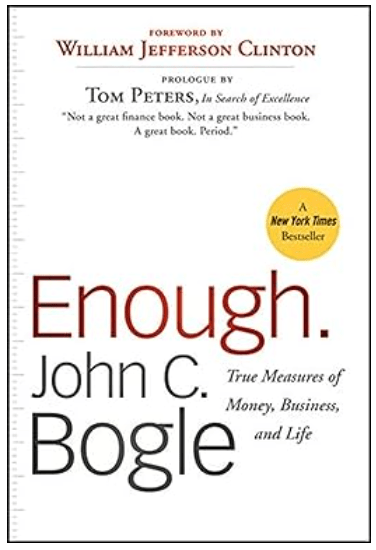
One of my favorite books Jack Bogle wrote was titled “Enough, True Measures of Money, Business, and Life”. It reveals Jack’s unparalleled insights on money and what we should consider as the true treasures in our lives. He details the values we should emulate in our business and professional callings and provides thought-provoking life lessons regarding our individual roles in society. Jack examined what it truly means to have “enough” in a world increasingly focused on status and score-keeping.
Most people choose a career in the investment business to make money; Jack Bogle chose to use that career to make a difference. Rest in peace, Jack. You’ve done enough.
Jack Bogle died peacefully at his home on Wednesday afternoon, January 16, 2019. He was 89 years old.
Bogle was never shy about expressing his views or talking about his life. He did so again in an essay for Forbes‘ 2017 centennial issue, which is republished here.
Jack Bogle Dies At 89—Here Is His Timeless Advice – Forbes 1/16/2019 by Abram Brown
Jack Bogle, the founder of the Vanguard Group who pioneered the idea of low-cost investing and index funds, has died. He was 89. His ideas have grown into the cornerstone of investing advice for average Americans, and Bogle was never shy about expressing his views or talking about his life. He did so again in an essay for Forbes‘ 2017 centennial issue, which is republished below.
“Reinvention”
By Jack Bogle
In 1965, my mentor, Walter L. Morgan, the founder of Wellington Management Co., called me into his office. It was the go-go era, and we only had a conventional, balanced mutual fund. “I want you to do whatever it takes to fix the company. You’re in charge now.” I was 35. So I merged with a very aggressive equity fund out of Boston with managers younger than I was. It seemed like an act of genius, until it wasn’t. The go-go era fell apart, and they turned out to be terrible money managers. In January 1974, the board of Wellington Management, controlled by that Boston group, fired me.
Except that the mutual funds themselves had a separate board controlled by independent directors, and I persuaded that board not to fire me. So there was a big fight, and it was resolved with a terrible deal: I would continue as chairman and CEO of the funds, which would be responsible for their own legal, compliance, administration and record keeping. (And I had to come up with a new name —that was the start of Vanguard Group.) My rivals, the people who fired me, would continue to oversee distribution, marketing and investment management. The scheme was totally irrational.
I had to find a way for Vanguard to take on the investment management and distribution of our funds. I had done some work on index funds in my senior thesis at Princeton in 1951. I had experienced the failure of active management firsthand. And I had just read an article by Nobel Laureate Paul Samuelson, saying, in essence, “Somebody, somewhere, please start an index fund.” I took the idea to the board and they said “You can’t get into investment management,” and I said, “This fund has no investment management.” They bought it, and there’s where the index revolution began. Then I decided we couldn’t allow Wellington and its sales force to continue to distribute the funds so we eliminated all sales commissions and went no-load overnight. The directors said “You’re not allowed to take over distribution,” and I said “We’re not taking it over; we’re eliminating it.” They bought it, again.
When a door closes, if you look long enough and hard enough, if you’re strong enough, you’ll find a window that opens.
 BOSTON DR LIM