

(Picture from left to right: Alberto Gimona, Guy Braunstein (CMO), André C. Muller (CFO), Martin Clozel (CSO) and Jean-Paul Clozerl (CEO))
Idorsia has spun out of Actelion after Johnson & Johnson wrapped up its $30 billion takeover of the Swiss biotech. The new company starts life with $1 billion in cash, multiple clinical-phase drugs and a deal with J&J, strengths that prompted traders to drive up its share price by 30% in its first hours on the Swiss stock exchange.
Shares in Idorsia began trading at CHF 10 ($10) a piece but quickly soared higher. The stock settled around the CHF 13 mark a few hours after the market opened. That jump was foreseeable. Talking to Reuters, an anonymous trader said the initial CHF 10 “reflects the company’s cash and actually is rather cheap.”
Allschwil, Switzerland-based Idorsia’s $1 billion starting cash position is one of several eye-catching characteristics of the biotech. Unlike almost all newly minted biotechs, Idorsia also has multiple drugs in the clinic, one of which could net it a $230 million fee if J&J opts in.
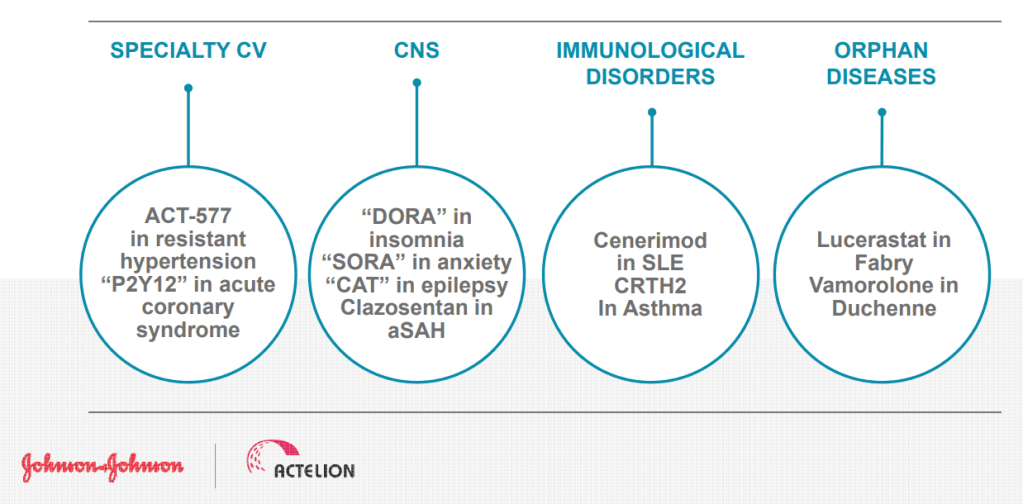
The J&J agreement covers dual endothelin receptor antagonist ACT-132577, one of four phase 2 assets in Idorsia’s pipeline. Actelion posted data from a phase 2 trial of ACT-132577 last month. The readout linked the experimental therapy to statistically significant reductions in mean diastolic and systolic blood pressure.
J&J can pay $230 million and commit to royalties that range from 20% to 35% to opt-in. The 30-day opt-in countdown will start once Idorsia has shared the data with J&J and held an end-of-phase 2 meeting with the FDA. Idorisa plans to run a phase 3 trial in patients with resistant hypertension.
ACT-132577 is one of a clutch of Idorsia assets edging toward phase 3. Idorsia is a phase 2 dose-finding study away from having the data it needs to move cenerimod into a pivotal trial. Insomnia asset ACT-541468 is set to deliver the phase 2 data Idorsia needs to move it into phase 3 later this year. And regulatory talks in preparation for a phase 3 trial of Fabry disease hopeful lucerastat are taking place. Idorsia plans to start a phase 3 trial of lucerastat next year.
Investigators are also testing cerebral vasospasm treatment clazosentan in a phase 2 trial.
Further back in the pipeline, Idorsia is set on four phase 1 assets, although the long-term status of these programs is unclear
“We will be taking decisions on our phase 1 pipeline assets before the end of the year,” Idorsia CEO Jean-Paul Clozel said in a statement.
Clozel is one of several key executives who have moved from Actelion to Idorsia. The CEO is joined at the biotech by Guy Braunstein, who has taken the role of head of global clinical development.
The FDA blessed Idorsia’s Quviviq (daridorexant), a sleeping pill for those with insomnia. Because the FDA has recommended Idorsia to register Quviviq as a controlled substance, the treatment will not reach the market until May, the company said.
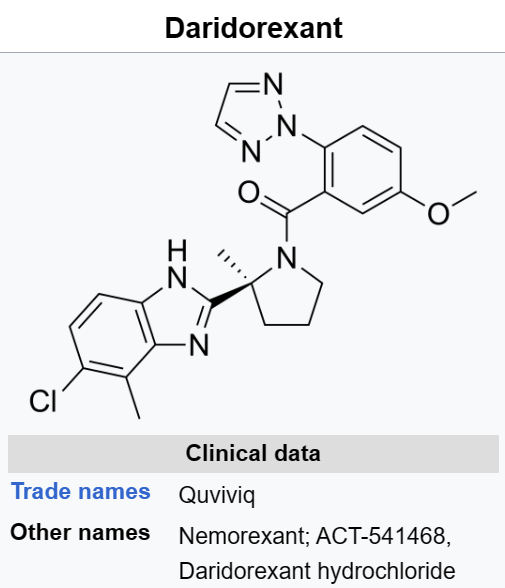
After more than two decades of trial and error and experiments with—by their estimate—25,000 compounds, the husband and wife team of executives at Idorsia, Jean-Paul and Martine Clozel, said they have finally reached the finish line with a drug they believe can be a game-changer.
With 25 million Americans affected by insomnia and only about 30% of them diagnosed, a huge untapped market awaits. But Idorsia has a big task ahead to distinguish Quviviq from Merck’s Belsomra, which has been on the market for seven years, uses the same mechanism and has not had the most successful market.
Quviviq is the first approval for Switzerland-based Idorsia, a company the Clozels established in 2017 after they sold Actelion to Johnson & Johnson for $30 billion.
In two phase 3 studies, Quviviq showed significant improvement over placebo in sleep onset, sleep maintenance and total sleep time, while also reducing daytime sleepiness.
Both Quviviq and Merck’s Belsomra are from the dual orexin receptor antagonist (DORA) class. Belsomra has had difficulty catching on, generating sales of $327 million in 2020. Another DORA, Eisai’s Dayvigo, was launched in 2020.
The difference between Quviviq and the other DORAs, according to Idorsia, is that it keeps people energetic and awake throughout the day. Belsomra’s development was hindered by warnings about next-day somnolence and depression, forcing Merck to cut its dosage to suboptimal levels to gain approval.
Finding a treatment that strikes the delicate balance between providing nighttime restfulness and daytime functioning is why it took so long to develop Quviviq, Martine Clozel, executive vice president and chief scientific officer, said in an interview.
“It really took us many years to arrive [at] a compound with the right duration of action,” Clozel explained.
For decades, insomnia has been treated with sedatives, such as Ambien. The generic versions of these treatments still dominate the market, though they can cause memory problems and morning sedation.
Roughly 20 years ago, scientists found it was the orexin system that keeps the brain awake. This discovery kicked off a new way of targeting insomnia. Quviviq and other DORAs block the binding of the wake-promoting neuropeptides orexins, tuning down overactive wakefulness, as opposed to sedating the brain.
At Actelion, the Clozels developed an insomnia treatment, almorexant, but had to bail on it in 2011 because of safety concerns. After licensing the drug to Midnight Pharma, Actelion got to work on another insomnia treatment.
Ten years later, the Clozels believe they’ve finally got it right. “We believe we’ve hit the jackpot with regard to the dose response” Patty Torr, president and GM of Idorsia U.S., said in an interview, also pointing to the fact that Quviviq is not a brain-sedating-type medicine. The drug will be available in 50 mg and 25 mg doses.
Getting patients to believe in this DORA will require a major marketing effort, which the company has already begun with an awareness program, Alliance for Sleep. Another effort underway is the Seize the Night campaign which will specifically touts combination of daytime and nighttime benefits provided by Quviviq.
The unmet need in insomnia is undeniable. Many are diagnosed but do not seek treatment. Additionally, of those who are prescribed medicine, 25% drop out of the market annually, Torr said.
“There’s this churn going on in the marketplace,” she said. And that spells opportunity for Idorsia.
Up to 500 roles at Idorsia are at risk as the Swiss biotech tries to halve its cash burn while it waits for its approved insomnia treatment Quviviq to pay off.
Facing a “challenging financial situation” due to “lower than anticipated product sales and a difficult global financial environment,” the company has decided to sacrifice its R&D work in order to “maximize the time the company has to deliver commercial success.”
Exactly what will happen is still to be decided. Idorsia will now review its development pipeline and jettison all candidates that can’t be “advanced rapidly and with reasonable financial investment.” Work on those unwanted programs will be either paused or prepared for partnership or out-licensing, the biotech explained in an early morning release Friday.
The ultimate goal is to reduce cash burn at the company’s Allschwil, Switzerland, headquarters by 50% by early 2024.
It means a worrying period of limbo for many employees. Up to 500 positions could be set to go as part of the “cost reduction initiative,” mostly located in the R&D team and related roles. The affected employees will be decided as part of a consultation process due to wrap up by the end of the year.
“I continue to believe that Quviviq can be the success we hope for, but unfortunately it will take longer than originally planned,” the biotech’s CEO Jean-Paul Clozel, M.D., said in the release. “Idorsia’s immediate objective is therefore to maximize the time the company has to deliver commercial success with its products. This means making any funds that are raised last as long as possible by significantly reducing our global cash-burn.”
“The cost reduction initiative together with potential collaborations will give the company the time it needs to realize the value we have created,” Clozel added. “I deeply regret having to launch such an initiative, but we simply cannot sustain current investment levels.”
While Idorsia has previously claimed that Quviviq has become the No. 1 branded insomnia treatment since Idorisa launched it onto the U.S. market in May 2022, delays in securing reimbursement meant it only brought in total net sales of 4.3 million Swiss francs ($4.9 million) in the first quarter of the 2023.
In an earnings report in April, Clozel insisted that when it came to the reimbursement delays, “progress has been made and the situation is steadily improving.”
The company ended March with 212 million Swiss francs ($245 million) in cash and equivalents. Since then, Idorsia has secured bridge financing of 75 million Swiss francs ($86 million) as well as sold its Asia-Pacific rights outside of China to Sosei Heptares.
If its commercial rollout has been slow, Idorsia hasn’t had much luck in the clinic in recent years, either. In 2021, its Fabry disease medicine lucerastat flamed out in a phase 3 trial, while cenerimod missed the primary goal in a phase 2b systemic lupus erythematosus study. The following year saw its selective orexin-1 antagonist ACT-539313 fail to hit its goal in a binge eating disorder study, prompting the company to give up on the indication.
It’s made for a tough period for a company that arrived on the biotech scene with a splash in 2017 by way of a spinout from Actelion, which was bought by Johnson & Johnson. Idorsia launched with $1 billion in cash and a handful of clinical-stage drug candidates—plus a potentially lucrative development deal with J&J for the blood pressure medication aprocitentan, which has continued to show potential in a phase 3 trial.
Shares in the company have been on a steady decline in 2023, hovering around the 6.30 Swiss franc mark this morning from a January opening price 15.33 Swiss francs.
올해 3월에 마침내 Aprocitentan (Tryvio, ACT-132577)가 FDA 승인을 받았습니다.
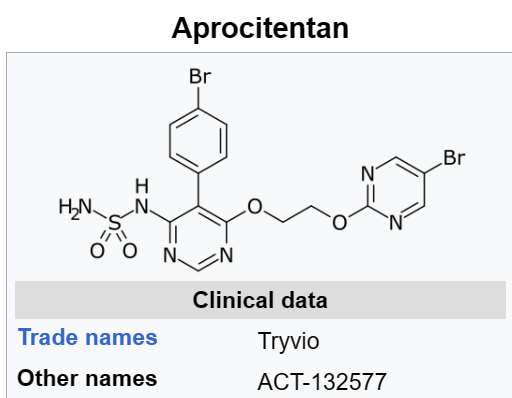
Idorsia Pharmaceuticals on Wednesday announced that the FDA approved its endothelin receptor antagonist aprocitentan for the treatment of hypertension to reduce blood pressure in adults who had not reached adequate control on other drugs.
Aprocitentan, which will now be sold under the brand name Tryvio, is an oral drug taken once-daily alongside other antihypertensive drugs.
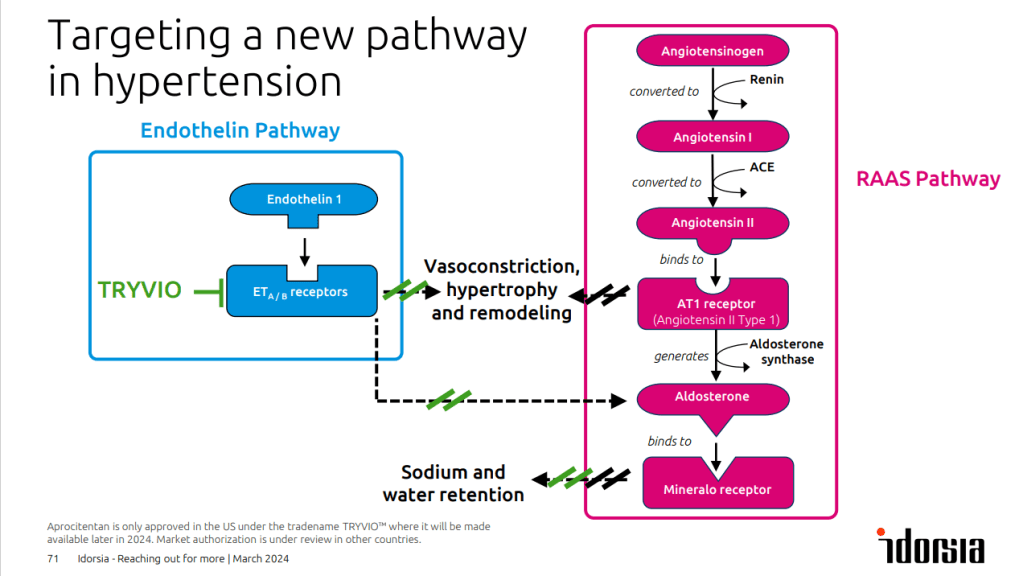
Tryvio is the first FDA-approved medication that targets the endothelin pathway for hypertension. Existing treatments act via different mechanisms, including the regulation of salt and water, the reduction of extracellular calcium influx into cells and the inhibition of the renin-angiotensin-aldosterone axis.
Tosh Butt, president and general manager of Idorsia U.S., in a statement said that Tryvio’s approval will “provide physicians and patients with a novel medicine working in a new pathway” to treat uncontrolled hypertension and provide additional blood pressure control. Idorsia is currently preparing its launch strategy for Tryvio and expects to make the drug available to prescribers during the second half of 2024.
Designed to be orally available, Tryvio is a small molecule drug that works by preventing the binding of the endothelin-1 ligand to its corresponding receptors. This mechanism of action dampens signaling cascades that bear many similarities with pathophysiology of hypertension, according to Idorsia’s announcement.
Tryvio comes with a black box warning for embryo-fetal toxicity, flagging the risk of major birth defects when used during pregnancy. Tryvio should not be taken by patients who are pregnant or currently trying to become pregnant.
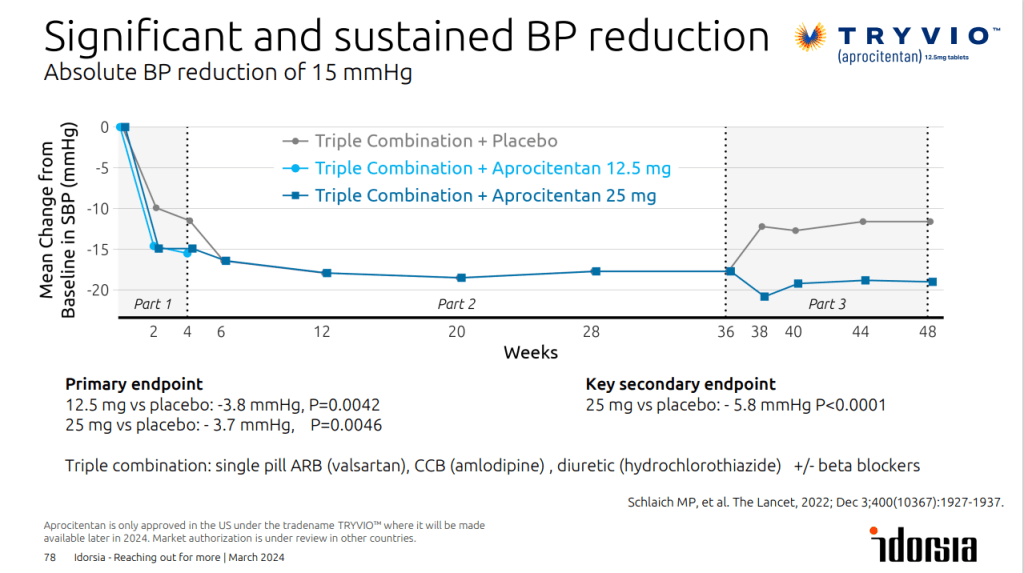
Idorsia backed Tryvio’s regulatory bid with data from the Phase III PRECISION trial, which enrolled 730 patients who had systolic blood pressure (SBP) of at least 140 mmHg and who were taking at least three antihypertensive drugs. Before treatment, all patients were switched to a standard background regimen consisting of a calcium channel blocker, a diuretic and an angiotensin receptor blocker.
Results showed that both the 12.5-mg and 25-mg dose levels of Tryvio could significantly reduce sitting SBP compared with placebo after four weeks of treatment. Treatment benefits were consistent across several patient subgroups, including according to age, sex, race, diabetes history and body mass index. Tryvio is only approved at its 12.5-mg dose.
Tryvio’s approval comes months after Johnson & Johnson turned its back on the endothelin receptor blocker, electing in September 2023 to return Tryvio’s worldwide rights to Idorsia. The Indianapolis-based pharma bought into the promise of aprocitentan in 2017, paying $230 million for joint development and sole worldwide commercialization rights.
Under the terms of the 2023 handoff, J&J will still be entitled to 30% of any out-licensing proceeds associated with Tryvio, as well as 10% of earnings from any product deal that Idorsia enters following approval.
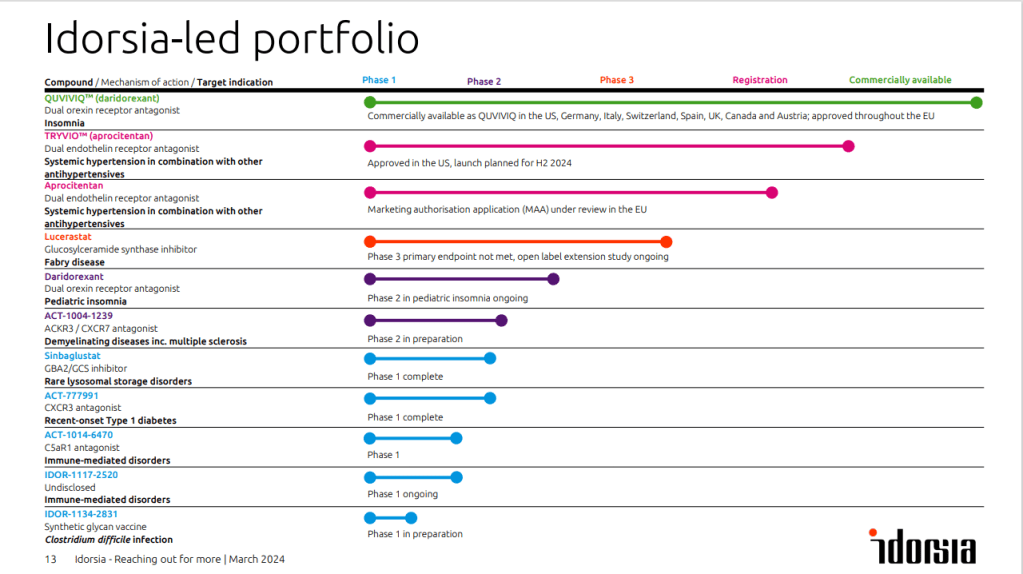
현재 파이프라인은 아래와 같습니다.
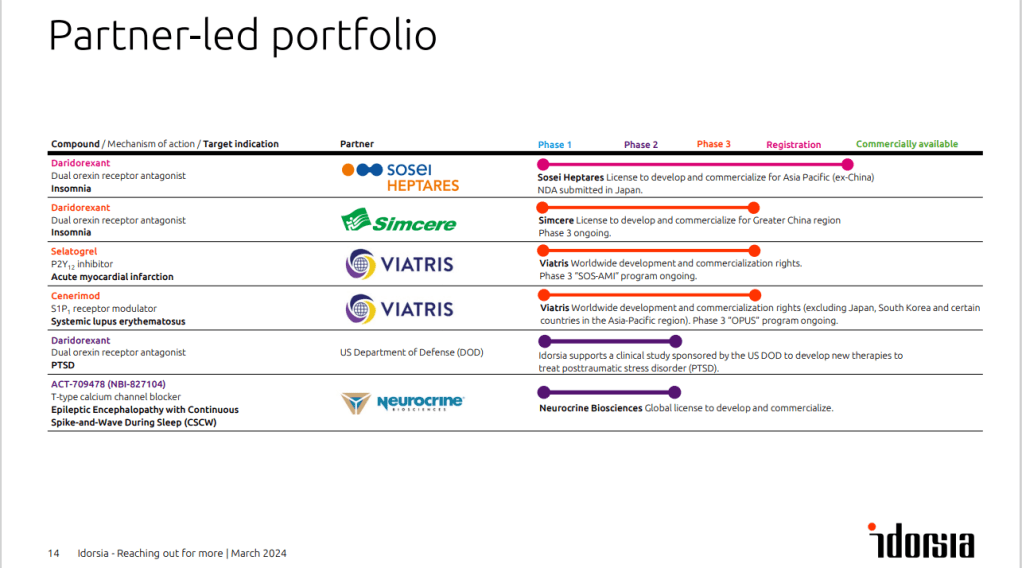
 BOSTON DR LIM