BIOTECH (158) Praxis Precision Medicines: CNS Small Molecules & Antisense Oligonucleotides Platform

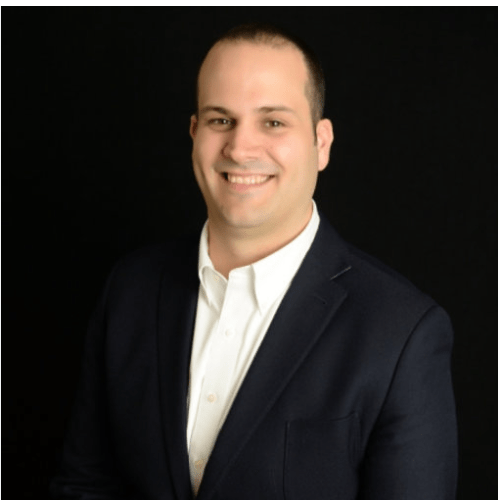
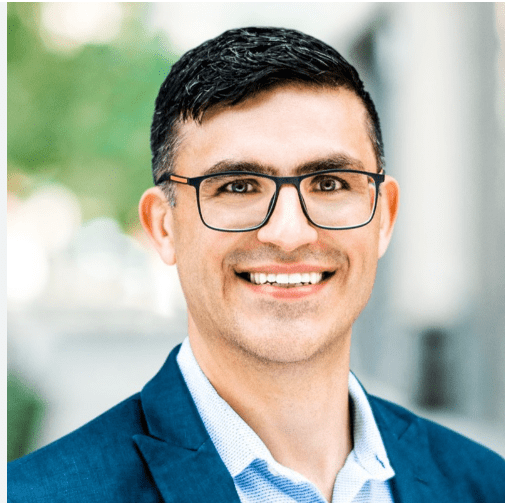
(Picture: Marcis Souza, CEO of Praxis Precision Medicines)
안녕하세요 보스턴 임박사입니다.

미국 바이오텍 기업들이 나스닥 상장 이전에는 펀딩 이력을 꼭 정확히 공표하지 않는 경우도 있습니다. 회사의 경쟁력을 확보하기 위해서 Stealth Mode로 오랜기간 있는 경우가 있죠.

Praxis Precision Medicines는 Private Equity Firm인 Blackston Life Sciences의 펀딩으로 오랜기간 파이프라인 준비를 하고 2020년이 되어서야 $100 Million 펀딩 소식을 발표했습니다. 이 펀딩은 시리즈 B인 것으로 보입니다. 파이프라인 중 가장 앞선 것은 allosteric GABAA modulator인 PRAX-114였고 Calcium channel blocker인 Ulixacaltamide (PRAX-944)가 뒤를 따르고 있다고 발표했습니다.

Praxis uncloaks with $100M to push precision medicines for brain disorders – Fierce Biotech 5/4/2020

Praxis Precision Medicines is coming out of the shadows with $100 million from the likes of Blackstone Life Sciences and a pipeline of central nervous system (CNS) programs. The cash will bankroll a pivotal study for a depression drug as well as push earlier stage programs into the clinic.

As suggested by its name, Praxis aims to do for brain disorders what precision medicine has done for cancer treatment. Its pipeline targets genes that control the imbalance in neuronal signaling that underlies CNS disorders, both prevalent and rare. Since its inception, the Cambridge, Massachusetts-based biotech has banked $100 million from the likes of Novo Holdings, Vida Ventures and Eventide.

Praxis has two candidates in phase 2: PRAX-114, a positive allosteric modulator of GABAA receptors in development for major depressive disorder and perimenopausal depression, and PRAX-944, which blocks a type of calcium channel to treat essential tremor.

“As was achieved in oncology decades ago, recent genetic insights have presented meaningful opportunities to treat brain disorders in entirely different and targeted ways based on the specific genetically validated pathways driving a patient’s disease,” said Kiran Reddy, M.D., a venture partner at Blackstone Life Sciences, Praxis’ founding investor. “We are reducing these insights to practice, to create novel medicines that could fundamentally alter the treatment path and outcomes for patients with brain disorders.”

Reddy’s fellow founders include Chief Scientific Officer Steven Petrou, Ph.D., director of the Florey Institute of Neuroscience and Mental Health at the University of Melbourne in Australia, and David Goldstein, Ph.D., who leads the Institute for Genomic Medicine at Columbia University.

At the helm is Marcio Souza, who joined from PTC Therapeutics, where he has worn several hats since 2014, most recently serving as its chief operating officer.

Over the next year, Praxis plans to start a pivotal study of PRAX-114 in major depressive disorder and release proof-of-concept data for PRAX-944 in essential tremor. It also aims to push its earlier-stage programs into the clinic, including treatments for rare epilepsies.

Praxis Precision Medicines Launches with over $100 Million to Advance Pipeline of High Impact Therapies for Brain Disorders – Business Wire 5/4/2020

Praxis Precision Medicines, a clinical-stage, genetic neuroscience company, launched today with more than $100 million in financing since its inception from premier life science investors led by founding investor Blackstone Life Sciences (via prior Clarus funds in 2016) as well as Novo HoldingsVida VenturesEventide and other prominent funds. Praxis is deploying a precision medicine approach to develop high-impact therapies that target the underlying causal mechanisms of both prevalent and rare brain disorders with overlapping disease biology.

“Neurology and psychiatry are finally primed for a revolution in how new therapies are discovered and developed, and Praxis’ approach has the potential to change the treatment landscape,” said Marcio Souza, president and chief executive officer of Praxis. “The combination of the expertise of our team in CNS drug development, insights into CNS biology, and our approach to drug discovery, positions us as at the forefront of the development of novel CNS therapies.”

“Depression, and more broadly, psychiatric and neurological disorders are a large and increasing unmet medical need with profound implications on the economy. Praxis aims to leverage the recent breakthroughs in genetics to develop innovative medicines that can improve the lives of the many patients who need them,” said Nicholas Galakatos, Ph.D., chairman of the Praxis board of directors and global head of Blackstone Life Sciences.

Praxis Approach and Pipeline

Praxis is leveraging recent discoveries in the genetics of epilepsy, which have elucidated genes, that when dysregulated, drive a range of neuropsychiatric and movement disorders. Using these insights, Praxis is rapidly advancing a pipeline of treatments that specifically address genes controlling the imbalance of excitation and inhibition of neuronal circuitry at the core of multiple CNS disorders. The company’s portfolio is led by PRAX-114, a GABAA positive allosteric modulator (PAM) in Phase 2 development for the treatment of major depressive disorder (MDD) and perimenopausal depression, and PRAX-944, a T-type calcium channel blocker, in Phase 2 development for the treatment of essential tremor. Within the next year, Praxis plans to initiate its first pivotal trial for PRAX-114 in MDD, report proof-of-concept data for PRAX-944 in essential tremor and advance its earlier stage programs into clinical development for rare epilepsies and other neurological disorders with genetically validated mechanisms.

“As was achieved in oncology decades ago, recent genetic insights have presented meaningful opportunities to treat brain disorders in entirely different and targeted ways based on the specific genetically validated pathways driving a patient’s disease,” said Kiran Reddy, M.D., co-founder and member of Praxis’ board of directors. “We are reducing these insights to practice, to create novel medicines that could fundamentally alter the treatment path and outcomes for patients with brain disorders.”

Internationally Recognized Founding Team

Praxis’ founders are renowned scientists and clinicians leading the industry’s growing understanding of the genetics and biology of disease-causing targets in psychiatric and neurologic disorders.

Dr. Reddy is a venture partner and senior advisor at Blackstone Life Sciences. He was previously on the corporate strategy leadership team at Biogen and was an associate partner at Third Rock Ventures, where he co-founded multiple biotech companies. Dr. Reddy is a neurologist and started his career in academic medicine at Harvard/Massachusetts General Hospital.

Co-founder David Goldstein, Ph.D. is the Director of The Institute for Genomic Medicine, and Professor in the Department of Genetics and Development, at Columbia University. Dr. Goldstein’s work focuses on broad aspects of precision medicine and is widely recognized for multiple influential studies in population and human genetics, including those of the Epi4K consortium that discovered and characterized novel epilepsy genes.

Co-founder and chief scientific officer, Steven Petrou, Ph.D. is the Director of the Florey Institute of Neuroscience and Mental Health, Head of the Department of the Florey Institute at the University of Melbourne in Australia, heads the Ion Channels and Human Disease Laboratory. Prof. Petrou is a recognized leader in the field of ion channel neuropathies in rare pediatric epilepsies and other neurodevelopmental disorders. His published interdisciplinary research has focused on functional genetics and genomics of epilepsy, elucidation of mechanisms of disease, development of several of the first animal models of genetic epilepsy and discovery and evaluation of consequent precision medicine approaches.

Successful Biotech CEO and Leadership Team

Prior to joining Praxis as president and chief executive officer, Mr. Souza was at PTC Therapeutics, where he served in leadership roles since 2014, most recently serving as chief operating officer. He also served in leadership roles in the U.S. and globally at NPS Pharmaceuticals, Shire and Genzyme. Mr. Souza holds a degree in pharmacy and biochemistry from University of São Paulo and an MBA from Fundação Dom Cabral in Brazil.

The Praxis leadership team is comprised of recognized leaders in neuroscience drug discovery, development, and commercialization, including Bernard Ravina, M.D., M.S., chief medical officer; Stuart Chaffee, Ph.D., MBA, chief business officer; Dr. Petrou., co-founder and chief scientific officer; Marion Wittmann, Ph.D., vice president of biology; Gabriel Martinez, Ph.D., vice president of chemistry; Rosa Tarng, vice president, portfolio management; and Karl Hansen, Ph.D., senior vice president, CMC.

About Praxis Precision Medicines

Praxis Precision Medicines is a clinical-stage genetic neuroscience company developing breakthrough therapies for patients and families affected by complex and debilitating brain disorders, including psychiatric disorders, movement disorders and rare pediatric epilepsies. These disease areas share overlapping genetics and neurocircuit biology, as well as a profound need for new therapeutic options that target the underlying cause of the disease. Praxis is advancing a pipeline of breakthrough medicines with the potential to more precisely treat brain disorders. For more information, please visit www.praxismedicines.com.

시리즈 B를 발표한지 2달만에 시리즈 C-1 $110 Million을 발표했습니다. 앞의 두개 파이프라인에 간질 및 통증 치료제인 PRAX-562가 추가된 것으로 공개했습니다.

Praxis raises $110M to advance 3 clinical-phase CNS drugs – Fierce Biotech 7/28/2020

Praxis Precision Medicines has raised $110 million to take its three clinical-phase central nervous system treatments forward. The pipeline is led by a GABAA positive allosteric modulator that is closing in on the start of a pivotal trial in depression.

Praxis kept a low profile in its early years, only breaking cover to disclose financings in Securities and Exchange Commission filings and publish the starts of clinical trials on registry platforms. The secretive approach was made possible by the support of deep-pocketed founding backer Blackstone Life Sciences, nee Clarus.

By the time Praxis uncloaked in May, the biotech had raised more than $100 million and moved to within one year of the start of a pivotal trial of its lead asset. That candidate, PRAX-114, was trailed closely by another phase 2 asset, PRAX-944, and a then-undisclosed prospect that has now joined the two more advanced prospects in the clinic.

With three clinical programs underway and a pivotal trial on the horizon, Praxis has pulled in more money to fund its R&D activities. Eventide Asset Management led the series C1 round with support from fellow existing investors Vida Ventures, Novo Holdings, Blackstone Life Sciences and OCV Partners. Praxis also disclosed investment from nine first-time backers including Avoro Capital Advisors and Qatar Investment Authority.

The $110 million round will support development of PRAX-114, which is in phase 2 development in major depressive disorder (MDD) and perimenopausal depression. Praxis is testing oral formulations of the GABAA positive allosteric modulator, making its approach similar to Sage Therapeutics’ stuttering effort to bring SAGE-217 to market. SAGE-217 failed a phase 3 trial last year, leading Sage to propose starting three new trials in postpartum depression and subsets of MDD patients.

Praxis’ second clinical candidate, PRAX-944, is a T-type calcium channel blocker in development as a treatment for essential tremor. That therapeutic idea has attracted other companies. Last year, Jazz Pharmaceuticals bought Cavion for T-type calcium channel modulator CX-8998. In May, Neurocrine Biosciences took up its option on Idorsia’s T-type calcium channel blocker ACT-709478. 

The two lead assets are trailed by PRAX-562, a phase 1 treatment for genetic epilepsies and pain, and another two treatments for genetic epilepsies that are yet to reach the clinic. The indications targeted by the pipeline reflect Praxis’ belief that it can use new understanding about the genetic causes of epilepsy to develop treatments for diseases driven by the same brain circuits. 

그리고 3개월 후에 Nasdaq IPO를 했습니다. 가격과 주식수가 늘어서 결국 $190 Million이나 되는 큰 규모를 할 수 있었습니다. 전광석화같이 보이지만 2020년 이전의 활동이 비공개여서 그 준비기간이 매우 잘 되었다고 생각할 수 있습니다.

Praxis clinches $190M IPO, surpassing even its upsized target – 10/15/2020

2020 is turning out to be a big year for Praxis Precision Medicines. After launching in May with $100 million, the CNS-focused biotech wasted no time topping up its coffers with another $110 million. Now, it’s pulled off a $190 million IPO, upgrading from the $100 million listing it originally sought in September and the revised goal of $175 it set on Thursday.

The old plan was to sell 7.4 million shares at a price between $16 and $18 apiece, but the company bumped the offering up to 10 million shares at $17 to $18 each. Praxis ended up selling the 10 million shares at $19 apiece.

As its name suggests, Praxis is taking aim at the genetic underpinnings of brain disorders to create precision medicines for them. It has three programs in the clinic for depression, essential tremor, epilepsy and pain.

About $70 million to $80 million of the IPO proceeds will bankroll the phase 2a and phase 2/3 trials of lead asset PRAX-114, an oral modulator of GABAA receptors, according to a securities filing. The company is testing the drug in major depressive disorder and perimenopausal depression.

The company tagged $30 million to $40 million to see a second program, PRAX-944, through phase 2a and phase 2/3 studies in essential tremor. Another $20 million to $30 million will fund a phase 1 study in healthy people, as well as the first patient trial, for PRAX-562, a treatment for genetic epilepsies and pain disorders.

All told, the IPO proceeds, along with its previous funding rounds, should carry Praxis through the next 18 months, the company said in the filing.

IPO한지 1년 후 $91 Million 주식공모를 해서 현금을 늘렸습니다. 파이프라인은 여전히 PRAX-114, Ulixacaltamide (PRAX-944) 및 PRAX-562로 세개 프로그램이 진행 중이었습니다.

Praxis Precision Medicines Prices Public Offering of Common Stock – Globe Newswire 5/13/2021

Praxis Precision Medicines, Inc. (NASDAQ: PRAX), a clinical-stage biopharmaceutical company translating genetic insights into the development of therapies for central nervous system disorders (CNS) characterized by neuronal imbalance, today announced that it has priced an underwritten public offering of 5,000,000 shares of its common stock at a public offering price of $18.25 per share. The gross proceeds to Praxis from the offering are expected to be approximately $91.25 million, before deducting the underwriting discounts and commissions and other offering expenses. Praxis has granted the underwriters a 30-day option to purchase up to an additional 750,000 shares of its common stock.

All shares in the offering are to be sold by Praxis. The offering is expected to close on or about May 18, 2021, subject to satisfaction of customary closing conditions. Praxis intends to use the net proceeds from the offering, together with its existing cash, cash equivalents and short-term investments, to (i) advance PRAX-114 into and through the completion of the Phase 2/3 Aria Study in monotherapy major depressive disorder (“MDD”), which is intended to satisfy one of two registrational trials required by the U.S. Food and Drug Administration to support clinical efficacy for monotherapy MDD, advance PRAX-114 into and through the completion of Praxis’ Phase 2 trial for the adjunctive treatment of MDD, complete Part B (perimenopausal depression) of the Phase 2a clinical trial for PRAX-114, initiate a Phase 3 monotherapy trial in MDD, initiate and complete a Phase 2 trial in post-traumatic stress disorder (“PTSD”), initiate and complete a Phase 2 trial in essential tremor (“ET”) and pursue the development of PRAX-114 in an additional indication; (ii) complete its ongoing Phase 2a clinical trial and a Phase 2 randomized, controlled clinical trial for PRAX-944 in ET and initiate and complete a Phase 2 trial of PRAX-944 in Parkinson’s Disease; (iii) complete its ongoing PRAX-562 Phase 1 healthy volunteer trial and initiate and complete Phase 2 trials of PRAX-562 in Short-lasting Unilateral Neuralgiform headache attacks with Conjunctival injection and Tearing (“SUNCT”), Short-lasting Unilateral Neuralgiform headache with Autonomic symptoms (“SUNA”), and Trigeminal Neuralgia (“TN”), and in developmental and epileptic encephalopathies (“DEEs”), including SCN8A-DEE and SCN2A-DEE, and (iv) advance other programs in its pipeline and support working capital and other general corporate purposes.

BofA Securities, Cowen and Piper Sandler are acting as joint bookrunning managers for the offering, and Wedbush PacGrow is acting as lead manager for the offering.

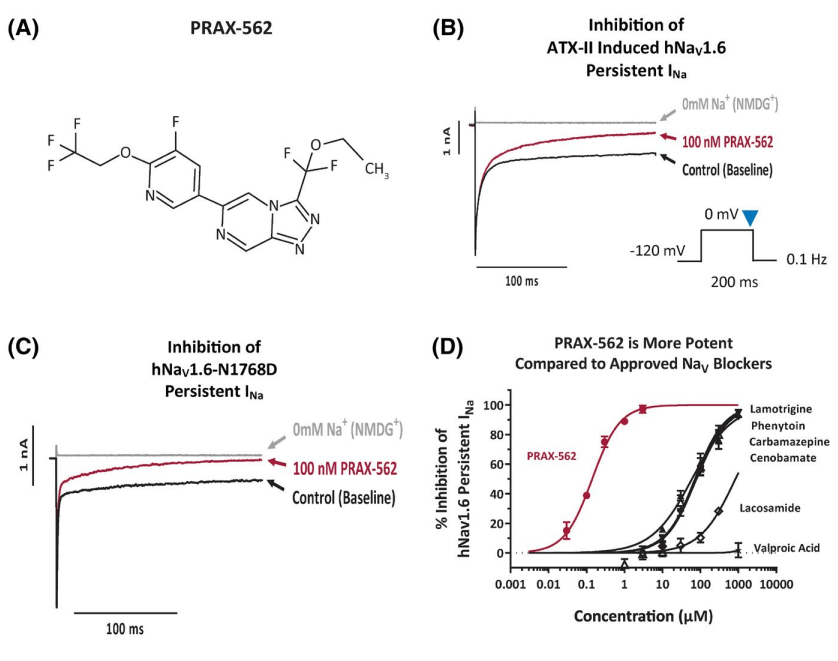
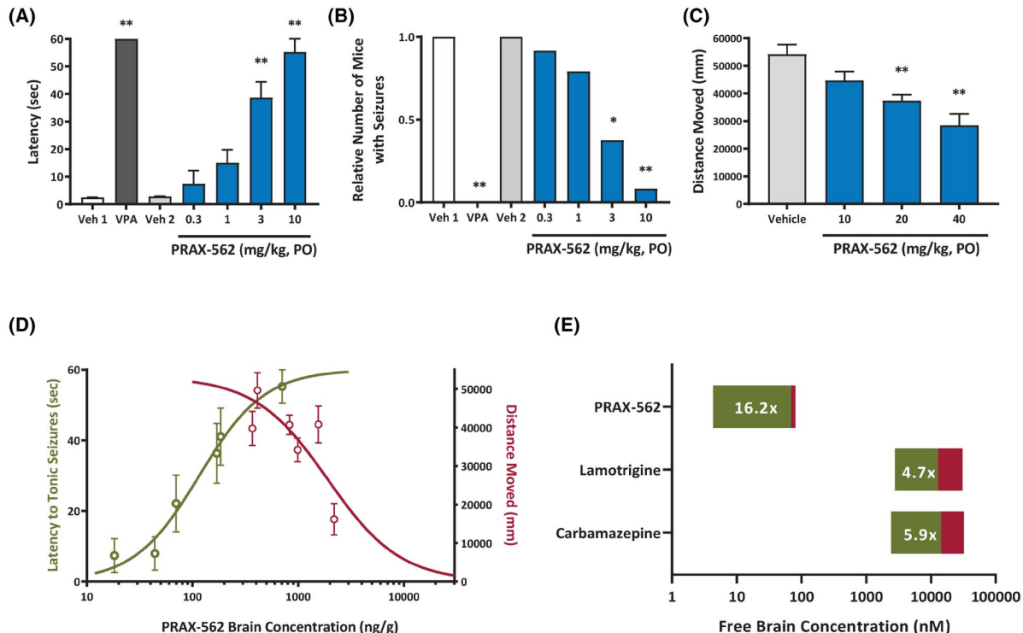
2022년 1월에 Epilepsia 논문에 PRAX-562의 전임상 연구결과를 발표하였습니다. 기존에 승인된 NaV blockers에 비해 월등히 우수한 약효 를 확인했습니다.
Sage의 Zuranolone에 대항하는 Praxis의 약물 PRAX-114는 primary end points, secondary end points 모두 실망스러운결과를 얻었습니다. 이로 인해 정리해고와 함께 PRAX-562와 PRAX-944 프로그램에 집중하는 것으로 전략이 신속히 수정되었습니다. 가장 선도하던 약물이 실패했을 때, 어떻게 회사를 Turnaround해야 하는지에 대해 잘 보여주는 사례입니다.

Praxis acts fast as depression drug flunks late-phase test, stopping trials and reducing headcount – Fierce Biotech 6/6/2022

Praxis Precision Medicines’ challenge to Sage Therapeutics has unraveled. With a phase 2/3 clinical trial in major depressive disorder (MDD) failing comprehensively, Praxis is stopping work on a clutch of other studies, laying off staff and pinning its hopes on two other candidates.

The failed candidate, PRAX-114, is a type of nervous system drug known as an extrasynaptic GABAA receptor preferring positive allosteric modulator. Sage has gone some way toward validating the mechanism of action with its own drug zuranolone. Yet, Praxis’ bid to improve on the competition by providing a fast, durable antidepressant effect across MDD symptoms, a wider therapeutic window and simple nightly dosing has come unstuck.

Praxis is yet to share data from the phase 2/3 Aria trial, but everything that is known is bad. The study failed its primary endpoint, which looked at change in a depression score at Day 15, and missed all of its secondary endpoints. 

“We are surprised and disappointed in the Aria study results,” Praxis CEO Marcio Souza said in a June 6 statement. “PRAX-114 was well-tolerated … yet the effect did not deliver to meet the needs of patients. Praxis is committed to our mission to help people suffering from CNS disorders and will prioritize our programs in movement disorders and epilepsy moving forward.”

The prioritization of the movement disorder and epilepsy programs will see Praxis lay off staff—it had 139 employees as of mid-February, up from 62 at the end of 2020—and stop work on other PRAX-114 trials. The biotech is also closing screening in its phase 2 Acapella study in MDD, positioning it to deliver results in the third quarter, stopping enrollment in a post-traumatic stress disorder phase 2 trial and discontinuing an essential tremor trial.

Through the changes, Praxis expects to extend its cash runway into 2024, giving it the time to rebuild its pipeline around its drugs PRAX-944 and PRAX-562. Top-line results from a phase 2b clinical trial of T-type calcium channel blocker PRAX-944 in the daytime treatment of essential tremor are due in the second half of the year, the same period given for epilepsy prospect PRAX-562 to enter phase 2 trials.

Praxis needs positive data on the candidates to drum up renewed enthusiasm for its pipeline. Shares in the biotech fell more than 60% to around $3 in premarket trading following news of the phase 2/3 flop.

위기는 기회를 동반한다고 하죠. PRAX-114의 실패, 정리해고와 PRAX-562의 Clinical Hold 후 다시 임상 재개 등 어려운 1년을 보낸데 대한 보상과 같은 UCB와 최대 $100 Million 규모의 공동연구계약을 맺습니다. KCNT-1 related epilepsy 프로그램으로 라이선싱 옵션이 있는 딜이었습니다.

Praxis ends year on high with $100M biobucks UCB deal for epilepsy medicine – Fierce Biotech 12/14/2022

It’s been a tough year of layoffs and pipeline culls for Praxis Precision Medicines, but the biotech is ending 2022 on a positive note courtesy of a collaboration with UCB to develop a potential first-ever treatment for a specific type of epilepsy.

The collaboration is based upon Praxis’ PRAX-020 program to discover small-molecule therapeutics as potential treatments of KCNT1-related epilepsies, for which there are currently no approved treatments. As well as an upfront payment from the Belgian biopharma, Praxis will be eligible for development and commercial milestone payments to the tune of up to $100 million, on top of royalties. UCB retains an exclusive option to in-license global development and commercialization rights to any KCNT1 small-molecule candidate that results from the agreement.

The money will come as welcome news to Praxis, which laid off staff and halted a clutch of clinical trials after its nervous system drug PRAX-114 failed to deliver in a phase 2 study in June. The company moved to prioritize its programs in movement disorders and epilepsy, a decision that appears to have paid off with the UCB deal.

Not that Praxis’ bank account is empty—the Boston-based company had $123.7 million in cash and equivalents as of the end September. It may be a drop of over $150 million on the funds the biotech entered the year with, but Praxis reckoned it was still enough to fund it through the start of 2024, even before any payments from UCB are taken into account.

“Our internal research efforts give us confidence that small molecules can selectively inhibit the KCNT1 channel and potentially could be an effective treatment for individuals suffering from KCNT1-related epilepsy,” Praxis CEO Marcio Souza said in a postmarket release Tuesday. “The collaboration with UCB validates this approach and will allow us to accelerate efforts toward a potential treatment for KCNT1 patients.”

As well as a number of other potential epilepsy programs in preclinical development, Praxis has one already in phase 2, with others due to enter phase 1 and 2 before the end of the year. One of these, PRA-562, was recently released from an FDA clinical hold.

Praxis의 Lead Program인 Ulixacaltamide (PRAX-944)의 임상3상 진입과 함께 $63 Million Public financing을 할 수 있었습니다.

Praxis Precision Medicines Announces Closing of Financing and Reiterates Corporate Priorities – Globe Newswire 6/22/2023

Praxis Precision Medicines, Inc. (NASDAQ: PRAX), a clinical-stage biopharmaceutical company translating genetic insights into the development of therapies for central nervous system (CNS) disorders characterized by neuronal excitation-inhibition imbalance, today announced the closing of the underwritten public offering of shares of common stock and pre-funded warrants, including the full exercise of the underwriters’ overallotment option. The net proceeds from the offering are $63.3 million, after deducting underwriting discounts and commissions and estimated offering expenses. Together with the Company’s existing cash, cash equivalents and marketable securities, this extends the cash runway into the first quarter of 2025. The proceeds will be used to advance the development of ulixacaltamide into two Phase 3 studies for essential tremor, to continue clinical development of PRAX-562, PRAX-222 and PRAX-628 for various epilepsies, and for working capital and other general corporate purposes.

The Company has initiated a study evaluating PRAX-628 in photo-sensitive epilepsy patients, also known as a PPR study, with expected readout by year end. Similar studies have shown a positive correlation to anti-seizure medicines (ASMs) used to treat focal epilepsy. With this study, Praxis plans to validate the mechanism of action of PRAX-628 and inform the study design for its Phase 2b program.

Praxis remains on-track for reading out the Phase 2 Study for PRAX-562 and the first cohort for PRAX-222 in DEEs by year end.

“This financing provides the means to continue advancing our portfolio in movement disorders and in epilepsy closer to patients, with a number of catalysts this year,” said Marcio Souza, president and chief executive officer of Praxis. “We are excited to advance our Phase 3 program in essential tremor, while also initiating the PPR study to inform and de-risk our program in focal epilepsy. Additionally, we are pleased to have received support from both existing and new investors.”

About Praxis
Praxis Precision Medicines is a clinical-stage biopharmaceutical company translating insights from genetic epilepsies into the development of therapies for CNS disorders characterized by neuronal excitation-inhibition imbalance. Praxis is applying genetic insights to the discovery and development of therapies for rare and more prevalent neurological disorders through our proprietary small molecule platform, Cerebrum™, and antisense oligonucleotide (ASO) platform, Solidus™, using our understanding of shared biological targets and circuits in the brain. Praxis has established a diversified, multimodal CNS portfolio including multiple programs across movement disorders and epilepsy, with four clinical-stage product candidates. For more information, please visit www.praxismedicines.com and follow us on FacebookLinkedIn and Twitter.

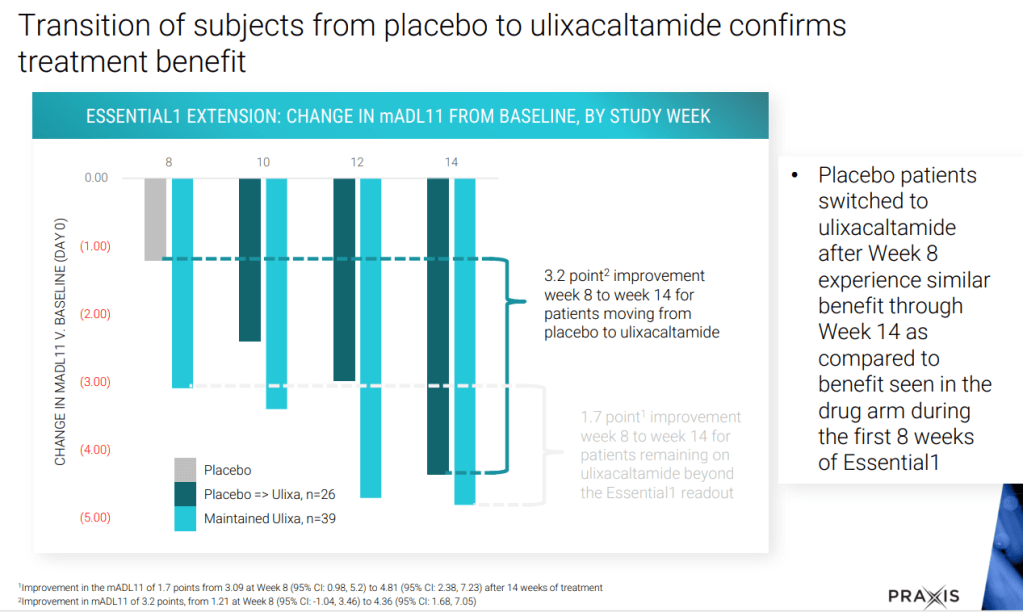
2023년 8월에 ulixacaltamide (PRAX-944)의 임상2상 결과를 발표했고 결과는 좋았습니다. 이 결과는 MDD International Conference에서 발표했습니다.
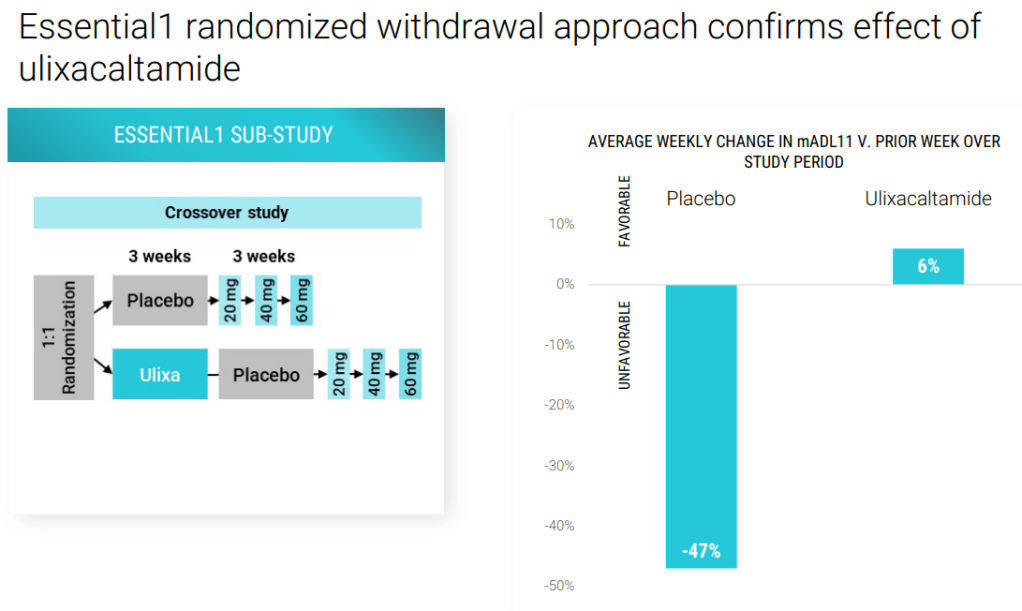
2023년 10월 Praxis R&D Day에서 파이프라인에 대한 총괄적인 발표를 했는데 그 자료는 아래에 링크합니다.

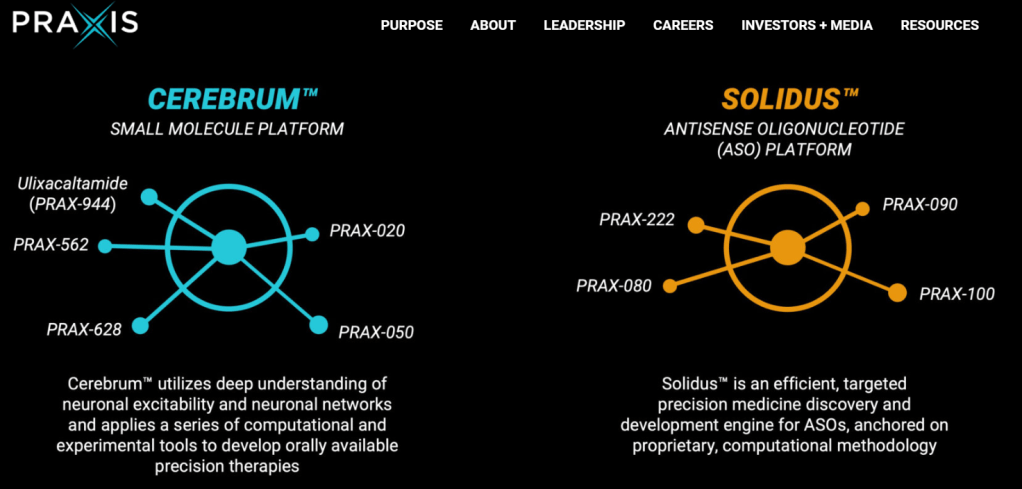
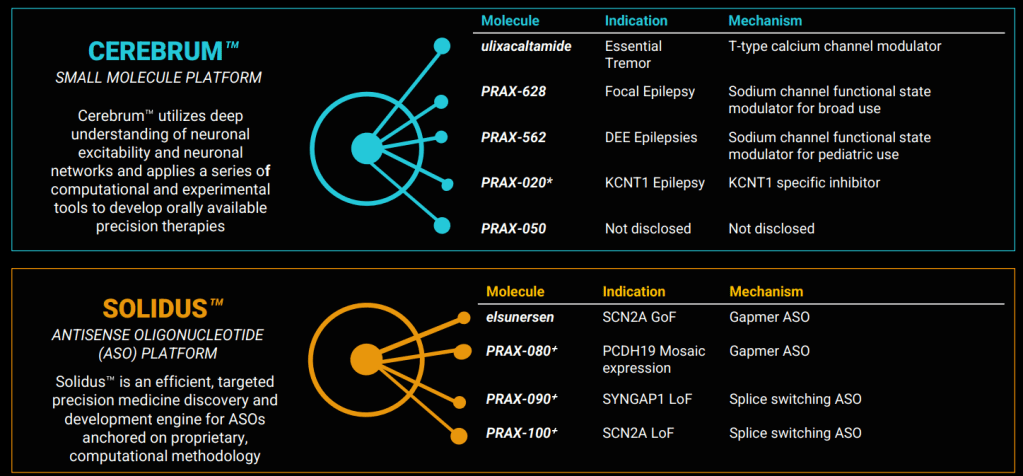
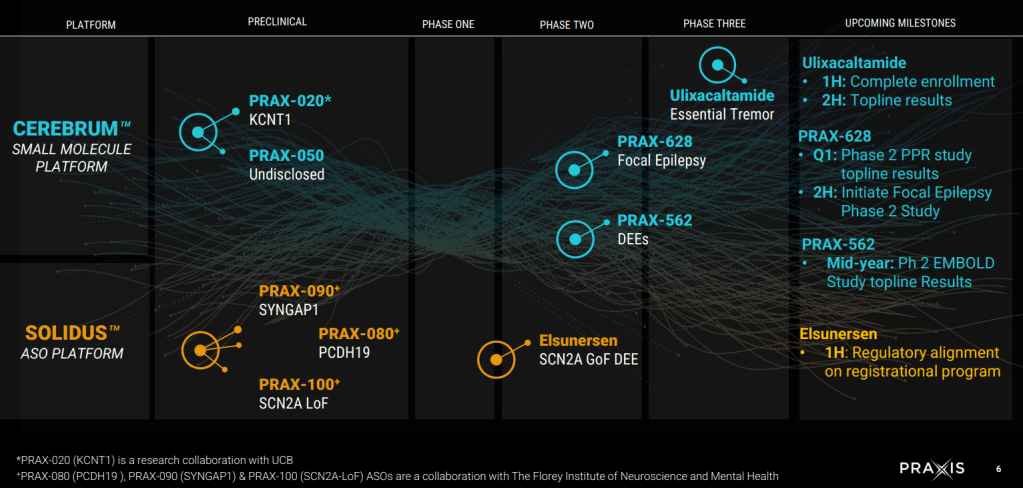
2024년 3월에 발표한 Corporate Presentation에 의하면 현재 파이프라인은 아래와 같습니다. Small Molecule Platform과 Antisense Oligonucleotide Platform으로 나뉘어져 있고 Ulixacaltamide (PRAX-944)가 임상3상으로 올해 하반기에 Pivotal result가 나올 예정입니다. 그 뒤를 이어서 PRAX-628과 PRAX-562가 임상2상에 진입해 있습니다. 최근 PRAX-629의 결과가 아주 좋게 나왔습니다.
Praxis’ epilepsy drug hits in phase 2, sparking stock rise and plans for next trial – Fierce Biotech 3/26/2024

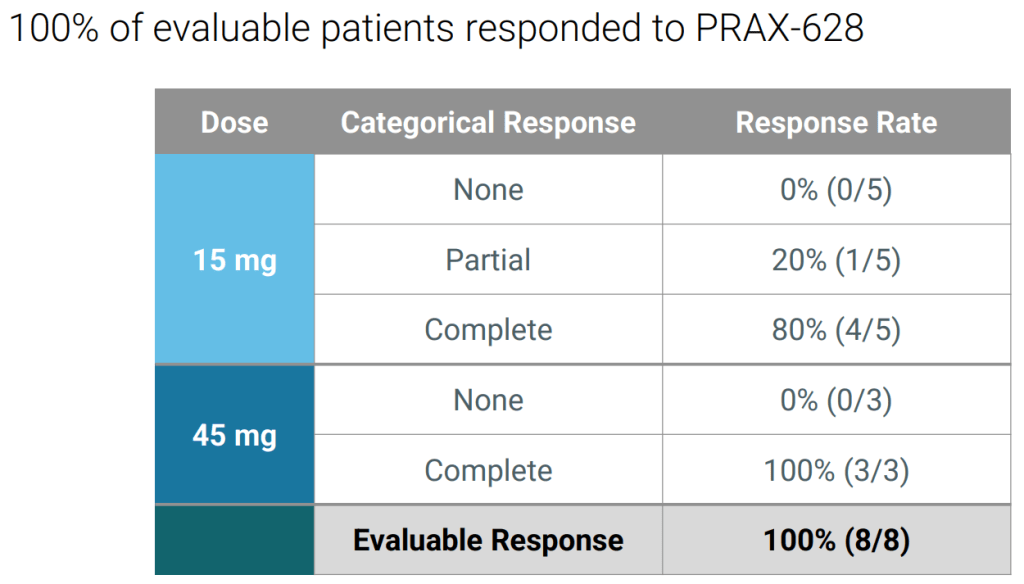
Praxis Precision Medicines has recorded a midphase win in epilepsy, linking the high dose of PRAX-628 to a 100% complete response rate to clear the path for a larger study in the second half of the year. 

The phase 2a trial tested the sodium-channel drug candidate in epilepsy patients with photoparoxysmal response (PPR), a form of photosensitivity. Patients needed to have demonstrated PPR during screening to be evaluated in the trial. After treatment with PRAX-628, Praxis saw a 100% complete response rate in the high, 45mg cohort. The complete response rate on the lower dose was 80%.

Shares in Praxis rose 25% to almost $64 in the opening hours of trading on Tuesday from a Monday closing price of $50.58.

On a conference call with investors to discuss the results, Dan Friedman, M.D., professor of neurology at NYU Grossman School of Medicine, said the photoparoxysmal model is very useful for first-in-patient studies because “it has predictive ability for drugs that are ultimately efficacious in the clinic, especially those with broad spectrum activity.” Friedman cited cenobamate, brivaracetam and levetiracetam as molecules that suppressed PPR and were then shown to be efficacious.

Yet, it is unclear exactly what the effect on PPR means for the prospects of PRAX-628. Friedman said the field lacks “a really good relationship between the degree of suppression we see in these relatively small studies with a heterogeneous group of patients with a specific type of epilepsy, usually a generalized epilepsy, and ultimate efficacy in the clinic.” 

45mg 환자들에서 8명중의 8명 (100%)의 Complete Response를 얻었다고 발표를 했습니다. 아직 환자수가 많지 않아서 계속 기대를 가지고 지켜볼 필요가 있습니다.
BOSTONIAN (44) 만약 미국에서 대학을 다녔더라면 어땠을까?

요즈음 막내와 관계가 많이 좋아진 것 같다.

12학년의 마지막도 거의 다가오고 그래서 그런지 딸아이가 학교 생활로 전보다 더 바빠진 것 같다. 고학년이라 후배들에게 자리를 넘겨주어야 할 것도 있고 학교에서 이런저런 행사들도 준비해야 하는 모양이다.

뿐만 아니라 수업도 마친 것이 아니어서 공부 강도도 이전과 크게 달라진 것이 없는 눈치이다. 매주 시험이 꼭 한두 과목씩 있었는데 다행히 이번주는 시험이 없다고 한다.

오늘은 막내와 함께 어느 대학교의 합격자 설명회를 갔다. 본래 서부에 있는 학교인데 동부 보스턴까지 와서 하는 걸보니 학교 입시 담당자의 마음도 바쁜 모양이다. 6:30에 시작한다고 해서 저녁을 제공하는지 안하는지 도무지 알 길이 없어서 일찍 저녁식사를 하고 갔는데 도착해 보니 만찬이 준비되어 있었다.

딸아이와 나는 서로 바라보면서 피식 웃었다.

학교 행사는 나무랄데 없이 좋았다. 역시 좋은 학교인 것은 틀림이 없다. 학교 소개에 유명인사의 이름과 중요한 사건들, 수많은 노벨상 석학들의 이름이며….스포츠는 또 얼마나 좋고 학교 음식도 좋다고 하고…

뭐 하나 빠지는 법이 없다.

이런 학교에 합격했다는 걸 깨달으며 설명하는 스크린을 바라보고 있자니 갑자기 마음 속에서 울컥하며 이런 생각이 든다.

‘나도 만약 이런 대학 생활을 했다면 얼마나 좋았을까?’

난 사실 고3이 되던 해 1월에 아버지 회사가 부도가 나는 바람에 그 이후부터 대학에 간다는 것보다는 가지 못한다는 마음에 95% 이상은 포기한 상태로 고3 한 해를 보냈었고 대학에 갈 때도 돈을 생각하지 않을 수 없었다. 등록금이 지금 생각해 보면 그리 비쌌던 것도 아닌 듯한데 그 때는 너무나 커 보였다.

어찌어찌 하여 대학에는 갔지만 순탄치 않은 4년이었고 기억하기 싫은 4년이었다. 그래서 지금도 나에게 대학생활은 그리운 시절이 아니라 고달픈 아픔이 되었다.

학교 설명을 들으며 가만히 아이의 옆모습을 보고 있자니 이 녀석…피곤하다고 하면서도 열심히 듣는 모습이 기대에 가득찬 모습이 완연하다.

참으로 부러웠다. 그리고 다짐했다.

그래, 내가 너에게 만큼은 행복하고 즐거운 대학생활을 할 수 있도록…

그래서 나중에 아빠 나이가 되었을 때 돌아보며 그리워할 수 있도록.

나중에 아주 나중에 이런 얘기 들을 수 있도록.

“아빠, 난 대학시절이 가장 행복했어요.”

그런 말 듣는 아빠가 되고 싶다.

사랑하고 부럽다. 너의 곁에 항상 든든히 서 있을테니 즐겁게만 살아다오.

BIOTECH (157) Dr. Josep Bassaganya-Riera’s LANCL-Targeting Autoimmune Drug Discovery – from Landos Biopharma to NImmune Biopharma

(Picture: Josep Bassaganya-Riera, Professor of Virginia Tech University, PhD, Founder of Landos Biopharma, Founder & CEO of NImmune Biopharma)

안녕하세요 보스턴 임박사입니다.

바이오텍의 성공확률이 높지 않다는 것은 놀라운 사실이 아니지만 파이프라인에 문제가 없는데도 이사회와의 갈등으로 어려움을 겪는 것은 좀 드문 경우입니다. Virginia Tech 교수이면서 LANCL2 (Lanthionine Synthetase C-Like Protein 2) 라는 표적을 발견하고 이 표적을 이용한 자가면역질환 (Autoimmune Disease) 치료제를 개발하고자 하는 노력에 대해 좀 나누고자 합니다.

Josep Bassaganya-Riera 교수는 2012년에 LANC:2 표적 약물을 Computational Discovery를 통해서 발견했다고 PLOS One에 발표하였습니다.

이 결과를 바탕으로 Landos Biopharma를 설립해서 $10 Million Series Aㄹㄹ 했습니다. Perceptive Advisors가 단독으로 참여했습니다.

Landos Biopharma Raises $10 Million in Series A Financing – Business Wire 9/21/2017

Landos Biopharma, Inc., an emerging biopharmaceutical company focused on developing improved treatments for autoimmune diseases, announced today it has raised $10 million in a Series A financing led by life sciences investment management firm Perceptive Advisors, LLC, which will serve as its exclusive investor for the Series A round.

Landos, founded by serial entrepreneur and innovator Dr. Josep Bassaganya-Riera, is advancing a robust pharmaceutical pipeline for autoimmune diseases toward commercialization and will partner operational efforts with Xontogeny, LLC, a life sciences accelerator operating company led by industry veteran Chris Garabedian. Xontogeny’s model works in synergy with partner companies to support management teams and provide expertise and strategic direction in the early stages of pharmaceutical and biotechnology development.

Current therapies for autoimmune diseases, a $100 billion market, have limited efficacy and significant side effects. Landos’ mission is to accelerate the development of safer, more effective therapeutics for painful and debilitating autoimmune diseases including Crohn’s disease and ulcerative colitis.

“I’m thrilled to have Xontogeny and Chris Garabedian as a strategic and operating partner along with Perceptive Advisors as Landos’ exclusive financier in the Series A, to bring our lead product, BT-11, through initial clinical studies in 2018,” said Landos Chairman and CEO, Dr. Josep Bassaganya-Riera “We have a committed leadership team with industry experience focused on developing oral treatments that address an unmet clinical need of patients, can disrupt the $9.2 billion per year inflammatory bowel disease (IBD) therapeutics market, and most importantly improve the lives of millions of patients living with these diseases.”

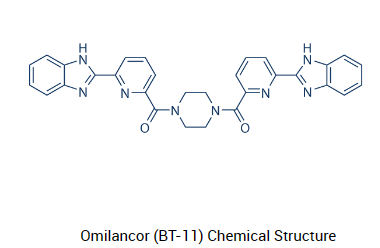
BT-11은 Omilancor라고 불리는 물질로서 발표한 자료는 아래에 링크합니다.

Landos will focus its development efforts in a novel target pathway called Lanthionine Synthetase C-Like 2 (LANCL2), which has shown promise for the treatment of autoimmune diseases by engaging a unique mechanism of action that exerts potent anti-inflammatory effects. Landos’ lead product candidate BT-11 is a first-in-class, orally active, locally-acting therapeutic for treatment of Crohn’s disease and ulcerative colitis that has shown a benign safety profile in animal models and that is advancing toward an Investigational New Drug (IND) filing. BT-11 intercepts IBD by decreasing the production of inflammatory mediators and increasing anti-inflammatory molecules within the gastrointestinal tract. IBD impacts approximately 1.6 million Americans and 4 million people worldwide.

Scientific Reports 에도 BT11에 대한 발표를 했습니다.

“Landos is an exciting company for Xontogeny to partner with as Josep and his team have produced very compelling data in animal models of IBD and have brought their lead compound, BT-11, to the cusp of clinical trials,” said Mr. Garabedian, who will serve as a Landos Board member and senior business advisor. “The properties of BT-11 are unique and well differentiated from current IBD products and we believe it has the potential to represent an advance in the treatment of both Crohn’s disease and ulcerative colitis.”

“We are extremely excited to partner with both Josep and Chris to build Landos into a global biopharmaceutical company focused on autoimmune diseases, and are convinced that the team will provide an accelerated path to compelling clinical proof-of concept for IBD,” said Joe Edelman, CEO of Perceptive Advisors. “As the first investment in a Xontogeny portfolio company since partnering with Chris earlier this year, we believe that Landos exemplifies the company profile we aim to support – an outstanding leadership team, a lead product with a novel mechanism, strong IP, and a compelling preclinical and translational dataset that is close to the clinic for the treatment of an important disease with an unmet need for safer and more effective drugs.”

With the Series A investment, Landos plans to complete remaining IND-enabling studies, file an IND for BT-11 in 2018 and expects to complete Phase 1 clinical testing by early 2019.

For more information about Landos Biopharma, visit www.landosbiopharma.com. For more information about Xontogeny, visit www.xontogeny.com. For more information about Perceptive Advisors, visit www.perceptivelife.com.

About Landos Biopharma, Inc.

Landos Biopharma, Inc. is an emerging biopharmaceutical company focused on the discovery and development of first-in-class oral therapeutics for patients with autoimmune diseases. Landos’ lead clinical asset, BT-11, is a novel, locally-acting small molecule targeting inflammatory bowel disease (IBD) that is expected to enter clinical testing for Crohn’s disease in 2018. Landos also has a robust pipeline of compounds for other autoimmune diseases. Landos is headquartered in Blacksburg, VA. For more information, please visit www.landosbiopharma.com, contact info@landosbiopharma.com or follow the company on Twitter at @LandosBio.

Xontogeny’s Landos Biopharma reels in $60M to ramp up IBD program – Fierce Biotech 8/13/2019

Two years ago, Landos Biopharma was the first biotech to come out of Xontogeny, the accelerator started by former Sarepta Therapeutics chief Chris Garabedian. Now, the autoimmune specialist has picked up $60 million to propel its lead program into phase 2 for inflammatory bowel disease (IBD)

The series B funding will also advance Landos’ earlier-stage pipeline, which includes candidates slated to enter the clinic in 2020. It comes from RTW Investments, Osage University Partners, PBM Capital and Perceptive Advisors—which includes Perceptive Life Sciences Fund and Perceptive Xontogeny Venture Fund. 

Landos is based upon the work of CEO Josep Bassaganya-Riera, Ph.D., a serial entrepreneur and Virginia Tech professor who outlined the potential for targeting the lanthionine synthetase c-like protein 2 (LANCL2) pathway to affect immune and inflammatory responses in a 2014 paper. Bassaganya-Riera went on to discover a drug that selectively binds LANCL2, found Landos and pick up $10 million from Perceptive Advisors to drive its lead program. 

The program, dubbed BT-11, is a small molecule that targets LANCL2 in the gut. In a phase 1 study published earlier this year, the drug beat placebo at lowering levels of fecal calprotectin, which Landos believes is a predictive biomarker of response to treatment in IBD. The company will kick off global phase 2 trials in the two main forms of IBD: Crohn’s disease and ulcerative colitis. 

“We believe BT-11’s mechanism of action is differentiated with the potential to transform the current treatment paradigm for patients with ulcerative colitis and Crohn’s disease,” said Rod Wong, M.D., a managing partner at RTW Investments who has just joined Landos’ board, in a statement. 

Landos is looking to provide a new option for patients with moderate to severe cases of IBD for whom current treatments are inadequate or have side effects. People with IBD may be treated with anti-inflammatory drugs or immunosuppressants such as anti-TNF (tumor necrosis factor) meds, but Landos believes the former can be used only in mild inflammation and reckons the latter only works in up to 60% of patients. 

“We believe there is tremendous commercial potential for an oral compound for IBD and BT-11 is the most promising candidate we’ve seen at this stage of development,” said Garabedian, portfolio manager at Perceptive Xontogeny Venture Fund. “As an investor in the Series A, we are impressed with the productivity and efficiency of the Landos team in completing a comprehensive preclinical program, securing two open INDs, and successfully generating Phase 1 clinical results in less than two years, and are prepared to move forward with two global Phase 2 studies in ulcerative colitis and Crohn’s disease.”

그리고 이어서 NX-13이라는 두번째 약물을 임상1상에서 첫번째 환자에게 약물복용이 되었다고 발표를 했습니다. 정말 굉장한 추진력입니다.

Landos Biopharma Announces First Human Dosing in a Phase 1 Study of NX-13, its Novel Candidate for Inflammatory Bowel Disease – Globe Newswire 7/14/2020

Landos Biopharma, a clinical-stage biopharmaceutical company focused on the discovery and development of therapeutics for patients with autoimmune disease, today announced that the first patient has been dosed in a Phase 1 study of NX-13, the Company’s novel, orally administered therapeutic candidate for the treatment of inflammatory bowel disease.

“Today marks a significant milestone for Landos, as we advance our second product candidate, NX-13, into clinical development,” commented Josep Bassaganya-Riera, Ph.D., Chairman, President, and CEO of Landos Biopharma. “This achievement highlights the success of our precision medicine platform in identifying novel targets to establish a robust and differentiated therapeutic pipeline for autoimmune disease. NX-13 is a compound for oral administration that targets the NLRX1 receptor, which is part of a pathway that modulates immune response linked to inflammatory bowel disease. We believe that, if approved, NX-13 could provide an additional treatment option to the up to 50 percent of ulcerative colitis patients that experience relapse within 1 year of current therapies and up to 70-90 percent of Crohn’s disease patients that fail to enter prolonged remission.”

The randomized, double-blind, placebo-controlled, ascending dose, multi-cohort Phase 1 study will evaluate the safety, tolerability, and pharmacokinetics of NX-13 in healthy volunteers. The study design includes evaluation of single ascending doses and multiple ascending doses of NX-13. Based on observations in preclinical models of inflammatory disease, NX-13 has the potential to be developed as a monotherapy or in combination with other therapeutics in the treatment of inflammatory bowel disease.

“Advancing two first-in-class oral products for Crohn’s disease and ulcerative colitis with new mechanisms of action into clinical development in less than 2 years is a substantial accomplishment,” said Jean-Frederic Colombel, M.D., a Clinical Advisory Board member for Landos’ IBD program, gastroenterologist and Director of the IBD Center at the Icahn School of Medicine at Mount Sinai. “We continue to see an unmet clinical need for chronic oral therapies to treat UC and CD with improved efficacy, safety, tolerability and convenience, including in the mild to moderate patients.”

About Inflammatory Bowel Disease

Inflammatory bowel disease (IBD) is a chronic autoimmune disorder with two primary subtypes: Crohn’s disease and ulcerative colitis, which impair quality of life and afflict over five million individuals worldwide.1 Currently, available therapeutics typically are only able to address a subset of overall patient populations and many fail to maintain therapeutic efficacy over time. In addition, current therapeutics are associated with serious side effects and toxicities related to systemic immunosuppression, including increased mortality.2

1. World IBD Day. Home. Available at http://www.worldibdday.org/index.html. Accessed July 2020.
2. Shivaji, U.N. et al., Review article: managing the adverse events caused by anti-TNF therapy in inflammatory bowel disease. Aliment Pharmacol Ther. 2019 Mar;49(6):664-680.

About NX-13

NX-13 is a first-in-class, orally-active, gut-restricted, small molecule therapeutic candidate for the treatment of inflammatory bowel disease. NX-13 targets NLRX1, a mitochondria-associated receptor with the ability to modulate immune responses. By activating the NLRX1 pathway, NX-13 increases oxidative phosphorylation in immune cells, reduces differentiation of effector CD4-positive T cells, and decreases production of inflammatory cytokines.

About Landos Biopharma

Landos Biopharma, Inc. is a clinical-stage biopharmaceutical company focused on the discovery and development of first-in-class oral therapeutics for patients with autoimmune disease. Lead asset BT-11 is a novel, first-in-class, oral, gut-restricted therapeutic candidate for the treatment of ulcerative colitis and Crohn’s disease that targets the LANCL2 pathway. NX-13 is a novel, first-in-class, oral, gut-restricted compound for the treatment of inflammatory bowel disease, which targets the NLRX1 pathway. Additional candidates are in development for the treatment of lupus nephritis, rheumatoid arthritis, multiple sclerosis, and diabetes. For more information, please visit www.landosbiopharma.com.

그리고 이듬해에는 $100 Million IPO를 할 수 있었습니다. 여기까지는 모든 것이 다 좋아보였습니다.

Landos Biopharma guns for a $100M IPO to boost AI autoimmune R&D work – Fierce Biotech 1/15/2021

Xontogeny’s Landos Biopharma is jumping into warm biotech IPO waters as it looks to go public with a $100 million offering.

Landos is based upon the work of CEO Josep Bassaganya-Riera, Ph.D., a serial entrepreneur and Virginia Tech professor who outlined the potential for targeting the lanthionine synthetase c-like protein 2 (LANCL2) pathway to affect immune and inflammatory responses in a 2014 paper.

Bassaganya-Riera went on to discover a drug that selectively binds to LANCL2, found Landos and pick up $10 million from Perceptive Advisors to drive its lead program.

Landos Biopharma was the first biotech to come out of Xontogeny, the accelerator started by former Sarepta Therapeutics chief Chris Garabedian. Back in the summer of 2019, it picked up $60 million series B to propel its lead program into phase 2 for inflammatory bowel disease (IBD).

Now, it wants a $100 million IPO, according to its Securities and Exchange Commission filing, to help boost its AI-based LANCE platform, which sees to make predictions of immunometabolic function. To date, it has identified seven novel immunometabolic targets and product candidates across 14 indications.

Its leading candidate, BT-11, has completed the induction phase of a phase 2 trial in mild to moderate ulcerative colitis (UC) patients, with plans to kick-start a phase 3 in UC and a phase 2 for moderate to severe Crohn’s disease in the coming months.

Landos is looking to provide a new option for patients with moderate to severe cases of IBD for whom current treatments are inadequate or have side effects.

People with IBD may be treated with anti-inflammatory drugs or immunosuppressants such as anti-TNF meds, but Landos believes the former can be used only in mild inflammation and reckons the latter only works in up to 60% of patients. It will now seek to out that theory to the test in later-stage trials.

그런데 IPO한 지 얼마되지 않아 Josep 교수는 갑자기 회사를 그만두게 됩니다. 이사진과의 갈등이 원인이 된 것 같죠. 아마 주된 이유는 이후의 일로 보았을 때 BT-11과 NX-13 중에서 어떤 약물을 집중하느냐의 문제였던 것으로 보입니다. Josep 교수가 그만둔 후 Landos는 NX-13의 임상을 진행하고 BT-11은 중단합니다.

Landos Biopharma CEO Josep Bassaganya-Riera leaves – Exchange 11/8/2021

 Josep Bassaganya-Riera, chief executive of Landos Biopharma, leaves. As announced by Landos Biopharma Inc. in a news release on Monday, November 8, 2021, Josep Bassaganya-Riera leaves his post as chief executive officer at the clinical-stage biopharmaceutical company, after about five years in the role, effective immediately.

Landos Biopharma will undertake a search for a successor.

Josep Bassaganya-Riera’s duties as CEO will be taken over temporarily by Tim M. Mayleben, most recently President, CEO and Director at Esperion Therapeutics, Inc., as Interim Chief Executive Officer.

Already a director

Mayleben is already a director of Landos Biopharma. Generally speaking, most director-turned-CEO appointments occur following a sudden resignation of the outgoing CEO and signal a lack of preparedness on the company’s part to groom internal talent. Directors-turned-executives represent a blend of outsider and insider.

They don’t have the constraints of a pure insider when it comes to leading painful changes or making unpopular decisions, and they have more company knowledge than a pure outsider.

Having been a director, Mayleben understands the expectations and dynamics of the board and has knowledge of Landos Biopharma’s organization, risk-management practices and strategy.

Chris Garabedian, also a Landos Director, has been appointed Chairman of the Board.

“This is the right time”

Josep Bassaganya-Riera’s departure from the CEO post is explained as follows. Chris Garabedian, Chairman of the Board, said: “With seven product candidates in the pipeline across three novel mechanisms, Josep and the Board agree that this is the right time to transition to our next phase of leadership.”

Precise information regarding Josep Bassaganya-Riera’s future plans was not immediately available.

“Stepped down”

Landos Biopharma said: “Josep Bassaganya-Riera, Ph.D., has stepped down as Chairman, President and Chief Executive Officer, effective immediately.”

Share price increase since June 2021

The announcement follows an increase in Landos Biopharma Inc.’s share price of 30% since June 2021.

In the position of CEO since 2017

Josep Bassaganya-Riera became CEO of the Company in 2017.

Bassaganya-Riera will serve as an advisor to the Company to ensure a smooth transition.

Josep Bassaganya-Riera has served as the Company’s Chairman, President and Chief Executive Officer since the Company’s founding in January 2017.

Bassaganya-Riera has served as the Director of the Nutritional Immunology and Molecular Medicine Laboratory since July 2002 and the Chairman of the board of directors of Biotherapeutics Inc. since October 2008.

He previously served as the Chief Executive Officer of Biotherapeutics from October 2008 to September 2017 and a Research Professor of Immunology at Virginia Tech from December 2002 to May 2020.

Bassaganya-Riera holds a degree in Veterinary Medicine from Universitat Autònoma de Barcelona and a Ph.D. in Nutrition and Immunology from Iowa State University.

하지만 Josep 교수는 여기서 포기하지 않습니다.2023년 3월에 Landos로 부터 NX-13을 제외한 물질을 사게 됩니다. 그리고 NImmune Biopharma를 설립합니다.

Endpoints 의 기사가 좀더 자세히 상황을 설명해 주는 것 같습니다. 약물의 용량을 줄이고 subset disease로 임상3상을 추진한다는 계획을 밝혔습니다. 펀딩에 대해서는 자세한 언급은 없었지만 투자자들이 든든히 받치고 있다고 했다는군요. 펀딩 부분은 조만간 뉴스가 있겠죠.

Exclusive: After getting his drug back, Landos founder assembles new startup for the big PhIII test – Endpoints News 3/22/2023

By the time Josep Bassaganya-Riera stepped down as founding CEO of Landos Biopharma in 2021, the company had racked up Phase II data for its top autoimmune program, completed what he called a positive end-of-Phase-II meeting with the FDA and plans to launch pivotal Phase III trials.

Since then, though, the new leaders at Landos have reshuffled their plans for the drug, omilancor, first announcing they will run a Phase IIb ahead of a Phase III and eventually shelving it altogether.

Now, Bassaganya-Riera is picking back up where he left off.

NImmune Biopharma, his new startup, has bought rights to omilancor and other similar drugs from Landos, with an eye to launching Phase III this year. The company’s name first cropped up in SEC filings when Landos announced the deal in early March, but Bassaganya-Riera is sharing more details about the Phase III design and his team in an official launch.

Joining him in the C-suite are several veterans of Landos, including CSO Raquel Hontecillas, Marek Ciszewski (CFO), Andrew Leber (chief development officer), and Jennifer Collette (chief accounting officer & controller). The executives were formerly Landos’ VP of financial strategy and investor relations, VP of scientific & product development and head of finance, respectively.

The team’s focus remains on a portfolio of drugs targeting LANCL2, a protein that Bassaganya-Riera had researched for years as a professor at Virginia Tech.

While the clinical remission rate shown in the Phase II trial Landos ran in mild-to-moderate ulcerative colitis was not statistically significant, Bassaganya-Riera believes there’s evidence the drug works for a subset of patients with more serious disease.

For the late-stage trial, that means “a refinement of the patient population consistent with the expectations of the FDA.”

“In a nutshell, the expectation of the FDA is that we focus on patients that have more active disease,” he said, adding that NImmune will go for a 440 mg dose, which is lower than the 500 mg and 1,000 mg tested in Phase II.

He declined to offer specifics on fundraising progress so far, saying only there are institutional investors on board that will put NImmune in a well-capitalized position.

NImmune will aim to start other trials for omilancor in Crohn’s disease while testing a second candidate for lupus and rheumatoid arthritis — in line with the broad potential it sees for the LANCL2 pathway in treating autoimmune diseases.

“It’s different from the current Landos, but it’s not that different from the Landos that I founded in 2017,” he said.

Josep Bassaganya-Riera Launches NImmune Biopharma with Phase 3-Ready Clinical Candidate Omilancor for the Treatment of Ulcerative Colitis and Crohn’s Disease – Biospace 3/22/2023

NImmune Biopharma (“NImmune”), a late-stage precision immunology biopharmaceutical company that develops best-in-class biomarker-driven immunoregulatory therapeutics, today announced its launch following the acquisition of omilancor, NIM-1324, and the entire LANCL portfolio of immunoregulatory therapeutic assets from Landos Biopharma, Inc.

Omilancor is a Phase-3-ready, once-daily, oral, gut-restricted therapeutic for Ulcerative Colitis (UC) with potentially fast-to-market follow-on opportunities in Crohn’s disease (CD) and Psoriasis. NIM-1324 is a Phase-2-ready biomarker-guided once-daily, oral therapeutic for the treatment of Systemic Lupus Erythematosus (SLE) and Rheumatoid Arthritis (RA). These clinical candidates, originally developed by NImmune’s Founder, Executive Chairman, President, and Chief Executive Officer Dr. Josep Bassaganya-Riera, activate the Lanthionine Synthetase C-Like 2 (LANCL2) pathway, which enhances immunoregulatory processes that provide protection from autoimmune disease.

“I am thrilled to regain ownership and leadership of the LANCL immunoregulatory therapeutic portfolio and look forward to continuing the development of these candidates at NImmune, a science-driven company developing best-in-class biomarker-driven immunoregulatory therapeutics for a growing patient population with autoimmune diseases and unmet medical needs,” stated Dr. Bassaganya-Riera, Founder & CEO of NImmune. “Our leadership team was instrumental in the creation of the LANCL immunoregulatory portfolio, and brings substantial experience working with omilancor specifically to NImmune. Omilancor has the potential to impact the global inflammatory bowel disease (IBD) market as a safe and effective therapy, given the statistically significant clinical remission data it has produced in active disease UC patients as well as promising efficacy and safety results in CD patients. We are highly encouraged and motivated by these results and are pleased to have identified a robust regulatory path to commercialization.”

Omilancor was previously evaluated for the treatment of UC in a Phase 2 randomized, placebo-controlled clinical trial that demonstrated biologic-like efficacy with potentially best-in-class safety. Based on these findings and positive correspondence with the U.S. Food and Drug Administration (FDA), NImmune plans to initiate a Phase 3 randomized, placebo-controlled clinical trial in 2023. This study will be similar in design to the previous study but will only include the 440mg dose and utilize refined criteria for active disease, that includes rectal bleeding (RB) > 0, histological activity and elevated fecal calprotectin (FCP) at baseline. An analysis of the Phase 2 data using the 440mg dose and the refined active disease population attained statistically significant clinical remission at week 12. Meeting the approvable primary endpoint in its planned Phase 3 population of active disease UC patients sets a robust regulatory path for omilancor to New Drug Application (NDA) filing and commercialization.

A summary of the Phase 2 omilancor data can be found in NImmune’s corporate presentation.

NImmune’s second pipeline clinical candidate, NIM-1324, a once-daily, oral, systemically distributed LANCL2 agonist, has demonstrated ability to induce enhanced regulatory T cell (Treg) function in preclinical models of SLE and RA, reduced interferon gamma signaling in human peripheral blood mononuclear cells, and the potential to reduce inflammatory cell infiltration with less toxicity than current standard of care, including biologics and JAK-inhibitors. Additionally, Phase 2-ready NIM-1324 successfully completed a Phase 1 randomized, double-blind, placebo-controlled multi-cohort study evaluating its safety, tolerability, and pharmacokinetics (PK) in normal healthy volunteers where all endpoints were met, and it is now ready for further clinical testing in lupus and RA patients.

About NImmune Biopharma

NImmune is a late-stage precision immunology biopharmaceutical company that develops best-in-class biomarker-driven immunoregulatory therapeutics. Underpinned by advanced computational modeling and bioinformatics coupled with biomedical research capabilities to pioneer innovation in immunoregulatory drug development, NImmune’s business model enables the rapid and capital-efficient clinical development of high conviction drug candidates into New Drug Application (NDA) filing and commercialization. NImmune’s clinical development pipeline includes omilancor, a Phase 3-ready lead clinical candidate targeting LANCL2, an oral, once-daily, gut-restricted, first-in-class therapeutic for Ulcerative Colitis and Crohn’s disease with registration-directed pivotal clinical trials planned for 2023. Additional information: www.NIMMUNEBIO.COM or contact media@nimmunebio.com.

NImmune Biopharma Announces Positive Results of Omilancor in Ulcerative Colitis and Crohn’s disease at the American College of Gastroenterology 2023 Annual Scientific Meeting – Business Wire 10/23/2023

NImmune Biopharma, (“NImmune”), a private late-clinical-stage precision immunology biopharmaceutical company focused on the discovery and development of best-in-class biomarker-driven immunoregulatory therapeutics, led by omilancor, a Phase 3 best in class once daily oral therapy for Ulcerative Colitis, announced that it will present three abstracts, including final Phase 2 data for omilancor in active Ulcerative Colitis patients at the American College of Gastroenterology (“ACG”) 2023 Annual Scientific Meeting (“ACG 2023”), taking place at the Vancouver Convention Center in Vancouver, Canada, between October 20 and October 25, 2023.

Dr. Josep Bassaganya-Riera, Founder & CEO of NImmune, said, “Final and complete Phase 2 data for omilancor in mild to severe UC patients with active disease affirms best-in-class efficacy and unrivaled safety. Omilancor is a first-in-class wholly-owned therapeutic, developed with the guidance of TITAN-X, a proprietary computational modeling and AI-powered precision medicine discovery engine that efficiently accelerates biomarker-driven immunoregulatory therapeutic development of omilancor, NIM-1324 and our other immunoregulatory therapeutics. Meeting the primary endpoint of clinical remission in UC patients with active disease substantially de-risks omilancor’s regulatory path to New Drug Application (NDA) and commercialization and provides clinical validation of the LANCL2 pathway as a novel mechanism of action for addressing the significant unmet clinical needs of patients with autoimmune diseases. These positive clinical findings further underscore the importance of our recently announced research collaboration with the NIMML Institute and the value of its advanced computational modeling and A.I.-powered TITAN-X precision medicine platform, which efficiently accelerates biomarker-driven immunoregulatory therapeutic development of omilancor, NIM-1324 and our other immunoregulatory therapeutics.”

“As we approach a significant milestone—the initiation of the pivotal global Phase 3 clinical program of omilancor for the treatment of UC by year-end 2023—we are pleased to present our results at ACG 2023 and encouraged by the continued scientific validation of our clinical findings and the overall momentum of omilancor’s clinical and regulatory development. We look forward to continuing to realize the significant potential of omilancor as the first-in-class LANCL2 agonist for UC and additional autoimmune indications including Crohn’s disease and psoriasis.”

Presentation Details

Title: Efficacy and Safety of Omilancor in a Phase 2 Randomized, Double-Blind, Placebo-Controlled Trial of Patients with Ulcerative Colitis.

Poster: Board NumberP2216,Monday October 23, 2023, 10:30 AM – 4:15 PM

  • Clinical remission in the approvable UC population of active disease mild to severe patients was induced in 30.4% of patients treated with omilancor relative to 3.7% of patients given placebo (Δ=26.7, P = 0.01), meeting the primary endpoint.
  • Endoscopic and histological remission were achieved in 41.7% of omilancor given patients relative to 18.6% and 22.2%, respectively, patients in the placebo group (Δ=23.1, Δ=19.5).
  • Durable remission was induced in 38.5% of patients in the omilancor group versus 21.4% of patients given placebo (Δ=17.1, P = 0.05).
  • Endoscopic response was achieved in 73.1% of patients treated with omilancor relative to 53.6% of patients given placebo (Δ = 19.5, = 0.02).
  • Omilancor exhibited statistically significant decreases in TNF-a expressing myeloid cells (p = 0.037) in the colonic mucosa and statistically significant normalization of fecal calprotectin levels (P = 0.048).
  • Oral omilancor was well-tolerated in patients with UC with no trends in AE profile observed and no dose-limiting toxicities.
  • Pharmacokinetic analysis validated a gut-restricted profile with stable drug levels in stool over the treatment period, penetration into colonic biopsy tissue and limited systemic exposure.

Title: Efficacy and Safety of Omilancor in a Phase 2 Randomized, Double-Blind, Placebo-Controlled Trial of Patients with Crohn’s Disease.

Poster: Board NumberP2215,Monday October 23, 2023, 10:30 AM – 4:15 PM

  • PRO-2 clinical remission was achieved in 41.7% of moderate to severe CD patients in the omilancor group relative to 9.1% give placebo (Δ=32.6).
  • Crohn’s disease activity index (CDAI) clinical remission was achieved in 25.0% of omilancor-treated patients relative to 9.1% of the placebo group (Δ=15.9).
  • Omilancor demonstrated a promising efficacy signal in both biologic naïve and biologic-experienced moderate to severe CD patients.
  • Normalization of fecal calprotectin was induced in 33.3% of patients treated with omilancor compared to 14.3% in the placebo group (Δ=19.0).
  • In patients with histological activity in at least one segment at baseline, omilancor induces remission in all segments in 42.9% of patients relative to 20.0% in the placebo group (Δ=22.9).
  • Oral omilancor was well tolerated in patients with CD and displayed a benign safety profile.

Title: Transcriptional Analysis of Colonic Biopsies from Patients with Ulcerative Colitis Treated with Omilancor.

Poster: Board NumberP2217, Monday October 23, 2023, 10:30 AM – 4:15 PM

  • Predictive biomarker signatures from colonic biopsies were identified by using the RandomForest A.I. algorithm within NIMML’s TITAN-X drug development platform.
  • A newly identified precision immunology biomarker signature predicts omilancor responders from non-responders with 75% accuracy and patients treated with omilancor and achieving clinical remission were identified with 100% accuracy.
  • Predictive modeling of gene expression changes from baseline accurately differentiated patients treated with omilancor from those given placebo with 83% accuracy.
  • Biomarkers upregulated by omilancor were associated with lipid metabolism, ion balance, and known critical elements of the LANCL2 pathway.
  • Biomarkers downregulated by omilancor were associated with immune systems processes, mainly linked to neutrophils and leukocyte trafficking.

The posters will be available under the “Publications” section of the NIMML’s website at www.nimml.org and at the ACG 2023 ePoster Hall during and after the meeting. Additionally, the peer-reviewed accepted abstracts will be published verbatim in a special supplement to the October 2023 issue of The American Journal of Gastroenterology.

About Ulcerative Colitis (UC)
UC is a chronic, autoimmune, inflammatory bowel disease that causes inflammation, irritation, and ulcers in the lining of the large intestine (colon) and rectum. Symptoms include abdominal pain, rectal pain and bleeding, bloody stools, diarrhea, fever, weight loss, and malnutrition. Having UC puts a patient at increased risk of developing colon cancer. Diagnosis typically occurs in early adulthood and the disease requires maintenance treatment for the remainder of the patient’s life. UC is estimated to affect over 900,000 patients in the United States and over 1 million patients throughout the rest of the world. With 70% of addressable patients experiencing a second flare within one year and 30% of patients in remission failing to stay in remission for more than one year, there is an unmet medical need in UC for safer and more efficacious therapeutics.

About Crohn’s Disease (CD)
CD is a chronic, autoimmune, inflammatory bowel disease that causes inflammation, irritation and ulcers in any segment of the gastrointestinal tract. CD impacts the end of the small bowel and beginning of the colon most commonly, which in turn can lead to symptoms of abdominal pain, increased abdominal sounds, rectal pain and bleeding, bloody stools, diarrhea, fever, weight loss and malnutrition. There are four classes of CD and treatment depends on the level of severity. Current therapeutic options for severe disease, primarily biologics, have several limitations, which include but are not limited to safety risks for malignancies and infections, limited efficacy and lack of long-term maintenance options. There is an urgent need to establish a consensus for a first-line therapy for CD and improve upon the existing constraints in administration and efficacy.

About Omilancor
By activating the LANCL2 pathway and modulating the interactions between immunological and metabolic signals in immune and epithelial cells, omilancor is a first-in-class, oral, once-daily, gut restricted therapeutic designed to create a favorable regulatory microenvironment in the gut, decreasing the production of key inflammatory mediators and increasing anti-inflammatory functions in regulatory T cells (Treg) within the site of inflammation. Omilancor has completed Phase 2 clinical testing in UC patients showing a clinical remission of 30.4% with a placebo-adjusted 12-week clinical remission rate of 26.7% (p=0.01) for the 440 mg dose. Following demonstration of a statistically significant approvable primary endpoint for clinical remission in an active disease patient population, NImmune expects to initiate a global pivotal Phase 3 program (PACIFY I and PACIFY II trials) in UC patients in the second half of 2023. Omilancor’s target U.S. market size is expected to be valued at $394.9 billion 2021-2030, of which a peak annual market size of $49.5 billion is expected to occur in 2030. NImmune expects peak unadjusted revenue of $12.5 billion in 2030.

About NIM-1324
NIM-1324 is an oral, systemically distributed, small-molecule therapeutic candidate which activates LANCL2, a surface membrane-associated receptor that is responsible for modulating key cellular and molecular changes tied to autoimmune diseases. By activating the LANCL2 pathway, NIM-1324 increases the anti-inflammatory capacity and stability of regulatory CD4+ T cells while also supporting the metabolic demands of autophagy in phagocytes. To date, treatment with NIM-1324 has reduced the production of interferon alpha in human peripheral blood mononuclear cells (PBMCs) from systemic lupus erythematosus (SLE) patients and provided protection from clinical disease and tissue pathology in mouse models of lupus, rheumatoid arthritis, and multiple sclerosis. Phase 2-ready NIM-1324 completed Phase 1 clinical testing where it met all endpoints and demonstrated a dose proportional change in plasma exposure within the therapeutic range with no accumulation. NIM-1324 target U.S. market size is expected to be valued at $226.0 billion 2021-2030, of which a peak annual market size of $23.1 billion is expected to occur in 2030. NImmune expects unadjusted revenue estimates from NIM-1324 therapeutics to be valued at $2.3 billion from the 2028-2030 projections.

About NImmune Biopharma
NImmune is a late-stage precision immunology biopharmaceutical company that develops novel best-in-class biomarker-driven immunoregulatory therapeutics. Underpinned by a discovery platform that utilizes advanced computational modeling, A.I. and bioinformatics coupled with biomedical research capabilities to pioneer innovation in immunoregulatory drug development, NImmune’s business model enables the rapid and capital-efficient clinical development of high conviction drug candidates into New Drug Application (NDA) filing and commercialization. The lead product candidate from NImmune’s internal discovery platform is omilancor, a wholly-owned Phase 3 oral, once-daily, gut-restricted, first-in-class therapeutic targeting LANCL2 for Ulcerative Colitis, with fast follower potential in Crohn’s disease, Psoriasis and other autoimmune diseases. Phase 2 first-in-patient data for omilancor in UC show potential best in class efficacy and safety. To learn more, visit www.NIMMUNEBIO.COM or contact media@nimmunebio.com.

그러는 와중에 Landos Biopharma는 $138 Million에 Abbvie에 팔렸습니다. 신약개발은 개발자의 의지와 추진력이 중요한데 Josep 박사가 이끄는 팀의 추진력이 매우 좋고 의지도 좋습니다. 몇년간의 마음고생이 있었겠지만 다시 일어난 만큼 좋은 결과가 있기를 진심으로 기대해 봅니다.

AbbVie grabs a wrench to add immunology-focused Landos Biopharma for $137.5M – Fierce Biotech 3/25/2024

AbbVie has grabbed a wrench to add on some new autoimmune disease options to its pipeline via the acquisition of Landos Biopharma.

The deal values the oral-therapeutic-focused biotech at $137.5 million, with the terms offering $20.42 per share in cash upon closing. AbbVie is also offering a non-tradeable contingent value right at up to $11.14 per share, or an additional $75 million, subject to certain clinical milestones.

AbbVie’s business development team has been incredibly busy over the past few months, snapping up Cerevel Therapeutics in neuroscience and ImmunoGen in oncology for $8.7 billion and $10.1 billion, respectively. But that left immunology, where AbbVie has a major legacy thanks to Humira that just went off patent.

Executives previewed a plan to look for smaller companies after those major outlays, with President and Chief Operating Officer Robert Michael saying that the team would be on the lookout for some smaller deals with early-stage opportunities. Michael said during a fourth-quarter earnings call in February that “our focus in immunology in terms of BD is really looking for new mechanisms of action that can elevate standard of care, whether monotherapy or in combination. I’d say there’s a lot of interest in combination.”

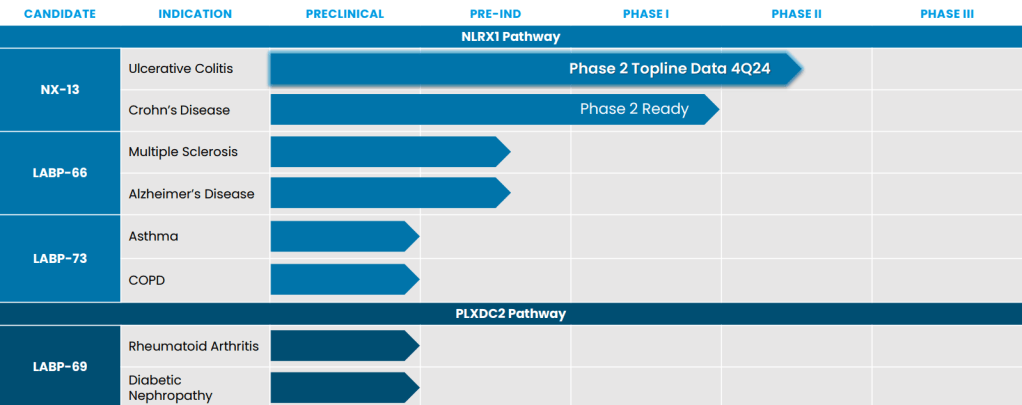
Landos will bring the phase 2 asset NX-13 to the mix, an oral NLRX1 agonist with a bimodal mechanism of action that acts as an anti-inflammatory by facilitating epithelial repair. The biotech is evaluating the treatment in the midstage NEXUS trial in patients with ulcerative colitis (UC). Top-line data are expected in the fourth quarter, according to Landos’ fourth-quarter earnings update issued last week. In addition, NX-13 is being prepped for a phase 2 test in Crohn’s disease.

Also in the pipeline at Landos for the NLRX1 pathway is LABP-66 in multiple sclerosis and other neurodegenerative diseases, plus LAPB-73 in asthma and eosinophilic disorders. The company is studying the PLXDC2 pathway with the early-stage med LABP-69 in rheumatoid arthritis, UC and Crohn’s.

The transaction is expected to close in the second quarter.

2024년 1월에 발표한 Corporate Presentation 자료를 올립니다.

BIOTECH (156) Merck – Should You Start a Chemistry Podcast?

(Picture: Loius-Charles Campeau, PhD, Merck)

Merck Process Chemistry 팀은 자타공인 세계최고의 Process Chemistry Development 팀이라고 자부심도 대단하고 공정화학자라면 다들 일해 보고 싶어하는 회사입니다. 화학만 하는 줄 알았더니 그간 팟캐스트와 유튜브도 하고 있더군요.

재미있는 소재를 Organic Letters 2024년 1월판에 내서 읽어봤는데 흥미롭네요. 몇가지 점이 흥미로웠습니다.

  • Audience가 주로 북미에 있는 대학원생, 포스닥 들이었다고 하는 점이 흥미로웠고요
  • Guest를 활용하는 것이 중요하다고 합니다.

유튜브로 한국어로 화학 얘기나 신약개발 얘기하면 몇명이나 들을까요?

Pharm to Table Podcast – Apple

Pharm to Table Podcast는 현재까지 37개의 에피소드가 올라와 있습니다.

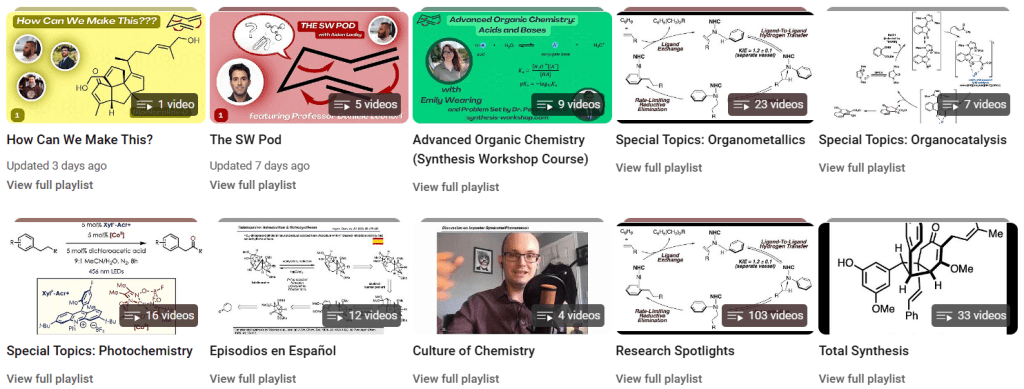
Synthesis Workshop Youtube Video

BIOTECH (155) Stoke Therapeutics: Splicing Up-regulation by Antisense Oligonucleotides

(Picture: Edward M. Kaye, MD, CEO of Stoke Therapeutics)

안녕하세요 보스턴 임박사입니다.

Stoke Therapeutics는 Biogen/Ionis Pharmaceuticals의 Spinraza 개발에 참여한 Adrian Krainer 박사와 Isabel Aznarez 박사에 의해 2014년에 설립되었습니다.

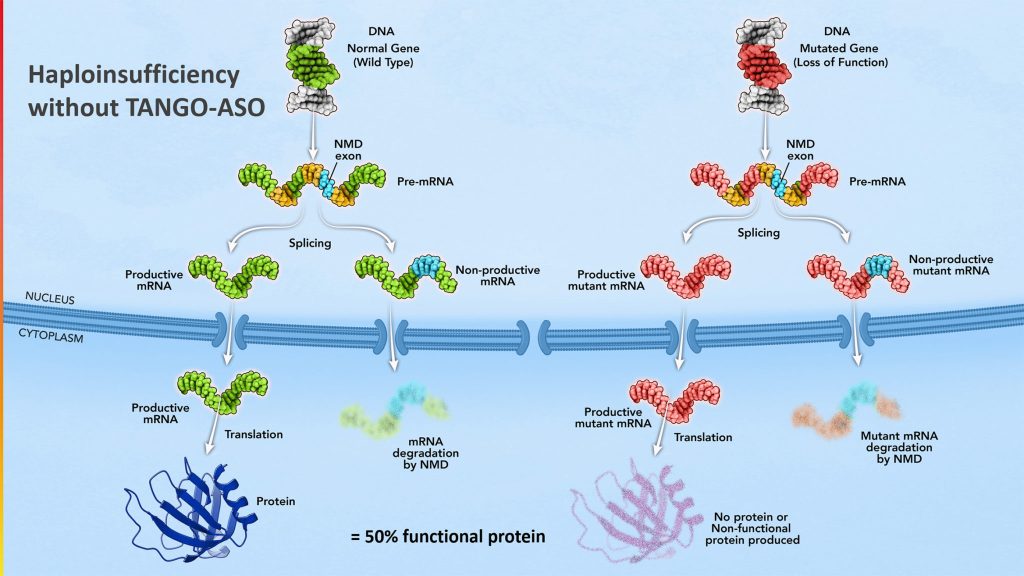
Stoke는 TANGO (Targeted Augmentation of Nuclear Gene Output) Platform에 기반을 둔 Antisense Oligonucleotide 회사입니다. TANGO에 대해서는 2020년 Nature Communications에 발표를 했습니다.

Stoke Therapeutics TANGO
TANGO (Targeted Augmentation of Nuclear Gene Output), Stoke’s proprietary research platform, aims to restore missing proteins by increasing—or stoking—protein output from healthy genes, thus compensating for the non-functioning copy of the gene. [Stoke Therapeutics]

Lead Compound인 STK-001에 대해서는 2020년 Science Translational Medicine에서 Mouse Model을 이용한 PoC 결과를 발표하였습니다.

Stoked About ASOs: Stoke Therapeutics Treats Rare CNS Diseases With RNA-Based Medicines – GEN Edge 11/21/2022

Using their proprietary TANGO (Targeted Augmentation of Nuclear Gene Output) approach, Stoke Therapeutics is developing antisense oligonucleotides (ASOs) to restore protein levels selectively.

For decades, Adrian Krainer, professor at Cold Spring Harbor Laboratory (CSHL), has studied the mechanisms of RNA splicing, how they go awry in cancer and genetic diseases, and how to correct faulty splicing. Krainer’s lab has found that it is possible to stimulate protein production by altering mRNA splicing through the introduction into cells of chemically modified pieces of RNA called antisense oligonucleotides (ASOs).

In late 2016, one such molecule, nusinersen (sold by Biogen under the brand name Spinraza), became the first FDA-approved drug to treat spinal muscular atrophy (SMA) by injection into the fluid surrounding the spinal cord. Nusinersen was conceived and tested over several years in SMA mouse models by Krainer and his CSHL colleagues, in a long-standing collaboration with drug developers led by Frank Bennett PhD at Ionis Pharmaceuticals.

Two years earlier, in 2014, Krainer co-founded Stoke Therapeutics (Nasdaq: STOK) with Isabel Aznarez, PhD, to use their groundbreaking science targeting pre-mRNA splicing to develop precision medicines that treat genetic diseases. Headquartered in Boston, Stoke Therapeutics is a biotechnology company focused on upregulating protein expression with RNA-based medicines. Using a proprietary TANGO (Targeted Augmentation of Nuclear Gene Output) approach, Stoke is developing ASOs to restore protein levels selectively.

Stoke’s initial focus includes haploinsufficiencies and diseases of the central nervous system and the eye, although proof of concept for its proprietary approach has been demonstrated in other organs, tissues, and systems. Stoke’s first compound, STK-001, is in clinical testing for the treatment of Dravet syndrome, a severe and progressive genetic epilepsy. Dravet syndrome is one of many diseases caused by haploinsufficiency (in which a loss of ~50% normal protein levels causes disease).

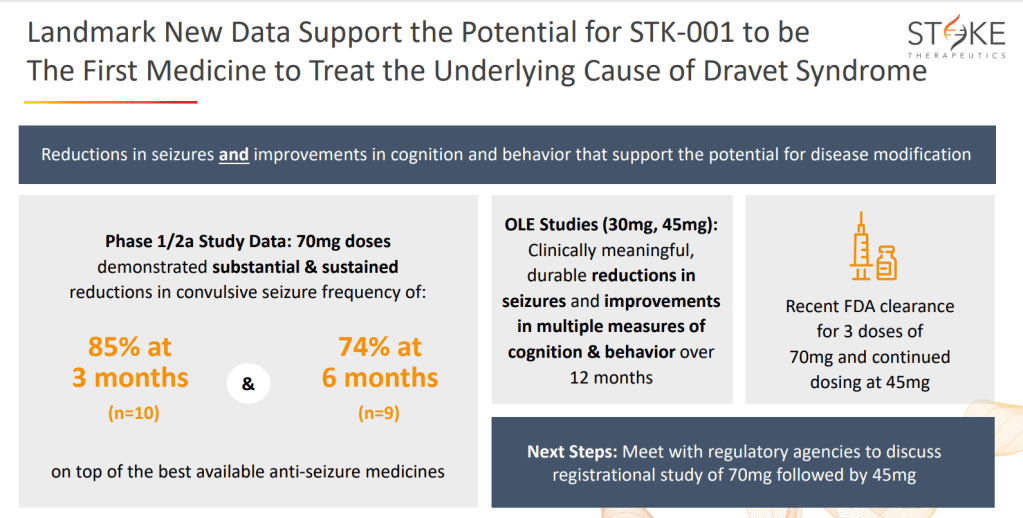
STK-001은 현재 임상1/2a상을 진행 중이고 가장 최근의 데이타는 몇일전에 발표되었습니다. 70mg을 받은 환자들은 3개월간 85%, 6개월간 74%의 높은 확률로 Seizure 빈도가 줄어들었고 30mg, 45mg을 받은 환자들의 경우 12개월간 인지 행동 측정결과 개선되고 Seizure 감소를 보였습니다. 이에 따라 FDA는 3 Dose (70mg, 2 x 45 mg)을 승인했습니다. 이 뉴스에 의해 오늘 주가가 거의 두배나 올랐습니다.

Stoke’s Early-Stage Data for Genetic Epilepsy Drug Sends Stock Skyrocketing – Biospace 3/26/2024

Stoke is also pursuing the development of STK-002 to treat autosomal dominant optic atrophy (ADOA), the most common inherited optic nerve disorder. In August 2022, Stoke enrolled the first ADOA patient in a two-year prospective clinical study.

STK-002에 대해서는 2022년 ASGCT 학회에서 발표한 바가 있습니다.

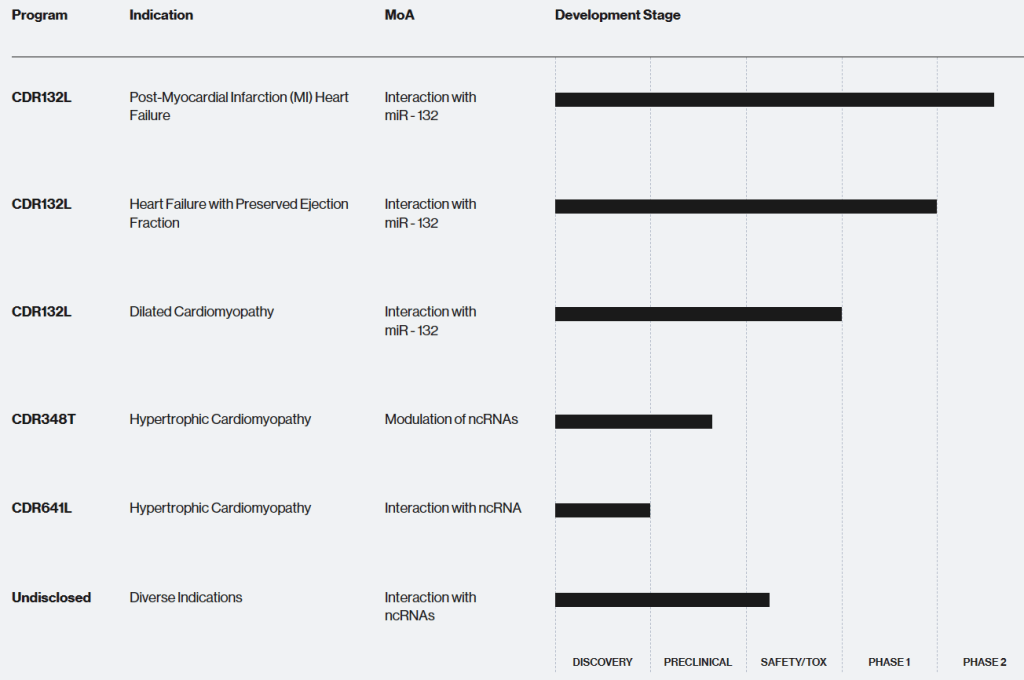
Stoke Therapeutics의 2024년 Corporate Presentation 자료를 올립니다. 현재 파이프라인은 아래와 같습니다. STK-001과 STK-002는 Stoke Therapeutics가 개발하고 Acadia와 공동개발하는 프로그램이 세개가 있습니다. Stoke Therapeutics가 개발하는 STK-001이 임상3상을 향해 가고 있습니다. 지난 10년간의 노력의 결실이 서서히 보이는 것 같습니다.

GEN Edge interviewed CEO and director Edward M. Kaye, MD, to learn how he was brought onto the leadership team at Stoke Therapeutics and the company’s latest progress treating rare genetic diseases with ASOs.

GEN Edge: Edward, what attracted you to be a part of Stoke Therapeutics?

Edward Kaye: I worked with Adrian on the Spinraza program when I was working with Genzyme. I got to know him as a scientist and respected his work. He called me and said we’ve got this new company interested in protein up-regulation using RNA splicing. I realized this is a fascinating approach to upregulating protein.

Most people have thought about upregulating proteins using messenger RNA (mRNA). There’s a lot of interest in mRNA because of vaccine development with Moderna. But one thing that is complicated with mRNA is that it breaks down immediately—all these endonucleases break it down. Getting it delivered into a cell to express a protein was challenging. It worked for things like vaccines because lymphocytes immediately took it up. However, other indications were a lot more challenging. Certainly, gene therapy is a way to upregulate a missing protein permanently. Still, the challenge is to deliver the exact amount of protein in the right cells using the current number of capsids and our gene therapy mechanisms.

This is a good approach to correct autosomal dominant diseases, where you’re missing 50% of the protein (haploinsufficiency). As a pediatric neurologist and biochemical geneticist, this was something that had stymied me. Most of the diseases we worked on were recessive diseases. At Genzyme, we avoided the dominant diseases! But now there’s an approach that we can titrate the exact amount of protein. We can take it from 50% to 100% and hopefully restore that protein and have a biological effect on the disease. It was an interesting opportunity to go after a set of previously difficult diseases.

I decided that this was too interesting of a scientific platform to miss out on, and I joined the company and came in as CEO in 2017. It’s been a fun experience going after new targets, especially since we are focused on rare diseases, most of which are pediatric. It was in my wheelhouse.

GEN Edge: Why go after pediatric CNS diseases?

Kaye: I had taken care of patients with Dravet syndrome and realized this was a challenging disease. I experienced firsthand that it’s more than just a seizure disorder. Dravet syndrome is considered one of the more common genetic seizure disorders. But when you take care of these patients, there’s more than simply seizures. There are other aspects of the disease, such as behavioral problems: sleep, gait, and speech problems. These children reach a period of stagnation in their development; for the first couple of years of life, they seem to be developing quite typically, and then they stop progressing.

That was as upsetting to families as the seizures. The treatments are anti-epileptic, which is fine, and they treat seizures. But they need to address the other aspects. Treating genetic epilepsy by going after the primary genetic cause seemed to be a very reasonable approach. In other words, if you’re missing the sodium channel and could upregulate that sodium channel to get it back up to a hundred percent, it should significantly improve these patients. That was the hypothesis that we had developed. We’re in the clinic now, and we can demonstrate that that is the case.

GEN Edge: How does delivery go into the choice of drug modality for pediatric CNS diseases?

Kaye: One of the reasons why we decided to go after the CNS is that antisense oligonucleotides (ASOs) are indeed quite good, but they don’t get into every organ or every cell type. Adrian had shown with Spinraza that if you deliver ASOs by intrathecal delivery, you get nice biodistribution throughout the brain. So, that was already precedent with the use of Spinraza. We knew we could get into very diffuse parts of the brain by giving an intrathecal administration. It does not work with this particular ASO if you give it systemically because it doesn’t cross the blood-brain barrier. You could get nice delivery into the eye with an intravitreal injection. One of the reasons why we focused on the CNS and the eye was a delivery issue.

That doesn’t mean we wouldn’t go after other organs and diseases. But we would have to have a delivery mechanism that went into those organs and tissues. Stoke has a whole program where we look at different ASO-backbone chemistries for delivery. We’ve looked at conjugation with fatty acids or antibodies. We are exploring and looking at other tissues that have already been demonstrated. One is the kidney. The other tissue is the lung. Others have demonstrated that if you give ASOs by an aerosol delivery, it gets into many parts of the lung. We’ve thought about muscle and heart, but we have to have a different delivery system. Several companies we’ve talked to have systems that might be amenable to us.

We also look at the TANGO signature. Only some genes have the TANGO signature. Specific genes are easy to regulate where you have a lot of RNA messages that are non-productive that you can turn into productive. Each gene and each disease is different. We go through a rigorous process before we decide on a new therapeutic area or target we want to go after.

GEN Edge: How does Stoke Therapeutic manufacture ASOs?

Kaye: We use a couple of contract manufacturers and go through a fairly rigorous process to audit other companies. One nice feature about using ASOs is that there’s been a lot of work done on manufacturing. There are a lot of contract manufacturers that can make these, so we don’t have to manufacture them ourselves. It’s not that complex. It’s not like gene therapy, which is very complicated.

You have to deal with the percentage of empty versus full capsids. Many companies have said this is important, and we have to do it ourselves. But that’s a massive investment. I remember looking at gene therapy when I was at Genzyme. We figured out this’s a half-billion-dollar investment to invest in a manufacturing facility to do it right.

If you can contract out and have quality manufacturers know how to do it, why reinvent the wheel if you don’t have to while spending money. So, that’s a fortunate thing for us that we can use contract manufacturers to make our product. The cost of goods is certainly much less than what you’d have to spend on things like gene therapy, which are costly and difficult to make.

GEN Edge: What milestones does Stoke Therapeutics have in its sights?

Kaye: Dravet syndrome is a major focus right now. We hope to get data from our Phase II that will inform us of the trial design for Phase III. We want to demonstrate proof of concept in humans with Phase II and then go on to Phase III, a placebo control study for registration and commercialization. That’s step number one.

We also plan to be in the clinic with our next program next year. That would be for dominant optic atrophy, the leading genetic cause of optic atrophy. This is similar to Dravet in that it’s a nonsense mediate decay (NMD) exon. You’re missing 50% of the OPA1 protein —an essential protein for mitochondrial function and structure.

These children are born with normal vision. Then, somewhere at the end of the first decade of life, typically in school when they have a vision test, they find out that their vision is affected and can’t be corrected by glasses. It’s a non-refractive error. Then you get sent to an ophthalmologist or a neuro-ophthalmologist, and somebody picks up that there’s optic atrophy, which is just a whiteness or a power of the optic nerve. Because these retinal ganglion cells are very energy dependent, they slowly die. But it’s a very slowly progressive process that takes decades.

If somebody finds out they have optic atrophy and are unsure why, they can undergo standard testing. People are currently being tested and explicitly diagnosed with autosomal dominant optic atrophy. But again, we’ve demonstrated recently that you can get the ASOs into those retinal ganglion cells. More importantly, we’ve shown that we can regulate protein very nicely—and even more importantly, we can improve oxidative phosphorylation in these cells. It is a good demonstration that we can get the ASO where we want it to be, and it has an effect. We like that one and expect to be in the clinic next year with that program and move that along.

We also have a collaboration with Acadia. That’s a program where we have three targets that we’ve identified, two of which we’ve announced publicly. One is Rett syndrome—a fairly common progressive disease that includes not only epilepsy but also autistic spectrum and a neurodevelopment problem. The other is genetic epilepsy. But more importantly, it has a big neurodevelopmental component to it. With both or at least one of these programs, we’d like to address some of these progressive diseases’ neurologic problems.

Rett syndrome is very similar. There are affected girls, and there could also be more severely affected boys that appear normal. In the first few years of life, they start to have these atypical movements in this progressive autistic spectrum disorder. There’s certainly evidence in mouse models that you probably can arrest this progression again if you can replace that protein, MECP2, which is a critical protein for brain function. That would lead to [therapeutic programs for] not only epilepsy but nerve developmental disorders.

There’s a host of haploinsufficient diseases that affect cognition, so that could be a fascinating area for us too. Nobody has cracked that. No one has gone after these developmental disorders. Based on animal work, we now know that it’s not all prenatally determined that this disorder continues to progress. Especially something like Rett syndrome, where these girls are quite normal at birth and then seem quite normal for four to six years, and then suddenly have this deterioration. So if you can identify these early, I think we could also affect some of these symptoms.

This has been a challenging time for small- and mid-cap companies, but we saw this coming two years ago, I thought it would happen a year earlier, but we went public, did financing, and used our at-the-market (ATM) offering. Part of it was to develop a war chest to survive the downturn. We have enough cash to get us into 2025, which is a nice position. We’re not worrying about running out of money. We’re just focused on trying to ensure we do the best science.

Antisense player Stoke Therapeutics picks up $40M series A – Fierce Biotech 1/4/2018

Stoke Therapeutics completed a series A round to support the development of its antisense approach to boost gene expression and treat disease caused by genetic insufficiency.

Apple Tree Partners ponied up the $40 million, which will drive Stoke’s antisense oligonucleotide preclinical development programs. The company’s focus is upregulating RNA splicing to ramp up production of messenger RNA that can be translated into protein.

“Stoke Therapeutics represents a bold step forward in opening up a vast new area of drug development focused on upregulation of gene expression,” new CEO Ed Kaye, who takes the helm in the briefest of periods after leaving his former DMD biotech Sarepta, said in a release. “By restoring gene dosage using target-specific antisense approaches, we have the opportunity to create a new way of treating diseases that are not amenable to enzyme replacement, gene therapy or other existing modalities.”

Stoke licensed its tech, dubbed Targeted Augmentation of Nuclear Gene Output (TANGO), from scientific founder Adrian Krainer of Cold Spring Harbor Laboratory.

Our plan for 2018 is to identify at least three preclinical programs that we can bring for IND studies in 2019,” Kaye said.

“Right now, we are focusing on the central nervous system,” he said. “We are looking at some of the genetic epilepsies and also some of the autosomal dominant forms of blindness. … We are looking at other organs, but those [programs] are not as well-developed at this time.”

The company will initially zero in on diseases caused by a single malfunctioning gene, but TANGO could potentially be used to modulate a nonmutated gene in order to halt or reverse disease progression, the company said.

We’re focusing on smaller indications and on organs we think we can handle as a small company, but I think the potential for this platform could be much larger,” Kaye said.

“We are tremendously impressed by the broad potential of this approach to address so many debilitating diseases and have assembled the team, platform and funding to thoroughly exploit this opportunity,” said Seth L. Harrison, M.D., founder and managing partner of Apple Tree Partners and chairman of the Stoke board of directors.

Stoke joins Atlantic Healthcare and Ionis Pharma in the antisense field. The former kicked off a rolling FDA submission for its inflammatory bowel disease candidate in May, while the latter recently licensed a second gastrointestinal antisense drug to J&J’s Janssen.

Stoke Therapeutics nabs $90M series B for oligonucleotide work – Fierce Biotech 10/23/2018

Stoke has completed a meaty $90 million second funding round as the startup eyes getting its leading candidate into the clinic by 2020.

The Bedford, Massachusetts-based biotech said it will also push on with work across its pipeline of antisense oligonucleotide medicines in other severe genetic diseases.

The financing round was led by RTW Investments with help from founding investor Apple Tree Partners. New investors include RA Capital Management and Cormorant Asset Management, as well as a host of others.

This builds on the $40 million series A it grabbed back at the start of the year. Stoke licensed its tech, dubbed Targeted Augmentation of Nuclear Gene Output (a.k.a. TANGO), from scientific founder Adrian Krainer of Cold Spring Harbor Laboratory.

Stoke said it has “identified thousands of genes that could be addressed” by its TANGO tech, which targets nonproductive RNA splicing to increase gene expression, aimed at getting to the heart of monogenic diseases caused by loss or reduction of gene function.

The company said it is “rapidly advancing” its lead program in Dravet Syndrome, a rare, lifelong form of epilepsy that begins in the first year of life with frequent and/or prolonged seizures. Current treatment options are limited, and patients with Dravet face a 15-20% mortality rate, according to the Dravet Syndrome Foundation.

Its early-stage pipeline also includes drugs targeting other diseases of the central nervous system, as well as diseases of the eye, ear, liver and kidney.

“Our technology is designed to address, for the first time, the genetic cause of diseases like Dravet Syndrome so we can do more than alleviate symptoms—we can potentially prevent the long-term disabling consequences of these diseases,” said Ed Kaye, M.D., CEO of Stoke, and former Sarepta chief. “We are delighted to have the support of such an outstanding group of crossover investors to speed our progress toward the clinic.”

Stoke joins Atlantic Healthcare and Ionis Pharma /Akcea in the antisense field, with the latter getting approvals earlier this year for its effort in Tegsedi (inotersen injection), an antisense oligonucleotide for certain patients with the rare disease hereditary transthyretin amyloidosis (hATTR), as well as Biogen’s SMA drug Spinraza.

Stoke Therapeutics raises $163.3M in Nasdaq IPO – S&P Global 6/21/2019

Stoke Therapeutics Inc. closed its planned IPO on the Nasdaq Global Select Market, raising gross proceeds of about $163.3 million.

The company sold 9,074,776 shares at $18 apiece, including 1,183,666 shares that were sold upon full exercise of the underwriters’ option.

The Bedford, Mass.-based company started trading on the Nasdaq under the ticker STOK on June 19.

Stoke Therapeutics has said earlier that it would use the proceeds for a phase 3 clinical development of its lead product candidate STK-001 to treat Dravet syndrome, a type of epilepsy with seizures often triggered by high body temperatures or fever. The funds would also go toward conducting preclinical studies for other product candidates.

J.P. Morgan Securities LLC, Cowen and Co. LLC and Credit Suisse Securities (USA) LLC acted as joint book-running managers, while Canaccord Genuity LLC acted as lead manager for the offering.

BIOTECH (154) Cardior Pharmaceuticals: micro RNA Oligonucleotides Targeting Cardiology

(Picture: Thomas Thum, MD, PhD, Professor of Hanover Medical School, Co-Founder, CSO, CMO of Cardior Pharmaceuticals)

안녕하세요 보스턴 임박사입니다.

micro RNA (miRNA)가 다시 돌아왔습니다. Antisense Oligonucleotide, siRNA와 함께 주목을 받았지만 miRNA는 임상에서 성공하지 못하고 속수무책으로 미국의 miRNA 바이오텍이 스러져 갔습니다. 그런데 이런 와중에도 독일 하노버에 있는 Cardior Pharmaceuticals GmbH는 2016년에 설립된 이래 꾸준히 연구를 지속해서 마침내 임상2상까지 좋은 약물을 만들어낸 것으로 인정되어 오늘 Novo Nordisk에 인수된다는 발표가 났습니다. 정말 꿈인지 생시인지 알 수가 없군요.

Cardior Pharmceuticals는 Hanover Medical School 교수인 Thomas Thum 박사의 오랜 miRNA 연구결과를 바탕으로 CEO인 Claudia Ulbrich박사와 공동으로 2016년에 창업되었습니다.

Thomas 교수는 mir-212와 mir-132가 항암제인 Doxorubicin으로 인한 Atrophy와 Cardiotoxicity를 줄인다고 보고한 연구결과를 Molecular Therapy 2019년에 발표했습니다.

Cardior의 접근법은 두가지 점에서 기존의 miRNA 회사들과 차이가 있습니다.

  • Oligonucleotide Chemistry에서 LNA (Locked Nucleic Acid)를 사용해서 효과와 안전성을 높였습니다.
  • 200여마리의 돼지 (Porcine) 동물모델을 이용해서 임상시험을 지지할 훌륭한 전임상 데이타를 확보했습니다.

PCT 2020/249713 Al에 따르면 CDR132L의 구조는 아래와 같습니다. 5’부터 염기 하나씩 건너서 LNA가 있고 Phosphorothioate linkage로 연결되어 있는 16-mer Oligonucleotide입니다.

Thomas Thum 교수의 연구실적에 대해서는 Fraunhofer 연구소에서 2021년에 게재한 바가 있는데 Cardiology와 RNA Biology 분야의 탄탄한 연구업적이 있는 과학자라고 소개가 되었습니다.

Fraunhofer Institute Director Prof. Thomas Thum is one of the most highly cited researchers worldwide – Fraunhofer Institute Press 11/23/2021

For the second time already, Prof. Dr. Dr. med. Thomas Thum is one of the most frequently cited scientists worldwide. Once a year, the U.S. company Clarivate Analytics reports which publications in a particular discipline are among the one percent that have been cited most. Thomas Thum is a specialist in cardiology and bioscience, with a clear research focus on the functional characterization and translational potential of therapeutic RNA strategies, and his publications have had a major impact on the progress of cardiac research.

Citations are the most important currency in the world of science. Results published by scientists in peer-reviewed journals can be used by other researchers for their own work, as long as they are clearly indicated as citations. The number of citations, however, is not the only indicator of the impact of a scientist: the reputation of the journal in which an article is published also plays an important role – and so it does in the evaluation criteria applied by Clarivate Analytics.

Thomas Thum is one of the most important pioneers of RNA-based therapeutics. With his team at the Hannover Medical School he was the first to successfully test an RNA compound for the treatment of heart failure patients in a clinical trial. He joined the Fraunhofer Institute for Toxicology and Experimental Medicine ITEM in Hannover (Germany) as institute director on January 1, 2021 and has since been managing this institute together with Prof. Norbert Krug. “To be a part of the global Who’s Who of science is really a great honor for me and makes me very happy,” Thum commented on this success. “I am quite optimistic that patients will soon be able to benefit from the findings of our research in clinical practice.” Prof. Thum is listed in the “Cross Fields” category, indicating that his work has an impact on science beyond his actual field of research.

For a complete list of the most highly cited researchers, please refer to the Internet page of Web of Science: https://recognition.webofscience.com/awards/highly-cited/2021/

Cardior Pharmaceuticals는 설립 후 1년이 지난 2017년에 EUR 15 Million ($17 Million) Series A를 했습니다. 이 때 Boehringer Ingelheim과 BMS가 참여했습니다.

Cardior Pharmaceuticals raises €15 million in series A financing – Bionty 5/11/2017

Cardior Pharmaceuticals, a spin-off from Hannover Medical School (MHH), today announced the completion of a €15 million Series A financing round led by LSP (Life Sciences Partners), Boehringer Ingelheim Venture Fund (BIVF), Bristol-Myers Squibb (BMS), BioMedPartners (with its new BioMedInvest III Fund) and High-Tech Gründerfonds (HTGF). Cardior is pioneering its proprietary RNA technology to revolutionize predicting and treating heart failure. The molecular targets are non-coding RNAs linked to heart failure development that simultaneously control cardiac growth and calcium handling/contractility of cardiomyocytes. The targeting of certain specific non-coding RNAs reverses maladaptive cardiac remodeling and restores normal cardiac function.

“It is a rare opportunity to develop cutting-edge science in the area of cardiovascular diseases with a high unmet medical need. I am delighted to join Cardior at this exciting development stage of the company and together with its motivated team, quickly put on the map a novel class of drugs and companion diagnostics with the potential to prevent and overcome heart failure” said Dr. Claudia Ulbrich, Chief Executive Officer of Cardior.

“The significant funding raised at this stage of development of the company will provide the resources for an ambitious development plan for our lead compound,” added Prof. Thomas Thum, who is joining the management team as Chief Scientific Officer.

“We are very excited to be leading this financing” said Dr. Joachim Rothe, Managing Partner at LSP and a Director of Cardior. “There has been a painful lack of scientific and clinical progress in the cardiovascular field for the past 15 years, and Cardior is well positioned to change this.”

2019년에 BioWorld에서 Cardior에 대해 기사가 나온 바가 있습니다. 이 때 이미 200마리의 돼지 동물실험으로 얻은 전임상 결과를 얻은 것으로 얘기를 하고 있습니다.

2020년 Nature Communications에 Anti-miR-132 Oligonucleotide인 CDR132L의 전임상 결과를 발표했습니다. 200마리나 되는 돼지를 대상으로 광범위한 동물실험 결과를 얻었습니다. 돼지는 인간과 심장의 크기 등이 유사해서 Gold Standard로 하는 동물모델입니다.

그리고 2021년 Journal of American College of Cardiology에 돼지 동물 모델을 통해서 CDR132L이 Myocardial Hypertrophy를 감소시킨다는 사실을 증명했습니다.

2021년에는 Biocentury에서 Cardior에 대한 기사가 나왔습니다. 이 때는 CDR132L의 임상1상을 끝내고 임상 2상을 준비한다고 얘기를 했습니다.

같은해에 $76 Million Series B를 했습니다. 이 펀딩으로 CDR132L의 임상2상을 수행할 수 있고 새로운 후속 파이프라인을 개발한다는 계획이었습니다. 유럽에서 이 정도 규모의 펀딩은 흔치 않은 규모입니다.

Cardior Raises €64M Series B to Advance Clinical Pipeline of RNA Therapeutics to Treat Cardiac Disease – Business Newswire 8/25/2021

HANOVER, Germany–(BUSINESS WIRE)–Cardior Pharmaceuticals, a clinical-stage biotech company developing non-coding RNA (ncRNA)-based therapeutics for patients with cardiac diseases, announced today the closing of a €64 million ($76 million) Series B financing round. The round was led by Inkef Capital, supported by fellow new investors Fund+, Sunstone, Hadean Ventures and Coparion with participation from existing investors including LSP, BioMedPartners, Bristol Myers Squibb and High-Tech Gründerfonds.

We believe ncRNAs can fundamentally change the treatment of heart disease by preventing, repairing and reversing damage to cardiac tissue. We thank our new and existing investors for their support and their confidence in our ability to achieve our goal,” said Dr. Claudia Ulbrich, Chief Executive Officer and Co-Founder of Cardior“This substantial funding, provided by leading biotech investors, validates the strength of our RNA approach and our team. We welcome our new directors and look forward to working closely with our board as we continue our rapid progress toward the start of the Phase 2 trial with our lead program CDR132L, which has the potential to demonstrate clinical proof-of-concept as a transformative heart disease treatment and to set the stage for the emergence of a new class of medicines.”

In conjunction with the financing, representatives from Inkef Capital, Fund+ and Sunstone will join the Company’s Advisory Board. The full composition of the Board can be found under the following link.

The Series B proceeds will be used to fund the late-stage clinical development of Cardior’s lead program and the expansion of the company’s earlier-stage pipeline. Lead candidate CDR132L is an oligonucleotide-based ncRNA inhibitor targeting micro-RNA-132. micro-RNAs are endogenous molecules that function as cellular regulators and their dysregulation contributes to the development of many diseases including cardiovascular diseases. Cardior’s lead program is intended to block the abnormal cardiac levels of micro-RNA-132 in heart failure patients thereby triggering a concerted therapeutic effect against key hallmarks of heart disease including cardiac hypertrophy, fibrosis, impaired contractility and reduced vascularization. Cardior’s approach is applicable to a broad range of heart diseases as represented in its development pipeline, which addresses large cardiac indications as well as rare diseases such as hypertrophic and dilated cardiomyopathies.

“Heart diseases are the leading cause of death worldwide, causing a massive burden on patients, their families and global healthcare systems,” added Dr. Simone Botti, Junior Partner at Inkef. “Cardior’s RNA approach has shown an encouraging safety and efficacy profile in its initial clinical read-out and has the potential to provide a true disease modifying therapy to patients. We are excited to support Cardior on its continued progress advancing the first ncRNA-therapeutic towards commercialization.”

“Cardior is on an exciting trajectory which is reflected in the Series B syndicate. I look forward to working with the incoming investors as we leverage the current momentum in the RNA therapy field to position Cardior for success,” said Dr. Karin Kleinhans, Partner at LSP.

***

About CDR132L

CDR132L is a highly stable water-soluble oligonucleotide ncRNA inhibitor directed to block aberrant micro-RNA-132 levels and thereby reverses the cellular pathology and restores normal function in cardiomyocytes, contributing to improved cardiac systemic and diastolic function in patients with heart failure (HF). CDR132L has completed Phase 1b development demonstrating a favorable safety profile and beneficial cardiac effects in 28 HF patients. Cardior is currently initiating a Phase II clinical trial of the antisense drug.

About Cardior

Cardior Pharmaceuticals is a leading clinical-stage biopharmaceutical company pioneering the discovery and development of RNA-based therapeutics designed to prevent, repair and reverse diseases of the heart. Cardior’s therapeutic approach uses distinctive non-coding RNAs as an innovative platform for addressing the root causes of cardiac dysfunctions. The company aspires to bring transformative therapeutics and diagnostics to patients and thereby make a lasting impact on the treatment of cardiac diseases worldwide.

About INKEF Capital

INKEF Capital is a venture capital firm based in Amsterdam, backing promising early-stage companies in Europe. INKEF takes pride in being a patient, long-term investor with the ability to support companies through several rounds of funding. From the early stages of a technology or life science venture, INKEF Capital supports entrepreneurs building their ideas into successful international businesses. For more information, please visit: https://www.inkefcapital.com/.

About LSP

LSP is one of the largest European investment firms providing financing for life sciences and health care companies. LSP’s management has raised over €2.7 billion ($3.2 billion) and supported the growth of 300 companies since it started to invest in 1988, including signature deals such as argenx, Crucell and Neuravi. With offices in Amsterdam, Munich and Boston, LSP currently has the possibility to invest through five strategies, each having a distinctive investment scope and a dedicated team: LSP 6 invests in private early- to late-stage drug development and medical technology companies; LSP HEF 2 focuses on private late-stage medical technology companies; the LSP Dementia Fund invests in companies targeting neurodegenerative diseases; LSP Public targets public healthcare companies; and EBAC is the first healthcare SPAC to exclusively focus on European biotech. LSP is an active contributor to the global life sciences industry and the European life science eco-system by assuming for-profit and not-for-profit roles as initiators, founders and board members in various private and public bodies and organizations, for example being founder and board member of the Oncode Institute. For more information: lspvc.com.

올해 2월에 있었던 학회에서 Thomas Thum 박사는 Cardior Pharmaceuticals의 CDR132L을 중심으로 Corporate Presentation을 발표했습니다.

임상 1b에서 NT-proBNP의 레벨이 23.3%의 감소를 보였고 placebo는 반대로 0.9% 상승했습니다. HFrEF subpopulation결과는 -37.1% vs +17.7% (placebo)로 격차가 더 큽니다.

이 발표 후 한달이 지난 오늘 Novo Nordisk는 $1 Billion에 Cardior를 인수한다고 발표했습니다. 지금 Novo는 GLP-1 당뇨병 및 비만치료제가 성공해서 자금 여력이 있지요. 그동안은 당뇨병 전문제약회사였는데 이제 심장병 분야도 진출하기 위해 노력하고 있습니다. 현재 IL-6 inhibitor ziltivekimab 의 임상3상이 진행 중입니다. Novo 입장에서는 First-in-class인 CDR132L의 가능성을 본 것 같습니다.

Novo Nordisk inks $1B Cardior buyout to pump up heart failure plans – Fierce Biotech 3/25/2024

Novo Nordisk is pumping up its heart failure plans. The drugmaker, swelled by its GLP-1 windfall, has decided to buy Cardior Pharmaceuticals and its midphase prospect in a deal that could top out above 1 billion euros ($1.1 billion).

Cardior is developing an antisense oligonucleotide to inhibit a piece of non-coding RNA, miR-132, that is implicated in heart failure. Upregulation of the RNA when certain cells are stressed can lead to changes in the size and shape of the heart. Blocking elevated miR-132 could therefore prevent or reverse changes that are associated with poor prognosis in patients who have heart attacks.

The biotech raised 64 million euros from investors including Bristol Myers Squibb in 2021 and used the cash to take (PDF) its oligonucleotide, CDR132L, into a phase 2 trial the next year. Cardior has designed the 280-subject study to show CDR132L’s effect on the volume of blood in part of the heart.

Cardior is still months away from the primary completion of the study, according to ClinicalTrials.gov, but Novo Nordisk is already planning to expand development. The Danish drugmaker plans to run another phase 2 trial in chronic heart failure patients with cardiac hypertrophy, a condition that negatively affects the heart’s ability to pump blood.

CDR132L will slot into a pipeline that already features heart failure programs. Novo Nordisk reported clinical trial data on semaglutide, the active ingredient in Ozempic and Wegovy, in heart failure patients last year. The company is running a phase 3 trial of the IL-6 inhibitor ziltivekimab in a heart failure patient population and is working with Heartseed to test a cell therapy in an early-phase study. 

Novo Nordisk moved to buy Cardior after identifying CDR132L as a molecule with “a distinctive mode of action” that has the “potential to become a first-in-class therapy designed to halt or partially reverse the course of disease for people living with heart failure.” Advances in the treatment of heart failure have so far largely focused on managing the symptoms. CDR132L could address the underlying causes.

The potential for CDR132L to provide long-lasting improvement in heart function led Novo Nordisk to put together an offer worth up to 1.025 billion euros for Cardior. The package includes an upfront payment and milestones, but neither party has provided a breakdown of the deal.

현재 홈페이지에 나타난 파이프라인은 아래와 같습니다. CDR132L은 세가지 임상이 진행 중이고 그 이외에 세개의 전임상 물질을 보유하고 있습니다. CDR132L이 승인까지 간다면 세계 최초로 승인되는 miRNA 약물이 됩니다. 정말 기대가 되는군요.

Bucket List (36) Art Conservator

(Picture: Museum of Fine Arts Houston – Art Conservation)

안녕하세요 보스턴 임박사입니다.

Science와 Art를 좋아하는 제가 오늘 논문을 찾아보다가 Art Preservation이라는 것을 배웠습니다. Biocide라고 불리는 산업용 항균제를 이용해서 그림이나 조각품들의 부패를 방지한다는 것도 알게 되었습니다. 제가 오래전이지만 Biocide 연구를 한 적도 있어서 전혀 문외한인 분야도 아닙니다. Art Conservation이라는 분야는 미국이나 유럽에서는 많이 하는 분야입니다. 이 분야가 저와 같이 Organic Chemistry 분야 전문가가 Technical 분야에서 중요하고 또 한분야는 Art를 배워야 합니다.

그래서 가장 이상적인 사람이 Art와 Chemistry Double Major를 한 사람이라고 합니다. 아마 Art Conservator로 일을 하려면 Art 공부를 해야할 것 같습니다. 한번 Art 공부는 해보고 싶은 마음이 있어서 어려울 것도 아닙니다. Skill Share라는 사이트에 Art Conservator 에 대해 좀 상세히 나와 있습니다.

How to Become an Art Conservator – Skill Share 5/27/2022

Ever wondered how paintings and sculptures from hundreds, if not thousands, of years ago still look so pristine, like they were only created a few weeks ago? Well, we have art conservators to thank for that.

If you have a passion for art and history, working as an art conservator could be a rewarding career option. We’re here to give you the rundown on what the job actually involves, the type of background you need to work in the industry, and how to become an art conservator for museums and private collections around the world.

What Is an Art Conservator?

Conservation work is all about preserving pieces of our collective history and culture so that future generations can enjoy them as much as we do. When we’re thinking about what art conservation is, the primary function is to stop artwork from degrading as a result of aging, damage, or environmental changes and to keep it as close to its current state for as long as possible.

Art conservators are crucial members of a gallery or museum’s behind-the-scenes team, responsible for the maintenance, storage, handling, and display of the collection of work to ensure that no further damage impacts the pieces.

Working as an art conservator shouldn’t be confused with the role of an art restorer. While the professions are similar, restoration is considered to be a sub-field of conservation. A restorer focuses their attention on correcting flaws or bringing a piece of art back to its original form after it’s been damaged. The goal is to ensure that no one would ever know that it wasn’t in its perfect, original condition.

Conservation, on the other hand, is about preserving the existing state, protecting against damage, and delaying any inevitable aging that might happen. 

What Does an Art Conservator Do?

So what do art conservators do in their day-to-day work? Most art conservator jobs are in museums, which means working with hundreds of different pieces of historically significant art, whether that’s photographs, paintings, sculptures, or ceramics. From monitoring the works that are currently on display to the public to addressing those that are being housed in storage, art conservation is an ongoing process that requires plenty of attention to detail.

Many conservationists have a particular focus in their work. Some choose to specialize in paper conservation (which can include both paintings and other types of paper sources like books, letters, or maps), while others may work with a handful of stoneware pieces like marble sculptures, pottery, or woods and metals.

While there are plenty of different tasks that conservation specialists do, most art conservator job descriptions will outline similar requirements like:

  • Gathering information about how a piece of art was made, determining what could be causing any environmental damage to the work, and coming up with a plan to prevent further degradation.
  • Undertaking specialized conservation techniques and practices to keep artwork in its current condition.
  • Working with the rest of the restoration and conservation team to determine the appropriate conditions for storage, handling, or display—this could include things like making sure harsh lights aren’t being placed directly over a painting on display or keeping a piece of wooden art in a temperature-controlled case.
  • Monitoring pest management systems to ensure that works of art aren’t exposed to damaging insects that could ruin a piece beyond repair.
  • Planning and coordinating with senior team members on emergency preparedness plans and providing solutions for removing and transporting artwork in an emergency situation, without causing any unnecessary or lasting damage.

Some art conservators may also supervise other members of the conservation team, including restoration experts and trainee conservationists.

Degree and Education Requirements

As art conservation is such a unique field, it’s almost impossible to find a job without an advanced art conservation degree.

At the undergraduate level, most art conservators complete either an art degree or go straight into the technical side of things with a chemistry degree. Combining these fields into a double major can be even more beneficial and help you to get accepted into prestigious master’s level art conservation degree programs.

Having a comprehensive understanding of physical sciences, particularly in how different materials function and operate in various environments, is a crucial part of the job. 

cleaning painting
Source: instagram
Cleaning artwork with special chemicals is one of the most common tasks of conservation. (Via 
@jessie.carter.conservator)

While an interest in art is obviously helpful, knowing the science behind why materials are behaving in certain ways will be invaluable throughout your career as a conservator. Almost all advanced degrees in this field require you to have taken at least several classes in chemistry, organic chemistry, and trigonometry in order to be eligible for their master’s level classes.

Since the educational process can be quite lengthy, finding experience where you can work alongside your studies will always be helpful. Try to find volunteering or part-time work in a museum or archive. These contacts can be incredibly useful when you’re looking for full-time employment and will help you to decide which kind of work environment might be best suited to your skills.

Apprenticeships

Whether you have a background in both art and science, or choose to pursue a chemistry degree alone, you will also need a significant amount of practical experience to become an art conservator. Even if you’ve managed to work part-time in a museum during your studies, that’s not enough to get you more than a foot in the door.

As part of most art conservation degrees, you’ll work as an apprentice for an existing conservator for anywhere between 400 and 4,000 hours over the course of your program. This will give you the hands-on experience that you need in order to qualify as an art conservator.

This level of advanced training is the perfect way to test out everything you’ve been learning in the classroom, all while under the careful supervision and guidance of someone who’s been there before. You will work with them on real projects and pick up the techniques needed to have a long and successful career.

Average Art Conservator Salary

You’re probably wondering, “With such a specialized set of skills, how much does an art conservator make?” 

The vast majority of conservators are employed by galleries and museums in full-time positions, so their average salary reflects the stability of their role and the specialized training that they’ve had to work in these positions. 

The average salary for a conservator is around $53,208 according to Glassdoor, but can be up to $86,000 for more senior levels and at museums or galleries in major cities.

Art Conservation Jobs

Art Galleries, Museums, and Archives

The most common employment route for art conservators is in museums, art galleries, or archives. But don’t just think about places like the National Gallery, the Met, or a Smithsonian museum. Even smaller, local museums often own significant amounts of artwork that needs caring for.

conservator with goggles on
Source: instagram
Conservators with different specialties will be responsible for various types of artwork. (Via 
@chiara.restoration)

Depending on the size of the museum or gallery that you work for, you may be one of a number of conservators and curators who look after both the permanent and temporary collections. In larger museums, there are usually several conservationists who all specialize in different materials. 

You’ll work both individually and collaboratively, especially if an artwork is made from several types of materials—for example, a painting might be done on paper but displayed on a wooden canvas or within an ornate wooden frame that needs just as much attention as the painting itself.

If you dream of working with some of the world’s most famous paintings and sculptures, this type of work is your best opportunity to do so. But that also makes these positions very competitive. Attending a top degree program with a track record of helping graduates secure work at larger galleries and museums is key. 

Private Collections

Museums and galleries aren’t the only places that are home to priceless and, often, very old artwork. Private art collectors often hire conservation specialists to assist them in caring for pieces of art in their own homes or offices. 

ficing painting
Source: instagram
Art conservators ensure that pieces are cared for, wherever they may be stored or displayed. (Via 
@conversationconservation)

This is quite common in historic buildings, even those that aren’t open to the public, and the conservator will work with the other members of the maintenance team to ensure that any artwork is being taken care of correctly.

Some private collectors may also hire art conservators on a temporary basis to help with the transportation and storage of artwork during house moves or relocations or if a new piece is being added to their collection. 

Particularly if the collector is purchasing a very expensive or old piece of art, having experts on hand to ensure that it arrives safely and is preserved in the right condition is worth every penny.

Keep Our Cultural Heritage Preserved

We learn so much from those who have come before us. Working to ensure that future generations can enjoy art from centuries ago and conserve the hard work of the world’s best artists is an incredibly satisfying job.

BOSTONIAN (43) – Moving 고윤정님의 노력에 박수를 보내며…

안녕하세요 보스턴 임박사입니다.

요즘 막내의 대학입시 결과를 초조하게 기다리면서 함께 시간을 좀 보내고 싶은 마음이 있었는데 큰딸이 추천을 해 주어서 “무빙 (Moving)”이라는 20부작 드라마를 함께 볼 수 있었습니다.

드라마라고 하기엔 쟁쟁한 영화배우들이 나오는 이 드라마의 신인 연기자들의 부담감도 만만치 않았을까 싶은데요 특히 류승룡님의 딸 “장희수”라는 캐릭터를 연기한 고윤정님의 연기에 저는 박수를 보내고 싶었습니다. 류승룡님과의 Chemistry도 좋았고 상대역이었던 “김봉석”을 연기한 이정하님과의 Chemistry도 아주 좋았다고 생각합니다.

특히 장희수의 주특기가 달리기 선수여서 정말 뛰는 Scene이 많았는데요 열심히 뛰는 모습을 보며

“참 힘들었겠다!”

하는 생각이 많이 들었습니다. 하지만 몸을 사리지 않고 정말 열심히 해 주어서 보는 저희들은 몰입이 정말 잘 되었습니다.

이런 판타지물은 사실 연기를 어설프게 하면 만화처럼 보이기가 쉽상인데요. 특히 강풀님의 웹툰만화를 영화로 한 것이기 때문에 연기자들의 실력이 정말 중요했는데 정말 잘 소화해 주신 것 같아서 많이 기뻤습니다.

좋은 드라마와 영화 등에 많이 나와서 좋은 배우자로 오래오래 연기해 주기를 바랍니다.

‘무빙’ 고윤정 “연기 칭찬, 행복해…처음으로 인정받아” [인터뷰] – 머니투데이 8/25/2023 김나라 기자

'무빙' 고윤정 "연기 칭찬, 행복해…처음으로 인정받아" [인터뷰]/
(사진=월트디즈니컴퍼니 코리아)

기대주’ 고윤정(27)이 디즈니+ 오리지널 시리즈 ‘무빙’으로 인생 캐릭터를 탄생시키며 대세 배우로 떠오르고 있다.고윤정은 지난 2019년 드라마 ‘사이코메트리 그녀석’으로 데뷔, 최근 가장 핫하게 주가를 올리고 있는 대세 중의 대세다. 넷플릭스 ‘보건교사 안은영’ ‘스위트홈’, 드라마 ‘환혼: 빛과 그림자’ ‘로스쿨‘ 그리고 이정재의 감독의 연출 데뷔작 ‘헌트’ 등에서 빼어난 미모와 안정적인 연기력으로 단박에 대중의 눈도장을 찍으며 빠른 성장세를 보였다.
특히 고윤정은 인기리에 스트리밍 중인 ‘무빙’에서 초능력을 지닌 체대 입시생 장희수로 완벽 변신, 눈부신 존재감을 뽐내고 있다. 그는 아빠 장주원(류승룡)과 훈훈한 부녀 관계부터 남사친(남자 사람 친구) 김봉석(이정하)과 풋풋한 케미까지 다채로운 활약으로 극에 재미를 높였다.
또한 물오른 연기력으로 상처를 입어도 다시 재생, 치유되는 초능력을 가진 인물을 설득력 있게 표현하며 전 세계 시청자들을 사로잡았다.고윤정 스스로도 장희수와 높은 싱크로율을 자랑, 찰떡 열연의 비결을 엿보게 했다. 그는 “‘무빙’은 오디션을 보고 출연했는데, 현장에서 대본을 접하고 어떤 캐릭터인지 알게 됐다. 원래 제가 사전에 준비해서 가는 건 괜찮은데 즉석 리딩은 어려워하는 스타일이다.
그런데 특이하게 희수 캐릭터는 낯설지 않게 해낼 수 있었다. 보여주고 싶은 만큼 편하게 보여주고 나왔다. 그만큼 희수가 저랑 성격이 비슷하다. 툭툭 내뱉는 말투도 비슷하고 낯간지러운 말 잘 못하고 감정 표현에 무딘 그런 면이 많이 닮은 것 같다”라고 남다른 의미를 강조했다.
마침내 인생 캐릭터를 만났다는 고윤정. 그는 “보통 맡은 캐릭터가 왜 이런 행동을 할까, 이해가 안 돼서 저를 납득시키려는 과정이 필요한데 희수는 그럴 필요가 없었다. 이전까지 다 매력적인 역할들을 연기해 봤지만 내 성격과 정말 똑같은 캐릭터를 해보고 싶었다. 말하듯이 연기하는. 희수가 이렇게 딱 제가 바랐던 인물이었다“고 밝혔다.

'무빙' 고윤정 "연기 칭찬, 행복해…처음으로 인정받아" [인터뷰]

환상적인 팀워크까지 그야말로 ‘무빙’은 고윤정에게 여러모로 귀중한 경험을 안긴 작품이었다. 그는 “마치 진짜 학교를 다닌 듯이 즐겁게 찍었다. 제가 남사친이 한 명도 없는데 이번 작품을 하면서 희수처럼 봉석이, 강훈(김도훈)이 두 명이 생겼다. 이 친구들과 정말 재밌게 촬영해서 ‘케미가 잘 나오겠다’ 하는 기대가 있었다. 정말 편하게 찍어서 오히려 고민을 좀 했어야 하는 거 아닌가 하는 걱정이 들 정도였다. 걱정 반, 기대 반의 마음으로 ‘무빙’을 기다렸는데 다행히 케미가 잘 묻어나서 ‘우리 정말 잘했구나’ 싶더라”라고 만족스러워했다.
특히 이정하와 극 중 우정과 사랑 사이를 넘나들며 설레는 케미를 형성, 시청자들을 열광하게 했다. 고윤정은 “(이)정하와 붙는 장면이 많다 보니 빨리 친해져야 한다는 생각이 컸는데 그 생각이 듦과 동시에 친해졌다. 정하의 친누나가 저와 동갑이고, 제 남동생이 정하와 동갑이라 바로 누나-동생 포지션이 잡힌 거다. 서로 얘기할 거리가 많아서 저절로 케미든 호흡이든 쌓아졌다”라고 이정하를 향한 애정을 과시했다.봉석이와의 미묘한 관계에 대해선 “그 나이대만 할 수 있는 사랑인지 베프(베스트 프렌드)인지 애매함을 살리고 싶었다. 어른들의 로맨스가 나오니까 더더욱. 그래서 봉석이와 관계 면에선 단정 짓거나 크게 고민하고 촬영하지 않았다”라고 답했다.극 중 아빠 류승룡을 실제로도 ‘아빠’라고 칭하며 찐 부녀 포스를 풍기기도. 고윤정은 “류승룡 선배님은 워낙 ‘딸 바보’로 유명하시지 않나. 선배님은 항상 잘해오시던 딸 바보의 아이콘이시니까, ‘나만 잘하면 되겠다’ 민폐 끼치면 안 된다는 마음으로 촬영에 임했다. 근데 현장에서 선배님과 눈을 마주치고 있으면 저도 모르는 감정이 올라오더라. 노을 지는 운동장에서 ‘아빠 나 왜 이래’라고 말했던 중요한 감정신도 사실 연습을 많이 안 하고 갔다. 대본을 보자마자 울컥해서, 여러 번 보면 무뎌질까 봐 현장에서 아빠의 눈을 보고 해야지 했는데 역시나 아빠의 눈을 보니 감정들이 자연스럽게 생기더라”라고 호흡을 맞춘 소감을 이야기했다
.'무빙' 고윤정 "연기 칭찬, 행복해…처음으로 인정받아" [인터뷰]
또한 고윤정은 ‘무빙’의 웰메이드 완성도에 놀라움을 금치 못했다. 그는 “지금 공개된 9회까지 다섯 번을 정주행했다. 촬영장에서도 박인제 감독님이 놀라웠지만 ‘내가 정말 엄청난 사람과 일했구나’, 더 실감이 나더라. 또 ‘무빙’을 보면서 음악이 주는 힘이 크다는 걸 새삼 느꼈다. 봉석과 희수의 계단신은 몽환적인 음악이 더해져 ‘인터스텔라’처럼 느껴지기도 했다. 부모님 세대 이야기 또한 너무 푹 빠져서 ‘과몰입’해서 봤다. 특히 한효주, 조인성 선배님의 멜로는 마치 부모님의 옛날 사진을 보면서 ‘이럴 때가 있었네’ 하는 것처럼 마음이 이상했다. 내 친구의 부모님이지만 어떻게 태어난 건지 사연을 알게 되면서 갑자기 우리의 존재가 더 소중해지는 거 같았다. 그리고 단순히 멜르로 바뀔 거라고 생각했는데 장르를 떠나 1~7회의 캐릭터가 훨씬 더 풍부해진 효과를 느꼈다”고 만족감을 내비쳤다.더불어 그는 “선배님들이 현장에 계시면 그냥 대기하고 대본을 보고 카메라 앞에 서 있기만 하셔도 배울 게 많더라. 선배님들의 연기는 ‘난 언제 저렇게 하나’ 당연히 더 배울 게 많고. 저는 아직 4년 차다 보니 선배님들의 작은 습관, 행동 하나하나 루틴에는 다 이유가 있을 거 같이 보여서 전부 다 배울 점이었다. 그래서 이번 ‘무빙’을 통해 많은 선배님을 만나 뵈면서 연기하시는 모습도 각기 다르시니까, 더 많이 배울 수 있었다”고 존경심을 드러냈다.'무빙' 고윤정 "연기 칭찬, 행복해…처음으로 인정받아" [인터뷰]
고윤정은 연일 뜨거운 호평에 행복한 비명을 지르기도 했다. 그는 “연기력을 칭찬받아서 좋은 요즘이긴 하다. 그전엔 못 한다, 잘한다 어떻다는 얘기를 아예 들어본 적이 없어서 갈증조차 없었다. 드디어 듣고 나니까 좋더라. 일곱 작품 만에 처음으로 인정을 받았다. 그러니까 앞으로 포부가 좀 달라지는 것 같다. 작품을 더 신중하고 책임감 있게 고르게 됐다. 무엇보다 연기가 더 재밌어졌고 흥미가 생겼다. 빨리 현장에 가고 싶다는 생각이 들어서 요즘 너무 행복하다”라고 기뻐했다.이어 그는 “미술을 호기심으로 시작했듯이, 연기도 처음엔 호기심이었다. 명확하게 ‘대한민국의 배우가 될 거야’는 아니었다. 오디션을 몇 십 번씩 떨어지고 또 준비하면서 그때부터 욕심이 생긴 거다. 오디션 현장에 가면 내가 작품으로만 보던 감독님을 실제로 만나게 되니까, ‘내가 진짜 배우를 준비하고 있구나’ 체감하면서 욕심이 생기더라. 미술을 그만두고 배우의 길을 택한 것에 후회는 없다. 제 성격 자체가 선택을 신중히 하고 한 번 선택하면 뒤도 안 돌아보고 직진하는 스타일이라 후회되진 않는다. 그때의 내가 옳은 선택을 했을 테고 그 선택엔 다 이유가 있지 않을까. 다른 선택을 했다면, 그럼 제게 지금의 ‘무빙’은 없을 테니까 후회는 없다”고 배우로서 단단한 마음을 드러냈다.치솟은 인기에 부담감은 없을까. 고윤정은 “다음 작품에서 부담이 커질 거 같다. 지금은 ‘무빙’이 정말 잘 되고 있고 많은 사람이 봐주시고 있구나 싶어 뿌듯하다. 같이 재밌게 촬영할 수 있게 도와준 (이)정하, (김)도훈이도 많이 생각 나고 그렇다”라고 전했다.
'무빙' 고윤정 "연기 칭찬, 행복해…처음으로 인정받아" [인터뷰]
끝으로 고윤정은 절반을 넘긴 ‘무빙’에 대해 “아직 안 나온 캐릭터들이 많다. 이 말은 안 나온 배우들이 많다는 거고 그렇기 때문에 스케일이 엄청 커지고 공간 활용도도 더 넓어지고 액션도 더 화려해질 거라는 얘기다. 누가, 언제, 어디서 싸우는지 궁금해하시면 좋을 거 같다 .커지는 판을 기대하면서 봐주시면 좋겠다”라고 당부의 말을 남겼다.’무빙’은 총 20부작으로 23일 10-11회가 공개됐다. 매주 수요일 오후 4시에 2편씩 오픈되며 마지막 주엔 3개 에피소드를 만나볼 수 있다.
'무빙' 고윤정 "연기 칭찬, 행복해…처음으로 인정받아" [인터뷰]/
(사진=월트디즈니컴퍼니 코리아)

기대주’ 고윤정(27)이 디즈니+ 오리지널 시리즈 ‘무빙’으로 인생 캐릭터를 탄생시키며 대세 배우로 떠오르고 있다.고윤정은 지난 2019년 드라마 ‘사이코메트리 그녀석’으로 데뷔, 최근 가장 핫하게 주가를 올리고 있는 대세 중의 대세다. 넷플릭스 ‘보건교사 안은영’ ‘스위트홈’, 드라마 ‘환혼: 빛과 그림자’ ‘로스쿨‘ 그리고 이정재의 감독의 연출 데뷔작 ‘헌트’ 등에서 빼어난 미모와 안정적인 연기력으로 단박에 대중의 눈도장을 찍으며 빠른 성장세를 보였다.
특히 고윤정은 인기리에 스트리밍 중인 ‘무빙’에서 초능력을 지닌 체대 입시생 장희수로 완벽 변신, 눈부신 존재감을 뽐내고 있다. 그는 아빠 장주원(류승룡)과 훈훈한 부녀 관계부터 남사친(남자 사람 친구) 김봉석(이정하)과 풋풋한 케미까지 다채로운 활약으로 극에 재미를 높였다.
또한 물오른 연기력으로 상처를 입어도 다시 재생, 치유되는 초능력을 가진 인물을 설득력 있게 표현하며 전 세계 시청자들을 사로잡았다.고윤정 스스로도 장희수와 높은 싱크로율을 자랑, 찰떡 열연의 비결을 엿보게 했다. 그는 “‘무빙’은 오디션을 보고 출연했는데, 현장에서 대본을 접하고 어떤 캐릭터인지 알게 됐다. 원래 제가 사전에 준비해서 가는 건 괜찮은데 즉석 리딩은 어려워하는 스타일이다.
그런데 특이하게 희수 캐릭터는 낯설지 않게 해낼 수 있었다. 보여주고 싶은 만큼 편하게 보여주고 나왔다. 그만큼 희수가 저랑 성격이 비슷하다. 툭툭 내뱉는 말투도 비슷하고 낯간지러운 말 잘 못하고 감정 표현에 무딘 그런 면이 많이 닮은 것 같다”라고 남다른 의미를 강조했다.
마침내 인생 캐릭터를 만났다는 고윤정. 그는 “보통 맡은 캐릭터가 왜 이런 행동을 할까, 이해가 안 돼서 저를 납득시키려는 과정이 필요한데 희수는 그럴 필요가 없었다. 이전까지 다 매력적인 역할들을 연기해 봤지만 내 성격과 정말 똑같은 캐릭터를 해보고 싶었다. 말하듯이 연기하는. 희수가 이렇게 딱 제가 바랐던 인물이었다“고 밝혔다.

'무빙' 고윤정 "연기 칭찬, 행복해…처음으로 인정받아" [인터뷰]

환상적인 팀워크까지 그야말로 ‘무빙’은 고윤정에게 여러모로 귀중한 경험을 안긴 작품이었다. 그는 “마치 진짜 학교를 다닌 듯이 즐겁게 찍었다. 제가 남사친이 한 명도 없는데 이번 작품을 하면서 희수처럼 봉석이, 강훈(김도훈)이 두 명이 생겼다. 이 친구들과 정말 재밌게 촬영해서 ‘케미가 잘 나오겠다’ 하는 기대가 있었다. 정말 편하게 찍어서 오히려 고민을 좀 했어야 하는 거 아닌가 하는 걱정이 들 정도였다. 걱정 반, 기대 반의 마음으로 ‘무빙’을 기다렸는데 다행히 케미가 잘 묻어나서 ‘우리 정말 잘했구나’ 싶더라”라고 만족스러워했다.특히 이정하와 극 중 우정과 사랑 사이를 넘나들며 설레는 케미를 형성, 시청자들을 열광하게 했다. 고윤정은 “(이)정하와 붙는 장면이 많다 보니 빨리 친해져야 한다는 생각이 컸는데 그 생각이 듦과 동시에 친해졌다. 정하의 친누나가 저와 동갑이고, 제 남동생이 정하와 동갑이라 바로 누나-동생 포지션이 잡힌 거다. 서로 얘기할 거리가 많아서 저절로 케미든 호흡이든 쌓아졌다”라고 이정하를 향한 애정을 과시했다.봉석이와의 미묘한 관계에 대해선 “그 나이대만 할 수 있는 사랑인지 베프(베스트 프렌드)인지 애매함을 살리고 싶었다. 어른들의 로맨스가 나오니까 더더욱. 그래서 봉석이와 관계 면에선 단정 짓거나 크게 고민하고 촬영하지 않았다”라고 답했다.
극 중 아빠 류승룡을 실제로도 ‘아빠’라고 칭하며 찐 부녀 포스를 풍기기도. 고윤정은 “류승룡 선배님은 워낙 ‘딸 바보’로 유명하시지 않나. 선배님은 항상 잘해오시던 딸 바보의 아이콘이시니까, ‘나만 잘하면 되겠다’ 민폐 끼치면 안 된다는 마음으로 촬영에 임했다. 근데 현장에서 선배님과 눈을 마주치고 있으면 저도 모르는 감정이 올라오더라. 노을 지는 운동장에서 ‘아빠 나 왜 이래’라고 말했던 중요한 감정신도 사실 연습을 많이 안 하고 갔다. 대본을 보자마자 울컥해서, 여러 번 보면 무뎌질까 봐 현장에서 아빠의 눈을 보고 해야지 했는데 역시나 아빠의 눈을 보니 감정들이 자연스럽게 생기더라“라고 호흡을 맞춘 소감을 이야기했다

.'무빙' 고윤정 "연기 칭찬, 행복해…처음으로 인정받아" [인터뷰]

또한 고윤정은 ‘무빙’의 웰메이드 완성도에 놀라움을 금치 못했다. 그는 “지금 공개된 9회까지 다섯 번을 정주행했다. 촬영장에서도 박인제 감독님이 놀라웠지만 ‘내가 정말 엄청난 사람과 일했구나’, 더 실감이 나더라. 또 ‘무빙’을 보면서 음악이 주는 힘이 크다는 걸 새삼 느꼈다. 봉석과 희수의 계단신은 몽환적인 음악이 더해져 ‘인터스텔라’처럼 느껴지기도 했다.
부모님 세대 이야기 또한 너무 푹 빠져서 ‘과몰입’해서 봤다. 특히 한효주, 조인성 선배님의 멜로는 마치 부모님의 옛날 사진을 보면서 ‘이럴 때가 있었네’ 하는 것처럼 마음이 이상했다. 내 친구의 부모님이지만 어떻게 태어난 건지 사연을 알게 되면서 갑자기 우리의 존재가 더 소중해지는 거 같았다. 그리고 단순히 멜르로 바뀔 거라고 생각했는데 장르를 떠나 1~7회의 캐릭터가 훨씬 더 풍부해진 효과를 느꼈다”고 만족감을 내비쳤다.더불어 그는 “선배님들이 현장에 계시면 그냥 대기하고 대본을 보고 카메라 앞에 서 있기만 하셔도 배울 게 많더라. 선배님들의 연기는 ‘난 언제 저렇게 하나’ 당연히 더 배울 게 많고. 저는 아직 4년 차다 보니 선배님들의 작은 습관, 행동 하나하나 루틴에는 다 이유가 있을 거 같이 보여서 전부 다 배울 점이었다. 그래서 이번 ‘무빙’을 통해 많은 선배님을 만나 뵈면서 연기하시는 모습도 각기 다르시니까, 더 많이 배울 수 있
었다”고 존경심을 드러냈다.

'무빙' 고윤정 "연기 칭찬, 행복해…처음으로 인정받아" [인터뷰]

고윤정은 연일 뜨거운 호평에 행복한 비명을 지르기도 했다. 그는 “연기력을 칭찬받아서 좋은 요즘이긴 하다. 그전엔 못 한다, 잘한다 어떻다는 얘기를 아예 들어본 적이 없어서 갈증조차 없었다. 드디어 듣고 나니까 좋더라. 일곱 작품 만에 처음으로 인정을 받았다. 그러니까 앞으로 포부가 좀 달라지는 것 같다. 작품을 더 신중하고 책임감 있게 고르게 됐다. 무엇보다 연기가 더 재밌어졌고 흥미가 생겼다. 빨리 현장에 가고 싶다는 생각이 들어서 요즘 너무 행복하다”라고 기뻐했다.이어 그는 “미술을 호기심으로 시작했듯이, 연기도 처음엔 호기심이었다. 명확하게 ‘대한민국의 배우가 될 거야’는 아니었다. 오디션을 몇 십 번씩 떨어지고 또 준비하면서 그때부터 욕심이 생긴 거다. 오디션 현장에 가면 내가 작품으로만 보던 감독님을 실제로 만나게 되니까, ‘내가 진짜 배우를 준비하고 있구나’ 체감하면서 욕심이 생기더라. 미술을 그만두고 배우의 길을 택한 것에 후회는 없다. 제 성격 자체가 선택을 신중히 하고 한 번 선택하면 뒤도 안 돌아보고 직진하는 스타일이라 후회되진 않는다. 그때의 내가 옳은 선택을 했을 테고 그 선택엔 다 이유가 있지 않을까. 다른 선택을 했다면, 그럼 제게 지금의 ‘무빙’은 없을 테니까 후회는 없다“고 배우로서 단단한 마음을 드러냈다.
치솟은 인기에 부담감은 없을까. 고윤정은 “다음 작품에서 부담이 커질 거 같다. 지금은 ‘무빙’이 정말 잘 되고 있고 많은 사람이 봐주시고 있구나 싶어 뿌듯하다. 같이 재밌게 촬영할 수 있게 도와준 (이)정하, (김)도훈이도 많이 생각 나고 그렇다“라고 전했다.

'무빙' 고윤정 "연기 칭찬, 행복해…처음으로 인정받아" [인터뷰]

끝으로 고윤정은 절반을 넘긴 ‘무빙’에 대해 “아직 안 나온 캐릭터들이 많다. 이 말은 안 나온 배우들이 많다는 거고 그렇기 때문에 스케일이 엄청 커지고 공간 활용도도 더 넓어지고 액션도 더 화려해질 거라는 얘기다. 누가, 언제, 어디서 싸우는지 궁금해하시면 좋을 거 같다 .커지는 판을 기대하면서 봐주시면 좋겠다”라고 당부의 말을 남겼다.’무빙’은 총 20부작으로 23일 10-11회가 공개됐다. 매주 수요일 오후 4시에 2편씩 오픈되며 마지막 주엔 3개 에피소드를 만나볼 수 있다.

BOSTONIAN (42) Museum of Fine Arts Boston – “Hallyu” Special Exhibition

안녕하세요 보스턴 임박사입니다.

미국 3대 미술관으로 불리는 보스턴의 Museum of Fine Arts (MFA) 에서 “한류 (Hallyu) 특별 전시회”가 열렸습니다. 우리 가족은 MFA Family Member이기 때문에 24일에 멤버들에게만 공개하는 첫번째 전시회에 참여할 수 있었습니다. 두 딸과 함께 갔는데 딸들은 너무나 좋아하고 자랑스러워한 것 같습니다.

조금 특이했던 것은 “기생충” 영화의 반지하 화장실 세트를 그대로 재현해 놓은 것과 K-Pop Dance Practice Room 그리고 한복을 개량한 패션들이 눈에 들어오더라구요.

최근들어 보스턴 중심지에서 열리는 이런 K-Culture들이 저희를 참 자랑스럽게 합니다. 감사합니다.

순수미술 전시공간도 뚫은 K-문화…보스턴미술관서 ‘한류특별전’ – 미주 한국일보 2/17/2024

▶ 한국 역사·K팝·영화·패션 주제 강좌에 공연 등 부대행사도 준비

미국의 3대 미술관으로 꼽히는 보스턴미술관이 한류에 대한 특별전시회를 개최한다. 보스턴미술관은 다음 달 24일부터 7월28일까지 ‘한류! 코리안 웨이브'(Hallyu! The Korean Wave)란 이름의 전시를 진행한다고 17일 밝혔다.

국제적으로 주목받고 있는 함경아 작가 등 현대미술 작품도 전시되지만, 전시회의 뼈대는 K팝과 K드라마 등 한국 대중문화다. 관객들은 한국 패션디자이너의 의상과 영화 소품, 포스터 등 250점의 물품을 접하게 된다.

최근 미국에서 실험미술 등 한국 순수예술에 대한 관심이 높아지고 있지만, 한국 대중문화를 전면에 내세운 전시회가 미국 주요 미술관에서 개최되는 것은 이번이 처음이다. 1870년에 설립된 보스턴미술관은 뉴욕 메트로폴리탄미술관, 시카고 미술관과 함께 수준 높은 전시물을 소장한 미국의 대표적인 미술관으로 꼽힌다.

보스턴미술관은 지난 2022년 영국의 빅토리아 앤드 앨버트 박물관이 기획한 한류 전시회의 전시품을 중심으로 자체 소장품인 달항아리와 불교 경전함 등을 전시할 계획이다. 특히 보스턴미술관은 전시와는 별개로 5월 초까지 한국 문화 전반에 대한 특별 강좌도 준비했다.

한국이 6·25 이후 70년 만에 문화강국이 됐다는 역사적 흐름을 소개하는 ‘잿더미에서 문화강국으로’를 시작으로 K팝과 한국 영화, 한국 패션, 한국 순수미술 등 6개의 유료 강좌가 3월부터 5월까지 진행된다. 이와 함께 보스턴미술관은 보스턴을 근거로 활동하는 한국 아쟁연주자 김유나와 미국의 블루스 기타 연주자 로만 바튼-셔먼의 ‘한국음악과 델타블루스’라는 특별공연도 미술관 내에서 개최키로 했다.

전시 외에도 강좌와 공연 등을 통해 한국 문화 전반에 대한 관람자의 이해를 제고하겠다는 것이다. 관람객 유치를 위해 1년에 여러 차례 열리는 특별전시에 각종 부대행사를 준비하는 미국 미술관의 일반적인 운영 방식을 감안한다고 하더라도 이례적으로 입체적인 기획이라는 것이 미술계의 평가다.

<연합뉴스>

부러우면 지는거다 (38) Sylvie Garneau-Tsodikova, PhD – Artistic Scientist & Scientific Artist

안녕하세요 보스턴 임박사입니다.

저는 최근 몇년간 제자신의 정체성 (생명과학자 vs 미래 예술가?)에 대해 많은 생각을 하게 되었습니다. 어쩌면 저의 블로그도 이런 제자신을 돕고자 하는 한토막의 조언 묶음이 아닐까하고 생각을 하곤 합니다. 처음에는 정말 막연했습니다. 대학에 들어가서 지금까지 생명과학자 (더 자세히는 Nucleic Acid Chemist) 로 사는 것이 당연하다는 식으로 생각하고 있다가 수년전에 프랑스 파리 Museo d’Orsay를 방문하고 인상주의 (Impressionism) 그림에 푹빠지게 되면서부터 저는 제자신이 단순히 생명과학자가 아닐지도 모른다는 정체성 갈등을 겪게 된 것이죠. 특히 이것은 제가 인생 2막 혹은 3막을 어떻게 여는게 좋을지를 고민하는 지금의 순간에 정말 반드시 필요했던 것이 아닐까하고 생각하게 되었습니다. 미술만 저의 관심사가 아니었습니다. 저는 K-Pop, US Pop, Hip-hop 등을 망라하는 대중음악과 A Capella를 포함하는 클래식 음악을 모두 좋아하는 사람이거든요. 이런 제자신이 많이 혼란스럽게 느껴지기도 했습니다.

“이제 새로운 직종 (Artist 나 Art 평론가 같은?) 으로 갈아타야 하지 않을까?”

그런데 저의 이런 질문에 대해 도움을 주는 글을 만나게 되었습니다. 그 분을 저의 ‘부러우면 지는거다’ 38번째 Role Model로 소개합니다.

Sylvie Garneau-Tsodikova, PhD, Professor, Associate Vice President for Research at University of Kentucky

보시다시피 소개할 Sylvie 교수님은 켄터키 주립대학 약학과 교수이자 부학장이십니다. 그 이전에는 이 분에 대해 알지 못했지만 오늘 “Artistic Scientist”를 Googling 하는 과정에서 이 분을 만나게 되었습니다. AAAS에 이 분의 블로그 한토막이 저를 사롭잡았습니다.

Sylvie 교수님은 어려서부터 그림그리기, 피아노, 댄스 등을 좋아하는 사람이어서 당연히 예술가가 되려고 했는데 고등학교 때 화학수업에서 과학의 세계를 배우게 되고 진로 변경을 위한 고민을 시작하게 되었다고 합니다. 아무의 도움도 받을 수 없는 상황에서 오랜 기간 방황한 끝에 그녀의 대답은 “두가지를 다할 수 있다” 였습니다.

“Artistic Scientist or Scientific Artist”

로 살면 된다는 것이었습니다.

그리고 그녀는 의약화학자 (Medicinal Chemist)로서 항생제 등을 연구하는 교수가 되었습니다. 그리고 또한 미래 과학자 꿈나무들을 키우는 SciCats (과학으로 유능한 학생을 키운다, Science Cultivates Academically Talented Students)라고 하는 초등학교 3학년-5학년 학생을 대상으로 하는 프로젝트를 대학원생 시절에 창설해서 지금까지 하고 계십니다.

Scientist or artist? – AAAS 3/2/2018 by Sylvie Garneau-Tsodikova

When I was younger I loved dancing, painting, and playing piano, but most of all, I treasured learning. When I was not doing homework, my evenings and weekends were consumed by painting, music, as well as ballet, jazz, contemporary, and tap dance lessons. It was obvious to me and to everybody in the small village where I grew up that one day I would become an artist!

Then, in high school, I was introduced to the world of science, more specifically to chemistry, a topic that most of my friends did not like in the least, but that totally fascinated me. The wonder of how atoms could get together in a multitude of ways to create life and cure diseases became a new passion of mine. However, with this newly found passion came a profound dilemma. What would I do for the rest of my life? What career path would I follow? Would I become an artist — my childhood dream — or a scientist?

The apparent conflict between these two career paths troubled me deeply. Nobody, including myself, could help me reconcile what seemed to be a world of differences. How could I choose one lifestyle over the other? How could I abandon the world of beauty as well as freedom of creativity and expression that art offered me to become a scientist? How could I let go of the possibility that science offered me of making new discoveries and understanding how nature functions, to become an artist?

My time in high school was approaching an end and I had to make a decision (of course, it is never too late to follow your passion in life, and I understand that very well now. However, at that time, I needed to make a decision for my next step). After countless hours of soul-searching and weighing the pros and cons of each career option, I came to a resolution:

I would become an artist… I would become a medicinal chemist!

Now, that might seem silly and indecisive to those who do not consider themselves artistic scientists, but it made total sense to me then, and 30 years or so later, makes even more sense.

Let me explain. I believe that all scientists, whether they realize it or not, are artists, as both disciplines require:

Creativity/Imagination: To be an artist, one has to be creative and imaginative and produce beauty out of raw materials (e.g., painters use blank canvas, colors, and brushes to create chef-d’oeuvres; sculptors form beautiful and inspiring pieces out of a variety of materials, some create masterpieces out of wood logs and chain saws; fashion designers design couture from unique fabrics and interesting patterns; musicians compose melodies from the alphabet of music; poets invent impactful stories out of simple words, etc.). Scientists, regardless of their field of research, need to be creative to come up with new ways to understand the intricacies of the world (e.g., chemists have to be creative in the way that they mix molecules to create new chemical matter; biochemists can create enzymes with new functions by manipulating DNA, etc.).

Inspiration: Both artists and scientists are inspired by what surrounds them: particularly by people and nature. People can inspire musicians to write new songs, painters and photographers to create beautiful images, dancers to combine movements into intricate choreographies, etc. People can also inspire scientists to work on understanding and combating various diseases or create new technologies to meet the needs of those they love/care about. Similarly, nature offers the beauty that inspires artists, and the puzzles that intrigue scientists.

Perseverance: Artists and scientists alike spend countless hours working on their craft, and have to persevere through the failed attempts, the days where inspiration is lacking, and many rejections and critiques of their work. Without perseverance, one cannot be an artist or a scientist.

Dedication/Passion: Not only does it take perseverance to be an artist or a scientist, it also takes dedication and passion. Without a love to create and a passion to make the world a better and more beautiful place to live, artists and scientists could not do what they do.

Since my first foray in the study of chemistry, I have expanded my love of science to biochemistry and microbiology. How nature produces molecules that can cure diseases is still something I am trying to understand and that I am sure will captivate me for the rest of my life. My analogy not only applies to medicinal chemistry. It applies to all fields of science.

For all of those who are trying to decide if you want to be an artist or a scientist, just like I did when I was a teenager, I ask: why not become both? Express your creativity in your favorite field of science or express your love of science in your chosen art form. Become an artistic scientist or a scientific artist!

If you are interested in being both an artist and a scientist, please feel free to get in touch to discuss. I’d also love to hear from those who already engage in both art and science, as to how they do so and what advice they would give to those struggling to marry the two.

About Sylvie Garneau-Tsodikova

Thumbnail

I am a medicinal chemist (associate professor) at the University of Kentucky. My research focuses on understanding and combating infectious diseases, particularly bacterial and fungal infections. I am also the founder of the SciCats (Science Cultivates Academically Talented Students) outreach program. I paint, play piano, and love to dance. You can follow me on Twitter at @GTsodikova.

Blog Name: Public Engagement Reflections

그리고 Sylvie교수님이 멘토로 가르치는 Emily Dennis 박사가 SciCats를 통해서 배운 것들을 나누는 글도 있습니다. Sylvie 교수님은 Artistic Scientist로서 생명과학 현상을 깊이 연구하고 알리는 일을 할 뿐만 아니라 미래의 과학자들을 키우는 데에도 많이 애쓰고 계신 것이죠.

이 글을 쓰다보니 저도 미래 과학 꿈나무를 키워내는 일을 해보고 싶다는 생각도 듭니다. 매일 누군가를 통해 하나씩 배우는게 있어서 저는 참 행복한 사람이라고 느낍니다.

How going back to elementary school helped my Ph.D. – AAAS 10/10/2019 by Emily Dennis

For the past four years, I have been lucky to actively participate in and serve as a leader for a science outreach program called SciCats (Science Cultivates Academically Talented Students). SciCats was started in 2013 by professor Sylvie Garneau-Tsodikova with the help of a graduate student, Maddy (Krentz) Gober. Originally, I joined SciCats to share my love of science with future scientists and also as a fun break from regular class and lab work. Currently, I am coordinator for about a half dozen grad students that go on a bi-weekly basis to do hands-on science experiments with 3rd-5th graders at two local elementary schools. In this short blog, I’d like to share how my experiences with SciCats have ultimately improved my grad school experience.

Public speakingAn important aspect of science is presenting your work; whether it’s to a committee or at a conference. Anyone who knows me, knows I am very soft-spoken and this has made presentations quite difficult. Before my first committee meeting, my PI, to get me to project my voice, asked me to sing very loudly the ABC’s to my lab group (my attempt was pitiful). However, with SciCats, I’m presenting to a whole class, which in past years has included students with hearing challenges. Each week, SciCats has been my time to practice projecting my voice and speaking with confidence. And I can say that, especially on days where we encourage group discussions, it is good practice for me to try talking over the whole class to get the young and very excited students’ attention. I’m happy to say that when I gave my departmental seminar last Spring, everyone could hear me, and I felt more empowered than I had been in past giving my talk.

Presenting ideas in easy to digest waysIt is one thing for the audience to hear you, it is another for the audience to understand you! Part of grad school is learning your field’s jargon, however, using jargon with 3rd-5th graders is a bad idea as you will receive blank expressions (Note: this will also happen with friends and family). Being able to put complex ideas (e.g., cells, DNA, molecules), into simple terms is very important when teaching young students and talking to the general public. We must be able to use analogies that can be understood by all. In my first year, I remember looking to the teacher to help me when I was getting blank stares from students, but now I’m better able to see when this is happening and guide other grad students away from jargon. I have learned that fancy words don’t mean anything if no one can understand what you are trying to explain. The simpler, the better!

A reminder that science goes beyond a dissertationWhile the main goal of grad school is to do research, put together a dissertation, and become an expert in a specific field of research, grad school is also often the first time for us to test our abilities as independent scientists. In this process, it is really easy to see our experiments as a reflection of ourselves; when our experiments work, we’re brilliant and when they continually fail, maybe we feel we shouldn’t be in grad school. For me, working with the elementary school students has been humbling. For one, I was in 3rd grade the first time I looked through a microscope, and I am happy I can provide similar experience for the students. Second, they remind me that I have gained so much knowledge between 3rd grade and now, but there is still so much more to learn. One experiment where this really struck me was when we were simply asking whether a boat would float better on fresh or saltwater. Most students guessed the answer would be fresh water. Instead of being disappointed for making the wrong guess, so many were excited to learn that new fact! Third, working with other grad students to develop activities has provided good lessons about how to collaborate and work in a team setting. And finally, I have been surprised to hear some students saying that they cannot do science. This has challenged me to make sure activities really are hands-on and fun because maybe if a student enjoys one experiment, they might look forward to the next and believe that indeed they too can do science. Science is for everyone! Also, this is a reminder for me that I am more than the success of my experiments.

SciCats has been a fun way to enhance my public speaking skills and to remind me that I am more than what happens with my experiments on a daily basis, while also helping grow the next generation of scientists. Working with kids who are eager to learn about the world we live in is refreshing. Even for grad students who are already great at public speaking, I believe outreach programs like SciCats could be highly beneficial, if only for bringing light to your day when experiments don’t work. I would highly encourage all grad students to take the time to seek out opportunities similar to SciCats. You won’t regret it!

About Emily Dennis

Emily Dennis Headshot

 I am a 5th year graduate student in the Pharmaceutical Sciences Program at the University of Kentucky. My research focuses on discovery of novel antifungal agents. You can follow me on Twitter @emdennis8I am writing this blog as a part of my public engagement class #UKCOPPublicEngagement #UKCOPSciComm.

I would like to thank my mentor Prof. Sylvie Garneau-Tsodikova (Twitter: @GTsodikova; Instagram: gtsodikova; YouTube: Sylvie Garneau-Tsodikova) for encouraging me on my outreach journey.

Blog Name: Public Engagement Reflections