한국식으로는 고3, 미국식으로는 Senior in High School로 어려운 인내의 시간을 잘 버텨준 딸에게 사랑의 마음을 보내고 싶다. 돌아보면 이 아이를 가질 때부터 우리 가족은 경제적으로나 영적으로 그리고 가정적으로 안정되기 시작했던 것 같다. 내가 미국에서 포스닥 생활을 마치고 첫 직장을 보스턴에 얻어서 이사를 오게 되었고 1년이 채 되지 않아 새집을 장만했었다. 그렇다보니 우리 딸은 보스턴이 자기가 평생 기억하는 유일한 고향이었고 이곳에서 초등학교부터 고등학교까지 같은 친구들과 내내 잘 지내었다.
어릴 때는 애교도 많고 항상 사랑받고 자라서 사랑을 줄줄도 아는 아이였는데 사춘기를 지나면서 변화가 생기고 차츰 소원해진 적도 없지 않았다. 큰딸과 나이차가 있다보니 어떤 마음에서는 새롭게 다시 양육을 배우는 과정이었던 것 같기도 하고 모든 면에서 처음인 것이 많았던 것 같다. 언니가 항상 학교를 가니 자기도 가고 싶었는지 장난감 가방을 지고 애기때부터 학교 가는 시늉을 하곤 해서 우리 부부에게 웃음을 안겨주던 딸이었다. 그게 습관이 되어서 항상 공부만큼은 나무랄 것 하나없이 잘했다. 자동차 운전도 운전할 수 있는 가장 어린 나이인 15살 9개월이 되자마자 Permit 받고 운전 연수를 시작했고 이제는 자기 차를 가지고 매일 등하교를 스스로 한다.
엄마가 잠시 한국을 방문하게 되어 단둘이 있는 시간이 많아졌는데 매일 저녁식사를 함께 하고 무빙 (Moving)이라는 20개의 에피소드를 함께 하루에 한두개씩 같이 보는게 유일한 낙이 되었다. 곧 칼리지 투어를 가야할 것 같은데 이 순간들이 딸 아이와 나 사이에 좋은 추억이 되기를 기대해 본다.
오늘 저녁 큰아이가 자기 집에 초대를 해서 저녁을 먹고 막내는 학교에 아카펠라 공연으로 다니러 갔다가 늦게 다시 큰아이 집에 모여서 작은 생일 케이크와 선물 교환을 하고 한국에 있는 엄마와 카톡으로 영상통화도 함께 했다.
이제 성인이 된 우리 딸.
하나님의 뜻을 깨닫기 시작한 우리 막내가 어엿한 어른으로 나아가는 새로운 세상에서 자신의 아이덴티티를 잘 붙들고 꿋꿋이 나아가기를 기대해 본다.
이곳이 투자를 얘기하는 곳이지만 투자에는 꼭 주식, 채권, 부동산만 있는 것이 아니라 연금도 있다고 생각합니다. 그 중에서 장수연금 (Longevity Annuity)는 장수 리스크를 해결할 수 있는 가장 좋은 방법이라고 생각하고 특히 401(k)나 IRA를 이용해서 들 수 있는 QLAC (Qualified Longevity Annuity Contract)을 60세가 되면 가입을 하려고 생각을 합니다.
Frank and Jenna, both 65 and in good health, have roughly $2 million saved for retirement, but Frank is reluctant to take the extended European vacation they had long promised themselves. “What if we live into our 90s and the markets tank?” he says. “We might run out of money.” Perplexed by his hesitation about spending, Jenna suggests they speak with their CPA financial planner, who explains that one option would be to buy a longevity annuity.
After further consultations, the hypothetical couple take 10% ($200,000) of their retirement nest egg and purchase an annuity that will pay $65,000 each year beginning when they reach age 85 for as long as either of them is alive.
Longevity annuities are a type of annuity that will “kick in if you’re still alive at a given age to ensure that no matter what’s happened in your portfolio, you have some amount of money to live,” said David Blanchett, Ph.D., who heads retirement research at PGIM DC Solutions, the global investment management business of Prudential Financial Inc.
Low-cost longevity protection
Blanchett observed in an interview that longevity annuities are “a relatively low-cost way to provide longevity protection.” While single-premium immediate annuities are expensive because the annuity payments begin right away, longevity annuities “cost a lot less because the guarantee starts at some point in the future.” In addition, because actuaries can predict that a certain percentage of the annuity purchasers won’t live long enough to receive a payout (to age 80 or 85, say), those who do survive receive correspondingly greater monthly annuity payments (calculated using the concept of “mortality credits”).
This makes longevity annuities “a very economically efficient way to create income that’s guaranteed for life,” Blanchett said.
Michael Finke, Ph.D., professor of wealth management at The American College of Financial Services, who will speak about annuities at this year’s AICPA & CIMA ENGAGE 2023 conference, concurred in this positive opinion of longevity annuities. He and others who research retirement view longevity annuities as “the ideal solution to getting rid of longevity risk in a tax-efficient fashion,” he said. He especially highlighted qualified longevity annuity contracts, or QLACs, which are purchased with qualified funds such as those in a 401(k) or an IRA.
Which clients they’re best for
Longevity annuities are ideal for clients whose worries about outliving their money are preventing them from enjoying their retirement years, like the hypothetical couple Frank and Jenna above. In Blanchett’s view, whether to buy a longevity annuity is “very much a conversation about how someone feels about spending their portfolio.”
“Even if you’re radically overfunded for retirement, if you’re not willing to go on cruises or do things that you enjoy because you’re worried about outliving your resources, OK, we can fix that” with a longevity annuity, Blanchett said.
“What annuities do, behaviorally,” Finke said, “is give the client a pathway to spending down the money that they’ve saved without the fear that they’re going to run out.”
It almost goes without saying that longevity annuities — also referred to as deferred income annuities or delayed income annuities — are best for healthy clients who are optimistic about living long enough to collect the annuity payments when they begin, typically at age 80 or 85.
Generally, high-wealth people are the ones who purchase longevity annuities, Finke said. The product might not be as worthwhile for average-wealth clients because, for one thing, longevity annuities “are priced based on the type of person who has enough money to buy one of these” — typically, wealthy Americans, who tend to live longer. In other words, the mortality tables reflect the longer-lived person who tends to buy an income annuity. But for certain clients of average wealth, a QLAC may be a sensible purchase.
For clients in general, the primary strategy to consider for increasing their guaranteed stream of lifetime income is to spend down savings, if necessary, as a bridge to delay claiming Social Security until age 70, both Finke and Blanchett said. Maximizing one’s monthly government check in this manner is advantageous especially because Social Security, which is essentially a government-funded annuity, comes with an annual cost-of-living adjustment.
Why clients hesitate to buy them
While academic researchers laud them, longevity annuities have yet to catch on widely with clients. They “are very behaviorally difficult to buy,” Blanchett said, noting that clients may think: “What do you mean? I’m going to allocate $100,000 to buy this annuity where if I’m alive in 15 years, it starts paying me?” Agreeing, Finke described these annuities as “probably the most difficult financial product to sell.”
In addition, some financial advisers have a negative perception of annuities in general, which may be partly because of some poor products on the market or their price, but, Finke said, they should rethink these negative views. Perhaps in some cases, too, advisers may be reluctant to remove money from their assets under management, he said.
Worries about insurance company solvency may be another reason clients hesitate to buy longevity annuities. “You really do need to pay attention to credit quality of the insurance company,” Finke said, because the payout does not begin for 15 or 20 years.
Also, some clients may be reluctant to buy a longevity annuity because of concern about future inflation eroding the value of the annuity payments. While a client can pay extra for an annuity the payments of which will increase annually by a fixed percentage (such as 2% or 3%), this does not truly protect against inflation, both Finke and Blanchett said.
Tax aspects
Longevity annuities have certain tax advantages. If one is purchased through a qualified retirement plan or an IRA, “you get the QLAC opportunity,” Finke noted. This includes being able to buy the QLAC with pretax funds. Also, the investment in the QLAC is not counted in calculating current required minimum distributions (RMDs) from qualified retirement plans, which may save substantially on taxes.
The maximum amount an individual can invest tax-deferred in a QLAC is $200,000 (indexed for inflation). If a workplace retirement plan doesn’t offer QLACs, a client could roll over funds to an IRA to buy the QLAC, Blanchett said.
Purchasing a longevity annuity through a taxable investment account has significant tax benefits, too. Blanchett highlighted that you won’t be taxed on the annuity income until you begin receiving payments (say, 15 or 20 years in the future), and the tax is only on the amount of income above the premium paid. “There is a little bit of ‘tax alpha’ that you get from buying these in taxable accounts versus qualified accounts, given the way that annuities structure the income,” he said.
Finke commented: “I think that annuities are chronically underused in financial planning as a way of sheltering nonqualified tax-inefficient investments such as bonds.”
In addition, “you may be able to get a tax arbitrage benefit if your client is in a lower marginal tax bracket environment in retirement, or if they move to a lower-tax state then,” he said.
But whether your client chooses to buy a longevity annuity through a qualified or a taxable account, Finke and Blanchett agreed that it may not make sense to pay extra for an optional “return of premium” rider that gives back the premium, or some of it, to your beneficiaries if you die early. The rider cuts into the size of the annuity payments.
Blanchett suggested that it is best to think about longevity annuities as longevity insurance: “OK, just say, ‘You know what? I’m going to buy this, and if I’m still alive in 20 or 25 or however many years, I’ll get the income. If not, I’m not going to worry about it.’ Right?”
Both Blanchett and Finke will be giving presentations on retirement planning at the upcoming AICPA & CIMA ENGAGE 2023 conference, which is being held June 5–8 in Las Vegas and live online. They also have a podcast together called Wealth, Managed.
— Dave Strausfeld, J.D., is a JofA senior editor. To comment on this article or to suggest an idea for another article, contact him at David.Strausfeld@aicpa-cima.com.
‘자격있는 장수 어누이티 계약’(qualified longevity annuity contracts·QLACs)라는 고령에 대비한 은퇴 저축 플랜에 대해 아는 한인들이 많지 않다. 3년전 버락 오바마 행정부가 장수시대를 맞아 은퇴 자금이 말년에 모두 고갈 되는 것을 막기 위한 새로운 연금상품 방식으로 출범했다. 주요 골자는 이렇다.
401(k), 403(b)와 같은 직장 은퇴저축플랜과 전통 IRA와 같은 개인 은퇴저축플랜을 가진 경우 돈의 일부를 ‘롱지비티 어누이티’(장수시대 대비 은퇴연금보험)에 투자한 후 일정 기간이 지나면 죽을 때까지 매달 고정금액을 받는 것이다. 이들 은퇴저축플랜은 세금을 내기전 수입에서 적립하므로 감세 효과는 물론이고 말년에 보장된 수입을 올릴 수 있는 저축 상품으로 환영을 받아왔다.
많은 보험회사들이 뛰어 들어 QLAC 상품을 선보이고 있지만 적지 않은 사람들이 구입할지를 놓고 고심하고 있다. 사실 완벽한 은퇴 저축플랜은 없다. QLAC 역시 새로운 상품이기 때문에 아직 장단점이 완전히 파악되지는 않았다.
65세 여성의 예를 들어 설명해 보자. 이 여성은 IRA에 50만 달러를 가지고 있다. 4%규칙에 따라 65세부터 매년 4%씩 찾는다고 가정하면 한달 수입이 1,666달러이고 그 금액은 매년 줄어들어 30년 후에는 모든 저축금이 고갈된다.
이 여성이 어누이티(은퇴연금보험) 옵션을 사용한다면 이야기는 달라진다. IRA에서 최대 12만5,000달러까지 인출해 QLAC에 투자한다. 85세까지는 찾아 않아도 된다. 이후 매달 3,300달러, 또는 연간 4만 달러를 받는다. 이 금액은 여성이 120까지 산다고 해도 죽기 전까지 계속 동일한 금액으로 받을 수 있다.
이 여성은 IRA에 남은 37만5,000달러를 여유 있고 공격적으로 투자해 돈을 더 불려나갈 수 도 있고 또 여유 있게 돈을 지출할 수 있다. QLAC에 투자한 돈으로 85세 이후 은퇴 수입을 보장받기 때문이다.
▲QLAC
QLAC는 401(k), 403(b) 또는 전통 IRA와 같은 세금 유예 은퇴저축플랜에서 구입할 수 있는 은퇴연금보험 계약이다. 상품의 목적은 말년까지 은퇴 수입을 만들 수 있도록 하자는데 있다. 물론 세금은 찾아 쓸 때까지 유예된다.
은퇴 유예저축플랜은 59½세부터 벌금 없이 찾아 쓸 수 있지만(세금은 내야 함) 70½세까지는 한푼도 찾지 않아도 된다. 하지만 70½세가 지나면 의무적으로 정부가 정한 계산법에 따라 최소한의 돈을 찾아 써야 한다. 이를 최소분배금(Required Minimum Distribution) 또는 RMD라고 부른다.
그런데 QLAC에 적립되는 돈은 RMD 계산 때 적용되는 은퇴 플랜 총액에서 제외된다. 이에따라 RMD가 줄어들 것이고 소득세도 그만큼 줄어들게 된다. 그러나 QLAC 적립금에도 한계가 있다. QLAC 적립금은 은퇴저축플랜에 있는 총액의 최고 25%까지 또는 12만5,000달러중 적은 쪽을 택해야 한다.
▲QLAC 혜택
세금 혜택 외에의 장점은 QLAC는 일반적으로 즉시 지불 은퇴연금보험 상품(single premium annuity product)보다 비싸지 않다는 점이다.
70세의 나이에 8만 달러를 투자했다면 80세에 찾을 경우 남성은 매년 1만2,850달러, 여성은 매년 1만1,500 달러를 받을 수 있다. 반대로 보험료를 일시불로 다 낸 후부터 즉시 매년 돈을 받는 즉시 은퇴연금보험(immediate annuity)에 같은 금액을 투자했다면 남성은 연간 6,150달러, 여성은 5,750달러를 찾아 쓸 수 있다. 거의 절반 수준이다.
은퇴 자금이 거의 동날 시점인 만년에 적당한 은퇴 수입을 지속적으로 받을 수 있는 매우 유익한 상품이다. QLAC는 또 일반적으로 직접 투자 관리를 하지 않아도 된다. 투자가 필요 없어 연례 관리비를 내지 않아도 된다.
▲부부 공동 가능
QLAC은 부부 또는 누군가와 공동으로 오픈할 수 있다.
다시말해 평생 보장된 수입을 죽을 때까지 부부 또는 공동으로 어카운트를 오픈하는 사람과 받을 수 있다는 의미다. 물론 매달 받는 수입은 혼자 받을 때 보다 줄어든다. 만약 공동 어카운트가 부부가 아닌 경우에는 별도의 제약이 따른다.
부부가 별도의 QLAC를 구입해도 된다. 이 경우 각각 IRA등 은퇴 저축플랜이 있어야 한다. 이런 경우 배우자 사망했을 때 생존한 배우자는 자신이 받는 돈을 그대로 유지할 수 있다.
▲유산 가능
가입자가 QLAC 페이먼트를 받기 전에 죽거나 돈을 받는 도중에 죽었고 구좌에 원래 지불했던 보험금이 남아 있다면 이 돈은 유산으로 물려 줄 수 있다.
페이먼트가 시작되기 전에 죽었다면 처음 냈던 보험금 100%를 일시불로 상속자에게 물려 줄수 있다. 페이먼트를 받는 동안에 죽었다면 남은 금액을 물려 줄 수 있다는 말이다.
얼핏 듣기에는 보험금을 모두 돌려 받을 수 있어 좋은 것으로 들리지만 사실은 그렇지 않다. 돈이 묶여 있는 동안에 불어난 수입은 찾지 못하고 원금만 돌려 받는다. 다른 투자상품들과 다른점이다.
▲QLAC 단점
장점도 많지만 그만큼 단점도 많은 상품이다.
우선 QLAC의 가장 큰 단점은 은퇴 자산의 일부를 한 투자처에 묶어 놓는다는 점이다. 앞서 말한대로 QLAC는 말년의 평생 수입을 보장해 주지만 일찍 죽을 경우 투자에 따른 수익은 지불이 되지 않는다. 원금은 보장되지만 수익까지 돌려받지는 못한다.
인플레이션 역시 우려할 문제다. 일부 어누이티 상품은 지불이 시작될 때 인플레이션에 따라 조절하는 조건을 붙인다. 하지만 일반적인 QLAC는 인플레이션으로부터 보호받지 못한다. 현금 가치가 줄어들 수 있다.
요즘같이 저금리 시대에서 과연 QLAC가 그만큼 이익을 내 줄 수 있는지에 대해 의문을 갖는 사람들도 많다. 그 돈을 다른 곳에 투자 했을 때 얻는 수익이 QLAC 투자수익보다 더 많다는 것이다. 따라서 이 상품을 구입할 때는 자신의 건강상태 등을 종합해 구입 여부를 판단하는 것이 좋다.
장수연금보험(QLAC) 요약
▲세금 감면 IRA 또는 401(k) 세금유예 은퇴구좌 적립금의 25% 또는 12만5,000달러까지(둘 중 작은 금액) QLAC 구좌에 이채할 수 있다. 이 돈은 최소분배금(RMD) 계산 때 제외된다. RMD 금액이 줄어들기 때문에 RMD 이상을 찾을 때 내야 하는 소득세 금액이 줄어든다.
▲RMD 금액 줄어RMD 금액이 많으면 소득세를 그만큼 많이 내야 한다. 예를들어 IRA 세금유예 은퇴 구좌에 50만달러가 있다면 최고 12만5,000달러까지 QLAC에 돈을 옮겨 놓을 수 있다. 이에따라 70½세 이후에 찾아야 하는 연 RMD는 50만달러가 아닌 37만5,000달러로 계산한다.
▲미래의 수입 계획QLAC는 입금 후 최대 15년 또는 85세까지 불려 나갈 수 있고 죽기 전까지 평생 수입을 보장해 준다.
▲배우자 또는 비배우자 혜택 모든 돈은 배우자 등 상속자에게 물려준다. 어누이티 보험회사가 갖는 것이 아니다.
▲원금 보장 QLAC는 장수은퇴연금 구조다. 고정금을 평생 받는다. 원금이 100% 보장된다.
▲COLA 추가보험사에 따라 생계비 조정(COLA)을 붙일 수 있고 도시 생활자 기준 소비자 물가지수(CPI-U)를 붙일 수 있다.
▲연 수수료 없음 QLAC는 고정을 돈을 지급하는 어누이티이며 연 수수료가 없다. 에이전트가 받는 커미션은 상품 판매 때 지불되며 변동 또는 인덱스 어누이티와 비교해 매우 낮다.
▲인덱스 또는 변동 투자 불허 변동 및 인덱스 어누이티는 QLAC로 사용할 수 없다. 오직 장수 어누이티 구조만이 QLAC로 인정된다.
▲인플레이션 적용 QLAC 규정에 따라 보험료를 인플레이션 수준에 맞출수 있다. 일시불 금액은 1만 달러이고 매 3~4년에 한번씩 올릴 수 있다.
(Picture: Vikram Sudarsan, Ph.D., CEO and president of Engrail Therapeutics)
안녕하세요 보스턴 임박사입니다.
Engrail Therapeutics는 Neuroscience Drug Discovery를 전문으로 좋은 Asset을 Acquisition을 통해서 성장하는 것을 목적으로 하는 회사입니다. Vikram Sudarsan 박사는 Cipla Technologies의 CEO 였는데 Pulmatrix에 2019년에 인수되었습니다.
그리고 Engrail Therapeutics를 창업했는데 중국의 Nan Fung Life Sciences (NFLS) 이라는 VC Firm의 전폭적인 지원 속에 현재까지 왔습니다. 1년 후 $32 Million Series A를 받았습니다. ENX-101이라는 GABA-A Modulator를 개발하는 중이었습니다.
San Diego-based biotech Engrail Therapeutics has raised $32 million as it looks to kick-start its first clinical work for its central nervous system med.
Nan Fung Life Sciences (NFLS), the global investment platform of the Nan Fung Group, led the round, which will see the cash funneled into its first pipeline asset, ENX-101, a sub-type selective GABA-A modulator. On top of this, it’s also looking to beef up its pipeline with more asset deals penciled in for the future.
The biotech, which launched last year, says it wants to buy up more assets with “validated mechanisms, ultimately catalyzing a diverse portfolio of therapies to treat diseases of the nervous system.” Its business model includes licensing, co-development and company buyouts—big ambitions for such a young startup.
Vikram Sudarsan, Ph.D., CEO and president of Engrail, said the cash should be there for its ambitious plans. “With these resources and a long-term commitment from NFLS to invest $1.5 billion in the life sciences sector, we will leverage our unique, flexible transaction model to build a world-class neuroscience company,” he said in a release.
Neuroscience is a notoriously tough R&D area, however, with billions of research dollars spent and lost on projects that simply couldn’t make the grade, especially in areas like Alzheimer’s disease.
Sudarsan, former chief at Cipla Technologies before it was bought by Pulmatrix last year, is confident the industry may be past the peak of these failures.
“Neuroscience is making massive strides. As the brain’s complexities and molecular mechanisms have become clearer, we are better able to identify disease targets, which has also a supported a resurgence in funding neuroscience drug development,” he said.
“These factors have contributed to recent clinical and commercial success across the industry. However, significant unmet needs persist, placing immense disease burden on patients. Our goal is to build a leading neuroscience company fueled by a robust pipeline. We are focused on the acquisition, development and commercialization of patient-centric neuroscience therapeutics. ENX-101 represents the first milestone in this effort.”
Just what it will be leading is being kept under wraps; Its MAO, GABA, is however the major inhibitory transmitter controlling synaptic transmission and neuronal excitability. It is present in a high percentage of neurons in the CNS and also present in the peripheral nervous system, and it acts to maintain a balance between excitation and inhibition.
A number of targets have been in development using this approach including epilepsy, anxiety and sleep disorders.
그리고 2021년에 NeuroCycle Therapeutics를 인수했는데 ENX-101과 같은 기전의 Drug candidate를 가지고 있는 회사였습니다.
Engrail Therapeutics™ (Engrail) today announced that it has acquired NeuroCycle Therapeutics, a company focused on sub-type selective GABA-A modulation. The acquisition strengthens Engrail’s presence in the GABA-A space and provides a strong platform for initiation of clinical trials with multiple assets in 2021.
“We believe Engrail represents the ideal company to carry on the work NeuroCycle started given their focus and experience in the GABA-A space. We look forward to seeing them bring novel medicines to patients that need them.”
“Our flexible transaction model and science-first approach allows us to acquire high-quality assets with a lower-risk path to market where significant patient need still exists,” said Vikram Sudarsan, Ph.D., CEO and president, Engrail Therapeutics. “We combine a comprehensive view of clinical development strategy, regulatory considerations and intellectual property to find differentiated assets with validated mechanisms of action. GABA-A is a well validated target and modulators of this receptor have therapeutic effect across a broad range of neurological and psychiatric conditions. We now have multiple sub-type selective GABA-A modulators with strong profiles and look forward to rapidly advancing development.”
Dr. Sudarsan continued, “We remain committed to building a leading, patient-centric neuroscience company with a growing pipeline through licensing, co-development and acquisitions. Our goal is to build a diverse pipeline of neuroscience therapeutics over the next several years, and the acquisition of NeuroCycle represents another important step on this path. We expect 2021 to be a busy year as we consider additional transactions to expand our portfolio.”
Jed Hubbs, Ph.D., CEO and president, NeuroCycle Therapeutics said, “We believe Engrail represents the ideal company to carry on the work NeuroCycle started given their focus and experience in the GABA-A space. We look forward to seeing them bring novel medicines to patients that need them.”
NeuroCycle을 인수한 이후에 Series A extension으로 총 $64 Million을 받게 됩니다. ENX-101은 임상1b에 있었고 ENX-102는 임상1a에 있는 상태였습니다.
Engrail Therapeutics™ (Engrail) (the Company), a neuroscience company focused on the acquisition, development and commercialization of patient-centric therapies, today announced the close of a $32 million extension of its Series A financing round, which brings the total round to $64 million. Nan Fung Life Sciences (NFLS), the global investment platform of the Nan Fung Group, led this round following their leadership of the original Series A raise. The Company will use the proceeds to finance the advancement of their diverse pipeline, including its lead assets, ENX-101, ENX-102 and internal preclinical programs. Engrail’s lead compounds are subtype-selective GABA-A modulators with compelling pharmacological profiles that possess wide ranging therapeutic utility.
“We are excited to support this team as it continues acquiring high-quality assets and advances them through clinical development.”
“Earlier this year, we initiated a Phase 1b study for ENX-101 and Phase 1a study for ENX-102. This funding will help advance these assets, as well as our earlier-stage pipeline, as rapidly as possible while continuing to build out our clinical development capabilities,” said Vikram Sudarsan, Ph.D., CEO and president of Engrail Therapeutics. “Additionally, NFLS has made a long-term commitment to invest $2 billion in the life sciences sector, enabling us to continue leveraging our flexible transaction model to acquire assets with validated mechanisms to treat diseases of the nervous system through licensing, co-development and company acquisitions. We continue to pursue transactions that will grow our pipeline and cater to major unmet needs in the neurosciences.”
Engrail has assembled a diverse portfolio of assets with validated mechanisms through its dynamic model for advancing drugs aimed at treating life-limiting diseases of the nervous system. By adopting a ‘science-first’ approach, combined with a comprehensive view of clinical development strategy, regulatory considerations and intellectual property, the Company can find differentiated assets with validated mechanisms of action for diseases where significant patient need still exists.
“Engrail has demonstrated impressive progress in the past year since its founding with the initiation of two Phase 1 studies for its lead candidates,” said Peter Bisgaard, managing director of NFLS and chairman of Engrail’s board of directors. “We are excited to support this team as it continues acquiring high-quality assets and advances them through clinical development.”
About Engrail Therapeutics
Founded in 2019, Engrail is forging a new direction to reduce the enormous burden of diseases that impact the nervous system. We unite biological insights with clinically meaningful solutions to build and catalyze a diversified portfolio of transformative medicines. Harnessing our rigorous scientific approach to identify the most promising therapies, we leverage our flexible transaction model to advance assets with validated mechanisms and efficiently move them through development to commercialization. Engrail is supported by a long-term capital commitment from Nan Fung Life Sciences. For more information, visit www.engrail.com.
About Nan Fung Life Sciences
Nan Fung Life Sciences is a global life sciences investment platform with a long-term capital commitment from the Nan Fung Group. Our team possesses diverse experience with long track records in company formation, venture capital, growth/buyout investments, and drug discovery and development. Through direct investments via Pivotal bioVenture Partners US and Pivotal bioVenture Partners China as well as fund investments, we cover the full spectrum of the life sciences industry including therapeutics, medical devices and diagnostics and across all development stages. To learn more, visit www.nanfunglifesciences.com.
2022년에 ENX-101 임상1b 결과를 발표했습니다. 대체적으로는 긍정적인 발표였는데 어떤 이유인지 파이프라인에서는 결국 사라졌습니다.
ENX-101 exhibited a favorable safety and pharmacokinetic profile in healthy volunteers • ENX-101 was well tolerated following once-daily oral administration with no dose titration • Translational biomarker data indicated target engagement consistent with anti-seizure activity • Engrail plans to initiate the ENACT phase 2 trial in epilepsy
SAN DIEGO – June 7, 2022 – Engrail Therapeutics™ (Engrail) (the Company), a precision neuroscience company focused on the acquisition, development, and commercialization of transformational therapies, has announced positive results from a phase 1b clinical trial of ENX-101, a subtype-selective GABA-A positive allosteric modulator (PAM). The phase 1b clinical trial data were presented on June 6, 2022, at the 2022 Epilepsy Pipeline Conference in Santa Clara, California. Following these results and recent interaction with the US FDA that included alignment on the phase 2 development program, Engrail plans to initiate the ENACT Trial, an international multi-center phase 2 clinical trial to evaluate the efficacy and safety of ENX-101 in patients with focal epilepsy.
“We are excited to announce that repeated administration of ENX-101 showed a highly favorable safety and tolerability profile in healthy volunteers across a wide range of doses,” said Kimberly Vanover, Ph.D., chief scientific officer of Engrail Therapeutics. “Moreover, translational biomarker data provided strong evidence of target engagement by ENX-101 that we believe are predictive of positive clinical benefit in patients with epilepsy as well as other disorders of the central nervous system.”
ENX-101, administered orally once daily for ten days, was safe and well tolerated in healthy volunteers. There were no dose-related, clinically meaningful changes in vital signs, electrocardiograms, physical exams, or clinical laboratory values. Treatment-emergent adverse events (TEAEs) were generally mild and transient. There were no serious adverse events or severe adverse events reported. The most frequent TEAE associated with ENX-101 administration was mild and transient somnolence that occurred primarily during the first few days of dosing. ENX-101 exhibited predictable dose-related exposure with a half-life of approximately 20 hours.
ENX-101 exhibited activity across pharmacodynamic biomarkers confirming target engagement. Notably, ENX-101 decreased saccadic peak velocity, consistent with centrally acting GABA-A PAM pharmacology, and increased beta power of quantitative electroencephalogram (qEEG) recordings. ENX-101 exhibited little to no adverse effect on alertness, psychomotor function, or sustained attention with repeated administration. Additionally, ENX-101 did not show a sedative-like increase in qEEG delta power, rather, ENX-101 decreased delta power. Moreover, there was no evidence of tachyphylaxis to functional target engagement or tolerance to the central nervous system inhibitory effects of ENX-101 with repeated administration. Taken together, the data are consistent with a GABA-mediated pharmacodynamic profile that is distinct from sedative benzodiazepines and other non-selective GABA-A PAMs.
“The data generated to date with ENX-101 are highly encouraging. I look forward to seeing the translation of these results into outcomes in patients suffering from therapy resistant epilepsy – an inherently tough disease in need of better treatment options,” said Jacqueline French, M.D., professor of Neurology at NYU Langone Health’s Comprehensive Epilepsy Center.
Vikram Sudarsan, Ph.D., chief executive officer and president of Engrail added, “the positive ENX-101 phase 1b clinical results are just one of many important outcomes we expect to see from the organization over the coming years. We founded Engrail in 2019 with the aspiration of becoming a leading neuroscience company. Our stellar and experienced team has built a deep and differentiated pipeline spanning six unique programs, including two programs rapidly advancing to phase 2. We built this pipeline through thoughtful business development as well as internal drug discovery efforts and are now focused on advancing our entire portfolio.”
About the ENX-101-004 Phase 1b Trial
ENX-101-004 was a randomized, placebo-controlled multiple ascending dose trial conducted in healthy volunteers. ENX-101 or placebo was administered orally once daily in the morning for 10 days. Five cohorts (N=9; 6:3 active:placebo in each cohort) evaluated doses of 5, 10, 15, 25, and 50 mg ENX-101. The primary objective of the study was to evaluate the safety and tolerability of ENX-101 following repeated administration. Secondary objectives included the evaluation of the effects of ENX-101 on electrocardiogram (ECG) parameters, pharmacokinetic (PK) parameters, and a battery of pharmacodynamic biomarkers such as saccadic eye movement, quantitative electroencephalographic (qEEG) parameters, visual analog scales, and cognitive performance.
Following a Screening Period (Day -28 to Day -3), healthy volunteers meeting inclusion criteria were admitted to an inpatient clinical research center for a Baseline Period (Day -2 to Day -1). Study treatment was administered on Days 1 through 10 and participants were followed for an additional three days following the cessation of treatment and discharged on Day 13. The extensive biomarker battery was collected at Baseline and on Days 2 and 9. Safety and tolerability were assessed daily.
About ENX-101
Targeting the gamma-aminobutyric acid A (GABA-A) receptor is a well-validated pharmacological approach for the treatment of epilepsy, anxiety, pain, and other centrally-mediated disorders. However, conventional, non-selective GABA-A modulators, such as benzodiazepines, have several liabilities limiting chronic use, primarily driven by GABA-A α1 subunit containing channels. ENX-101 is an investigational precision targeted GABA-A PAM that enhances neurotransmission in receptors containing α2, α3, and α5 subunits while blocking α1. This profile is thought to contribute to anti-seizure efficacy and a favorable safety profile while minimizing the undesirable effects associated with α1-mediated GABAergic neurotransmission. ENX-101 has been well-tolerated in clinical trials with once daily oral dosing and does not require dose titration.
2023년 7월에 ENX-102의 임상2상을 시작했다고 발표를 했습니다. 아마도 ENX-101 임상을 중단하고 ENX-102로 바뀐 것 같습니다.
Engrail Therapeutics™ (Engrail) (the Company), a precision neuroscience company focused on the acquisition, development, and commercialization of transformational therapies, today announced initiation of a multi-center phase 2 clinical trial, the ENCALM Trial, to evaluate the efficacy and safety of ENX-102 in patients with generalized anxiety disorder (GAD). ENX-102 is an investigational, highly selective GABA-A α2,3,5 positive allosteric modulator (PAM) and antagonist at α1-containing GABA-A channels. ENX-102 represents a first-in-class approach to the treatment of GAD.
“Translational and phase 1 clinical data indicate central target engagement with a highly differentiated safety and tolerability profile for ENX-102 vs. non-selective GABA-A PAMs such as benzodiazepines. ENX-102 exhibits a long half-life and can be dosed once daily without titration. These data support further evaluation of ENX-102 for efficacy in generalized anxiety disorder,” said Kimberly Vanover, PhD, chief scientific officer of Engrail.
“While there are a variety of options for treating GAD, they all have significant drawbacks – particularly limiting safe and tolerable long-term use. Engrail’s approach of selectively targeting GABA-A α2, α3, and α5 subunits holds promise for providing strong anxiolytic effect while reducing the risk of sedation and abuse potential,” said Charles Nemeroff, MD, PhD, chair and professor with the Department of Psychiatry and Behavioral Sciences at the Dell Medical School, University of Texas at Austin.
Vikram Sudarsan, Ph.D., chief executive officer and president of Engrail added, “We are excited by the best-in-class profile of ENX-102 and look forward to further elucidating its efficacy and safety profile in phase 2. The initiation of phase 2 and further advancement of the rest of our precision neuroscience pipeline makes 2023 a hallmark year for the organization.”
Targeting the gamma-aminobutyric acid A (GABA-A) receptor is a well-validated pharmacological approach for the treatment of anxiety and other centrally-mediated disorders. However, broad-spectrum GABA-A modulators, such as benzodiazepines, have several liabilities limiting chronic use, primarily driven by GABA-A α1 subunit containing channels. ENX-102 is an investigational subtype-selective GABA-A PAM acting to enhance GABA neurotransmission in receptors containing the α2, α3, and α5 subunits while blocking α1. This profile is thought to contribute to anxiolytic efficacy and result in a favorable safety profile without the undesirable effects associated with α1.
San Diego-based Engrail Therapeutics has closed a $157 million oversubscribed Series B funding round to support the development of its therapeutic assets for the treatment of anxiety disorders, depression, post-traumatic stress disorder and rare neurodegenerative diseases.
New investors, including Forbion, F-Prime Capital, and Norwest Venture Partners, led the funding. Other participants included RiverVest Venture Partners, Red Tree Venture Capital, Ysios Capital, Longwood Fund, Eight Roads Ventures and Pivotal Life Science.
Proceeds from the financing round will be used to support the advancement of Engrail’s pipeline through clinical development.
“With strong financial backing from highly sophisticated and dedicated life science investors, we are well-positioned to deliver multiple value-creating milestones. Notably, we look forward to completing our ongoing ENX-102 Phase II study in generalized anxiety disorder and advancing the rest of our pipeline into clinical development,” Engrail CEO Vikram Sudarsan said in a statement. “Engrail was fortunate to have been incubated under a tremendous commitment from Pivotal Life Sciences. We are excited to start the next chapter of our journey with some of the best thought partners in neuroscience and life sciences investing in our success.”
Engrail emerged in 2020 with a $32 million Series A financing round singularly funded by Nan Fung Life Sciences, which was designed to advance its first pipeline asset. Known as ENX-101, the drug was a sub-type selective GABA A modulator but the drug has since been removed from the company’s website. The Series A was extended to $64 million in 2021. Since 2019, the biotech has raised over $220 million.
“We see tremendous potential in Engrail’s pipeline and management team and are excited to participate in their development of transformative therapies for patients,” Stacie Weninger, board member and president of F-Prime Biomedical Research Initiative, said in a statement.
Engrail is among several biotechs that have recently secured funding. ProfoundBio, a Seattle-based antibody-drug conjugate company, raised $112 million in its Series B round in February 2024 to move four candidates forward.
In January 2024, Beijing Avistone Biotechnology, which is focused on precision oncology treatments, also completed a 1 billion yuan ($140 million) Series B round.
저는 어려서부터 가장 존경하는분들이 여기저기 기웃거리지 않고 한 분야에서 오랜 기간 한우물을 파는 분들이라고 여겼습니다. 오늘 소개할 분은 1980년대부터 시작된 Antisense Oligonucleotide라는 한 분야를 지난 40여년간 개척하신 Stanley T. Crooke 박사님입니다.
Stanley 박사님은 1989년에 Isis Pharmaceuticals (현재 Ionis Pharmaceuticals)를 설립하시고 2020년에 퇴직하실 때까지 31년간 Ionis의 Founder이자 Chairman & CEO로 일하셨습니다. 이 분이 은퇴하신 건 아닌 것이 Ionis Pharmaceuticals에서는 퇴직을 하셨지만 희귀병을 위한 n-Lorem Foundation 을 설립하시고 이곳의 Chairman으로 이제는 환자들을 위해 일하고 계시기 때문입니다.
Stanley 박사님이 n-Lorem Foundation에 대해 팟캐스트에 나와서 설명하시는 영상이 있습니다. Ionis Pharmaceuticals에 대해서도 잠깐 설명을 하십니다.
(Picture: R. Scott Struthers, Ph.D. – Founder and CEO of Crinetics Pharmaceuticals)
안녕하세요 보스턴 임박사입니다.
2008년은 미국 바이오텍의 최근 역사 중에 가장 힘들었던 시기입니다. 글로벌 금융위기와 함께 매년 구조조정이 있었습니다. 큰 도시인 보스턴이나 샌프란시스코도 이런데 샌디에이고와 같은 곳은 훨씬 충격이 컸고 2010년대 중후반까지도 샌디에이고에는 바이오텍 일자리가 없다는 말이 정설처럼 들리던 때입니다.
오늘 소개할 회사는 바로 San Diego에서 2008년에 설립한 Crinetics Pharmaceuticqls입니다.
Neurocrine Biosciences에서 1998년까지 2008년까지 10년간 Head of Endocrinology and Metabolism이었던 Scott Struthers는 2008년에 Neurocrine에서 함께 일했던 3명의 동료와 함께 자신의 집 주차장에서 Crinetics Pharmaceuticals를 설립합니다. NIH Grant를 열심히 써가며 월급도 없이 NIH SBIR grant로 회사의 프로그램을 조금씩 키워 나갔습니다. Crinetics의 스토리는 2019년에 San Diego Entrepreneurs Exchange에 비교적 상세히 실렸습니다.
Of the six San Diego life science initial public offerings (IPOs) in 2018, Crinetics Pharmaceuticals (CRNX) raised the most money at $117 million1. Started by four scientists in 2008 and now developing novel therapeutics for rare endocrine diseases, co-founder Scott Struthers was invited by Devang Thakkar and TiE South Coast to present how Crinetics went from garage to NASDAQ. Scott also co-founded San Diego Entrepreneurs Exchange (SDEE) so were happy to join him at JLABS San Diego for an update on his story.
Starting a Company During the Economic Recession
Crinetics was co-founded by Scott Struthers, PhD, Frank Zhu, PhD, Ana Kusnetzow, PhD, and Stephen F. Betz, PhD, in 2008. They had all worked at Neurocrine Biosciences, where they worked on a small molecule drug that acted on a GPCR peptide hormone receptor for the treatment of endometriosis. This incited ideas for doing drug discovery better. Although the economy was in the depths of the recession, starting a company had some advantages for Crinetics. Many companies were going out of business and selling their belongings. Colleagues in these labs told Crinetics they could have anything they didn’t sell. Not one to pass up a good deal, Scott drove his pickup around town and collected an assortment of lab supplies including chemistry glassware. Today Crinetics has seven chemists and they’ve never bought any glassware. “That was a big help back in the day because we had no money, we did not take a salary. We just filled our garages with this stuff until we got enough money to open a lab,” Scott said.
Private Funding for the First Lab
The first lab was modest and small. Steve would bring in his new puppy, Penny, instead of leaving her at home alone. “Because what is HR going to do?” Scott joked. “I would bring in my dog occasionally and it just became a thing, so you will still see puppies around the offices today.” Crinetics started working on areas where they could get funding. They had an approach for ovarian cancer that could selectively kill ovarian cells. This attracted the attention of a Santa Monica billionaire who wanted to reduce unnecessary euthanasia by spaying and neutering cats and dogs non-surgically. He gave them funding to apply their approach to an injectable method. “One lesson in entrepreneurship for me was to be willing to explore good ideas even if they are a bit outside of your comfort zone,” said Scott. It never panned out, but Scott says he’d like to resume the project when they have more time.
NIH Grant Funding Prompts Move to Second Lab
The NIH has three grant submission deadlines each year and Crinetics would submit two or three every cycle. “We were writing grants all the time to get our ideas funded. We had a 30% hit rate on ideas, and it helped us grow,” Scott said. When they got more money, they moved to their second lab. “There were still only four of us, but in a company at this stage you do everything yourself. We didn’t hire movers or even janitors. We moved ourselves, fixed broken fume hoods, and cleaned the restrooms,” Scott recalled.
Acromegaly and the Genesis of Crinetics
Things started to come together when they began working on a disease called Acromegaly. Acromegaly is excessive growth—enlarged hands, feet, and facial features—caused by a benign tumor in the pituitary gland producing too much growth hormone. Richard Kiel, a famous actor in Jaws and Bond movies, had acromegaly. It causes metabolic changes, hypertension, cardiovascular disease, and diabetes and if left untreated can have a severe effect on mortality, morbidity, and quality of life. Neurosurgery to remove the tumor is tricky and often leaves residual tumor that continues to cause too much growth hormone.
Based on their Neurocrine experience with GPCRS and Scott’s graduate studies at The Salk Institute under Wiley Vale, they knew it was possible to inhibit growth hormone secretion by making analogs of a peptide hormone called somatostatin. They wrote another grant and were awarded a $2 million Phase II SBIR. “We celebrated by taking the whole company and spouses out to a fancy dinner. We have always tried to celebrate our successes,” Scott beamed. This funding allowed them to lease more lab space and add more people. “For the first time, we hired movers, got new furniture, albeit from Ikea, that we put together ourselves. By 2014 we had a respectable-sized team—and added more puppies,” Scott said.
Discovery of CRN808
By 2015, Crinetics had identified some promising small molecules and the beginnings of a drug pipeline. Scott explained how they used iterative medicinal chemistry for small molecule drug discovery—make a molecule and test it to inform of improvements for the next one. Using this approach, they homed in on the 808th molecule as the drug candidate for acromegaly, as 807 were not good enough, but kept going making nearly 5,000 molecules as backups. “This is actually super-efficient, as other companies have made nearly 10,000 in other projects before identifying the first drug,” Scott said. While they had raised $12 million in non-diluted funding from their own sweat equity and grants over the first 10 years, they did not have enough money to move CRN808 forward to clinical trials.
Series A Funding for Clinical Trials
They took a big risk and stopped seeking grant funding and spent a year focused on raising venture capital. The investors valued Crinetics at $12 million and were willing to put in $30 million with an option to draw $10 million later. Crinetics thought that valuation was too low and met to decide if they should walk away. “We decided that the $30 million would allow us create to more value and de-risk fundraising in the future,” Scott said. They didn’t know what the financing environment would be like in the next 6-12 months and decided not to wait. “It was one of the best decisions we ever made,” Scott said. They closed a $40 million Series A, of which they only used $30 million before moving on to their next round.
Company Valuation—Competitive Advantage and Market Potential
The Series A investors were willing to make this large investment because Crinetics was developing their somatostatin analogs as small molecule drugs taken orally once a day—a welcomed alternative to monthly injections. Acromegaly is treated with a 2-ml “goo” injected intramuscularly, once a month, with an 18-gauge needle. “This is not a simple insulin injection,” Scott said. While it is painful, Scott says patients complain more about taking time off work for monthly doctor’s office visits. Their once-a-day oral approach enabled consistent exposure and rapid dosing adjustments. Furthermore, the market for the injectable-based treatments for acromegaly and neuroendocrine tumors was about $3 billion. Their approach to treating acromegaly and the possibility of developing related treatments in the future justified the investment early on. “We celebrated with a dinner out, hired more folks, and bought new equipment,” Scott said.
Successful Phase 1 Clinical Trial
With money in the bank, Crinetics began Phase 1 testing on healthy volunteers. When given CRN808 orally, it blocked 90% of growth hormone, establishing clinical proof of concept and the suitability of a once-a-day oral approach, with a starting dose of 10 mg per day for future trials. The drug worked in cell cultures, rats, and now in healthy volunteers, doing what it was supposed to do. The results from healthy volunteers were consistent with approved injectables drugs, which were being used in patients. “This is probably the most important piece of data that we generated,” Scott said. “This was enough to convince the investment community that we might have a real drug on our hands.”
Series B to Fund Clinical Trials and New Programs
Crinetics started exploring other projects because the peptide hormone somatostatin acts on five different receptors. They wanted to optimize a molecule to inhibit insulin secretion for treating hyperinsulinism. When they showed in a hypoglycemic rat model that increasing doses of their drug candidate 02481 could restore normal glucose, they knew they had a potential drug candidate and a second program. “We went to raise additional money to support the CRN00808 clinical trials and develop new programs, closing a $63.5 million Series B in March 2018,” Scott said. With the momentum of positive trials results, new programs, and the ability to attract funding, they flipped instantly into working on the IPO.
IPO
As the company was busy moving again and generating data, Scott focused his efforts on preparing for the IPO process. He says first you bring in an auditing firm to make sure your financial house is in order. Then you select your banks and sit in a room with 25-30 people—bank lawyers and staff and your senior management team—to produce an S-1 document. You go out on the road for “test the waters” meetings to see who’s interested. When the S-1 becomes public, you go on the actual road show to see if they’ll order. “We ended up with well over $1 billion worth of orders for our $100 million financing, allowing us to pick and choose the investors,” Scott said. “We wanted quality investors who believed our story and would stick with us long term.”
The Crinetics IPO did very well, opening at $17 a share in July 2018, climbing to $42 in September, and settling back to the low 20’s for a market cap of around $500-600 million. “Far from the original pre-money evaluation the Series A investors gave us of $12 million,” Scott said. “I was absolutely right that we were undervalued early on, but it was the right thing for us to take the money and build the company.” Scott added that Crinetics owns all the patents—no licensing in or out—with the first patents expiring in 2037. “This is what builds those valuations because you are looking at billions of dollars of potential drug sales discounted by the time to cash flow and the amount of risk,” Scott said. “Our goal is to commercialize these drugs ourselves and reinvest in the next generation of drugs.”
With the move to the new building complete, Crinetics has started new projects, such as a treatment for Cushing’s disease, continuing the theme of small molecule drugs acting on peptide hormone receptors. With CRN808 now in global Phase II trials, they have four molecules and four projects in various stages of discovery and development. At 54 employees Crinetics is actively recruiting in several areas such as patient advocacy and medical affairs. Scott closed with a recruitment pitch, “It’s a fun place to work, and you don’t have to have a dog.”
본래 항암제를 개발하려다가 Benign tumor인 Acromegaly에 대해 연구를 시작하고 CRN0808을 발견하고 데이타를 확보한 후 임상에 들어가기 위해 $40 Million 시리즈 A를 합니다. 이 당시 회사의 Valuation으로 $12 Million을 받았다고 합니다. Acromegaly는 성장 호르몬 과다분비로 인해 몸의 손, 발, 얼굴 등이 커지는 병입니다. 당시에는 매주 한번씩 주사를 맞기 위해 병원에 방문해야 했는데 매일 복용할 수 있는 알약을 개발하는 것이 Crinetics의 목표였고 CRN0808이 바로 그런 약이었습니다.
Crinetics Pharmaceuticals, an innovative therapeutics company focused on specialty endocrine disorders, announced today the completion of a $40 million series A financing led by 5AM Ventures, Versant Ventures, and Vivo Capital. Crinetics plans to use the proceeds to advance development of its small molecule somatostatin agonist program to clinical proof-of-concept for the treatment of acromegaly, as well as to move additional programs into development.
Concurrent with the financing, Wendell Wierenga, Ph.D. has been appointed as chairman of Crinetics’ board of directors. In addition, Mason Freeman, M.D. representing 5AM Ventures, Steve Kaldor, Ph.D. representing Versant Ventures, and Mahendra Shah, Ph.D. representing Vivo Capital have joined Crinetics’ board of directors. Drs. Wierenga, Kaldor, and Shah are all highly successful serial entrepreneurs with extensive CEO and senior management experience in the biopharmaceutical industry. In addition to his role as Venture Partner at 5AM Ventures, Dr. Freeman is an endocrinologist and professor of medicine at Massachusetts General Hospital, Harvard Medical School.
“This financing is a major step forward in advancing our pipeline of novel, internally-discovered therapeutics into clinical development,” said Scott Struthers, Ph.D., founder and chief executive officer of Crinetics. “We are thrilled to have on our side top-tier institutional investors to provide the financial resources to continue building our company and pipeline, and new board members who are so experienced in guiding drugs through clinical development and regulatory approval to commercial success.”
Acromegaly, a hormonal disorder caused by over-secretion of growth hormone, affects at least 20,000 individuals in the U.S. Current injectable peptide-based treatments generated over $2 billion in worldwide sales in 2014 for the treatment of acromegaly and other neuroendocrine tumors. “Acromegaly patients need much better options than those they have now,” said Dr. Freeman. “If Crinetics’ lead program is successful, it will represent an important improvement in therapy for these patients because it will be a major advancement in how the drug is administered and improve overall efficacy,” said Dr. Freeman.
“This is a group of highly-accomplished drug hunters that I have known for many years,” said Dr. Wierenga. “I look forward to working with the team to develop drugs that help improve patients’ lives across a range of specialty endocrine disorders.” Dr. Wierenga has a long and distinguished career in the biopharmaceutical industry where he has had a leading role in the discovery and development of 16 FDA approved drugs.
“We invested in Crinetics because we believe in Scott and his team’s ability to build an important new company in the area of specialty endocrinology,” said Tom Woiwode, Ph.D., Managing Director at Versant Ventures. “This investment is very much a continuation of our strategy of investing in proven drug discovery and development teams, such as our prior backing of the Quanticel team, as well as the Inception family of companies, all of which are also in San Diego.”
2918년 3월초에 CRN0808 (Paltusotine)의 임상1상 결과는 성공적이었고 $63Million Series B를 할 수 있었습니다. 시리즈B에서는 RA Capital, Orbimed 같은 큰 자본이 들어왔습니다. Paltusotine (CRN0808)의 개발에 대한 스토리는 ACS Medicinal Chemistry Letters 2023년호에 발표했습니다.
Five months after its lead drug began Phase I testing San Diego-based Crinetics Pharmaceuticals Inc has secured $63.5 million in Series B financing.
Crinetics said it will use the funds to continue development of its lead product CRN00808, which is in early-stage trial for acromegaly, a hormonal disorder. CRN00808 is a nonpeptide somatostatin agonist designed to be taken orally to free patients from painful injected therapies and the scheduling of frequent clinic visits to receive them, according to company information. Crinetics initiated a Phase I study in October 2017. The double-blind, placebo-controlled study will evaluate the safety, pharmacokinetics, and pharmacodynamics of CRN00808 in 83 healthy volunteers. Additionally, the trial will test CRN00808’s ability to suppress serum IGF-1 and GHRH-stimulated GH levels. CRN00808 is the first candidate Crinetics has moved into the clinical stage.
In addition to the development of CRN00808, Crinetics said it will use some of the funding “to develop additional new targeted therapeutics for endocrine disorders and endocrine-related cancers, and for general corporate purposes.”
The latest investment round was led by Perceptive Advisors and includes new investors RA Capital and OrbiMed. Existing investors 5AM Ventures, Versant Ventures and Vivo Capital participated in the financing as well, the company said.
Scott Struthers, the founder and chief executive officer of Crinetics, said he was delighted to have “some of the world’s most prominent healthcare investors” support the company as it moves into its next phase of growth.
“This fundraising puts us on a strong financial footing that allows us to further the development of CRN00808 and advance our pipeline of additional internally-discovered drug programs. We believe Crinetics is poised to make a meaningful contribution to the treatment of rare endocrine disorders and today’s successful fundraising validates that promise and our strategy to date,” Struthers said in a statement.
Joseph Edelman, founder and CEO of Series B backer Perceptive Advisors, touted the potential of Crinetics’ internally developed programs. Edelman said those assets have the potential not only to treat conditions such as acromegaly but also neuroendocrine tumors, hyperinsulinism and Cushing’s disease.
“There is considerable unmet need in rare endocrine disorders, and we are excited to be a part of this effort to bring new options to patients and their physicians,” Edelman said in a statement.
As part of the financing, two members of the Perceptive Advisors team have been appointed to the Crinetics Board of Directors. Weston Nichols, an analyst, and Matthew K. Furst, who has served as Senior Advisor for Perceptive, have taken the board positions. Another board change includes the departure of Vivo Capital’s Mahendra G. Shah. He will be replaced by Jack B. Nielsen, a managing director at Vivo.
시리즈 B를 하자마자 IPO를 준비합니다. 다행히 오랜 어려운 시기를 지나고 IPO 시장이 좋을 때였습니다. CEO의 판단이 돋보이는 부분입니다. 위의 San Diego Entrepreneur Exchange에 보면 수요예측에서 거의 $1 Billion 정도의 구매의사를 확인할 수 있어서 좋은 투자자를 선별할 수 있었다고 합니다.
Crinetics Pharmaceuticals, Inc. (Nasdaq:CRNX), a clinical stage pharmaceutical company focused on the discovery, development and commercialization of novel therapeutics for rare endocrine diseases and endocrine-related tumors, today announced the pricing of its initial public offering of 6,000,000 shares of common stock at a public offering price of $17.00 per share. All of the shares are being offered by Crinetics. The shares are expected to begin trading on the Nasdaq Global Select Market on July 18, 2018 under the ticker symbol “CRNX.” The gross proceeds from the offering, before deducting underwriting discounts and commissions and other offering expenses payable by Crinetics, are expected to be $102.0 million. The offering is expected to close on July 20, 2018, subject to the satisfaction of customary closing conditions. In addition, Crinetics has granted the underwriters a 30-day option to purchase up to an additional 900,000 shares of common stock at the initial public offering price, less underwriting discounts and commissions.
J.P. Morgan Securities LLC, Leerink Partners LLC and Piper Jaffray & Co. are acting as joint book-running managers for the offering.
About Crinetics Pharmaceuticals
Crinetics Pharmaceuticals is a clinical stage pharmaceutical company focused on the discovery, development and commercialization of novel therapeutics for rare endocrine diseases and endocrine-related tumors. In March 2018, the Company reported initial results from a Phase 1 trial with its lead product candidate, CRN00808, an oral somatostatin agonist for the treatment of acromegaly, an orphan disease affecting more than 25,000 people in the United States. The Company is also developing other oral somatostatin agonists for hyperinsulinism and neuroendocrine tumors, as well as an oral nonpeptide ACTH antagonist for the treatment of Cushing’s disease. Crinetics was founded by a team of scientists with a track record of endocrine drug discovery and development.
2023년 9월에 임상 3상의 Pathfinder-1 결과가 나왔습니다. 큰 부작용은 없었고 원하는 약효를 얻을 수 있었습니다.
A daily oral investigational drug has shown a significant ability to help patients with acromegaly maintain their insulin-like growth factor (IGF-1) levels. Paltusotine, developed by Crinetics Pharmaceuticals, demonstrated statistically significant improvements in primary and secondary efficacy measures during the phase 3 PATHFNDR-1 trial. This 36-week assessment, including an open-label extension, compared paltusotine to a placebo in patients with the rare condition of excessive growth hormone (GH) production.
These findings suggest a promising path for paltusotine to become a groundbreaking treatment for acromegaly, a severe and potentially life-threatening disease that significantly affects daily life and well-being. It offers a less invasive alternative for patients.
According to a statement from Crinetics, the randomized, double-blind, placebo-controlled PATHFNDR-1 trial produced significant positive outcomes with paltusotine. In this study, which is one of two ongoing phase 3 evaluations of the daily oral drug in acromegaly patients transitioning from standard-care injection therapy, the drug was assessed in patients previously controlled with octreotide or lanreotide depot monotherapy. Of the 58 adult patients enrolled, the primary endpoint was the proportion of patients maintaining their IGF-1 levels after switching to paltusotine following 36 weeks of treatment.
Crinetics reported that 25 (83%) patients receiving paltusotine achieved the primary endpoint of maintaining IGF-1 levels below 1.0 times the upper limit of normal (ULN) after 36 weeks, compared to only 1 (4%) of patients receiving the placebo (P <.0001).
Patients were randomized to either treatment (n = 30) or placebo (n = 28) during the treatment period and were given the option to participate in an open-label extension assessment of paltusotine if they were switching from somatostatin analogs.
Additionally, investigators observed significant improvements in three key secondary endpoints:
1. Mean change from baseline IGF-1 level (0.04x ULN vs. 0.83x ULN; P <.0001)
2. Mean change from baseline in Acromegaly Symptoms Diary Score (-0.6 vs. 4.6; P = .02)
3. Proportion of patients who maintained GH levels below 1.0 ng/mL (20 [87%] vs. 5 [18%]; P = .0003).
Data from PATHFNDR-1 also indicated that paltusotine was well-tolerated, with no reports of serious or severe adverse events among participants treated with the drug. The most commonly reported treatment-related side effects included arthralgia, headache, diarrhea, abdominal pain, and nausea, each reported in fewer than 30% of treated patients.
While awaiting a comprehensive, peer-reviewed analysis of PATHFNDR-1, to be presented at upcoming scientific conferences, Crinetics executives and investigators expressed their enthusiasm for these significant outcomes. They believe that paltusotine, if approved, could provide a much-needed, simple, oral, once-daily therapy for acromegaly patients, reducing the burden of injections. The company intends to seek regulatory approval as quickly as possible, pending the completion of the PATHFNDR-2 study early next year.
The initial findings of a Phase 2 study have shown that the investigational drug paltusotine may significantly reduce both the frequency and intensity of bowel movements and flushing symptoms experienced by those living with carcinoid syndrome.
In addition to reducing two of the key symptoms of the syndrome, the results of the study showed that paltusotine was well-tolerated by trial participants, according to Crinetics Pharmaceuticals, Inc., which developed and is testing the investigational compound.
Paltusotine is an oral, once-daily investigational compound being developed to treat carcinoid syndrome as well as the hormonal disorder called acromegaly.
The paltusotine trial consists of a randomized treatment phase followed by a long-term extension phase. During the open-label treatment phase of the study, 36 participants were randomized to receive either 40 mg or 80 mg of paltusotine daily.
The initial trial findings indicate that:
Paltusotine resulted in a 65% reduction in bowel movement frequency and 65% reduction in flushing episodes, a finding consistent with prior clinical studies
Paltusotine was generally well-tolerated, with a safety profile consistent with prior clinical studies
There were no treatment-related severe or serious adverse events
The majority of treatment-related adverse events were mild-to-moderate
The most frequently reported adverse events included diarrhea, headache, and abdominal pain.
Crinetics Pharmaceuticals, Inc., focuses on the discovery, development and commercialization of novel therapeutics for rare endocrine diseases and endocrine-related tumors. The company expects to complete the treatment phase of the study in the first quarter of 2024 before moving into phase 3 trial.
Crinetics Pharmaceuticals’ oral med paltusotine regulated levels of a hormone associated with the pituitary gland disorder acromegaly in a phase 3 test, setting up a regulatory submission for the second half.
Paltusotine met the primary endpoint of the PATHFNDR-2 trial with 56% of the 111 participants achieving an insulin-like growth factor 1 (IGF-1) level less than or equal to 1 time the upper limit of normal compared to those on placebo, where just 5% of patients met the mark, according to a Tuesday press release.
Acromegaly is a rare hormone disorder caused by a benign tumor in the pituitary gland that secretes growth hormone, causing excess secretion of IGF-1 from the liver. This can lead to bone, joint, cardiovascular, metabolic, cerebrovascular or respiratory diseases. Symptoms include abnormal growth of hands and feet, enlargement of heart, fatigue, sleep apnea, severe swelling and other complications.
Surgical removal of the tumors is the standard initial treatment for most patients, but therapies are needed for patients without this option or when surgery is unsuccessful. This accounts for about 50% of patients, Crinetics said. Patients are traditionally offered injectable depot somatostatin analogues, but Crinetics wants to offer an easier treatment option with a daily oral med.
Paltusotine also met the key secondary endpoints of the late-stage test, including change from baseline in IGF-1 levels, change in acromegaly symptoms and regulation of growth hormone, among others.
“This study demonstrates that paltusotine can provide both symptom control as well as biochemical control in patients who are not currently on pharmacologic treatment. If approved, the prospect that paltusotine can offer an innovative, once-daily oral alternative represents a significant step forward in improving the treatment experience for patients,” said principal study investigator Monica Gadelha, M.D., Ph.D., professor of endocrinology at the Medical School of the Universidade Federal do Rio de Janeiro.
The therapy was well tolerated, and no serious adverse events were reported in patients who received paltusotine, Crinetics said. Treatment-emergent adverse events were comparable across the treatment and placebo arms, with the most common events reported being diarrhea, headache, joint pain and abdominal pain.
Crinetics plans to submit an approval request for paltusotine in acromegaly in the second half of the year, with a potential launch to follow in 2025.
The PATHFNDR program includes two phase 3 studies. PATHFNDR-1 previously showed that paltusotine maintained IGF-1 levels in patients who switched from monthly injectable medications, backing up earlier phase 2 studies.
This is the second time this month Crinetics has announced a clinical trial win, after the same drug met the main goal of a phase 2 trial for carcinoid syndrome. Paltusotine led to “rapid and sustained reductions in flushing episodes and bowel movement” in patients with the neuroendocrine tumor.
Crinetics’ shares were trading up 13% premarket Tuesday to $42.86 compared to $37.93 at close Monday.
현재 Crinetics Pharmaceuticals의 파이프라인은 아래와 같습니다.
자세한 내용은 2024년 2월에 발표한 Corporate Presentation에서 확인할 수 있습니다. 금년 하반기에 Paltusotine의 NDA Filing을 하고 2025년에 FDA 승인을 받아서 상용화를 하겠다는 계획입니다. 2008년 그 어려운 어둠의 시기를 잘 견디고 이제 Benign tumor 환자들에게 매주 주사를 맞으러 병원에 가지 않고 매일 한번씩 복용하는 알약을 선사할 날이 가까이 온 것 같습니다.
Sunesis Pharmaceuticals (Sunesis) has granted Carmot Therapeutics (Carmot) an exclusive license to its proprietary Fragment-Based Lead Discovery (FBLD) technology.
Carmot is expected to use the FBLD technology, called ‘Chemotype Evolution,’ for identifying drug candidates in a broad range of therapeutic areas, including inflammatory, metabolic, and neurodegenerative diseases. Sunesis retains full rights to the technology for use in its future internal discovery efforts. Terms of the agreement were not disclosed.
Eric Bjerkholt, senior vice president of corporate development and finance at Sunesis, said: “This agreement reflects our strategy to leverage the value of our non-core assets while focusing our resources on advancing voreloxin into a pivotal Phase 3 trial in acute myeloid leukemia later this year.
“The FBLD discovery technology has the potential to generate compounds which may not be identified through traditional means of drug discovery. We are pleased that we can capitalise on Carmot’s use of the technology to advance its research activities while at the same time retain full rights to use the platform technology for our own internal research applications.”
Leader Ventures, an investment firm offering blended debt and equity financing, today announced equipment financing to Carmot Therapeutics Inc., an innovative drug discovery company.
Chemotype Evolution, Carmot’s proprietary drug-discovery platform invented by Carmot co-founders Stig K. Hansen and Daniel A. Erlanson while at Sunesis, is being used to identify promising drug candidates in a broad range of therapeutic areas.
“Leader’s flexibility and understanding of our needs has been a tremendous source of support for Carmot, not only financially,” said Stig K. Hansen, CEO at Carmot Therapeutics Inc. “We’re looking forward to continuing to work with Leader Ventures as we grow and lead innovation in drug discovery.”
“The leadership team is what first attracted us to Carmot,” said Brian Best, managing director at Leader Ventures. “We then learned about the Chemotype Evolution technology platform making rapid identification of compounds for a wide variety of challenging disease targets a reality.”
About Carmot Inc.
Carmot Therapeutics was founded by Drs. Hansen and Erlanson in 2008 with the goal of commercializing and further developing Chemotype Evolution. Carmot has licensed the technology and fragment libraries from Sunesis, and Carmot is in the process of further expanding the capabilities of Chemotype Evolution. Chemotype Evolution is a patent pending technology that was invented by Drs. Stig K. Hansen and Daniel A. Erlanson while they were working at Sunesis Pharmaceuticals.
Carmot Therapeutics, a small company located in San Francisco’s Mission Bay, has developed a very innovative drug discovery technology, called Chemotype Evolution (CE), that relies on fragment-based discovery but is different from traditional FBDD and HTS approaches in important ways.
The first important innovation is that CE relies on a “bait” molecule as a starting point for screening. The bait can be a known ligand, cofactor, or inhibitor. The bait is then derivatized with a linker moiety that allows it to become chemically bonded with every fragment in a proprietary library. This process generates a screening library that contains thousands of bait-fragment hybrids. These hybrids are then screened against the target for binding using either biophysical or biochemical screening techniques in a high-throughput plate format.
The most powerful aspect of CE is the ability to iterate over chemical space, allowing access to an exponential number of possible fragment-bait hybrids. The method can be iterated with new “baits” derived from the best fragment hits of the previous round. Thus, instead of having 7,000 fragments in your library, after 3 iterations you access 7,000^3 possible combinations (343 billion possible compounds), selecting only the most target-relevant chemotypes at each stage.
The CE approach is similar in concept to the “tethering” approach pioneered at Sunesis, but differs in the fact that no protein engineering of cysteine residues needs to be performed. The bait molecule performs the role of the engineered cys, providing a “handle” that binds to the target and selects for complementary fragment binders.
Carmot Therapeutics just embarked upon their first major industry collaboration with the January 2014 announcement of a partnership with Amgen to use CE technology against two challenging targets. Identifying leads and developing hits will be carried out jointly between the companies, while clinical trials will proceed at Amgen. I think Carmot is definitely a company to watch given its innovative and potentially paradigm-shifting discovery technology and increasing interest from big pharma.
Carmot Therapeutics에 투자한 VC 중 하나인 Axial VC가 Roche와 합병이 발표된 후 블로그를 쓴 것이 있습니다. Chemotype Evolution은 3번만에 1 Billion 이상의 화합물 라이브러리를 만들 수 있는 장점을 가지고 있습니다.
Carmot Therapeutics is focused on developing novel therapeutics for metabolic diseases like obesity and diabetes. The company’s proprietary drug discovery platform, Chemotype Evolution (CE), allows for the rapid discovery and optimization of small molecule drug candidates.
Obesity and diabetes are two of the most prevalent metabolic diseases globally, affecting over 750M people worldwide. These diseases significantly increase the risk of other severe health complications like cardiovascular disease, chronic kidney disease, and even death. Existing treatments have limitations in efficacy, tolerability, and convenience. There is a significant unmet need for improved therapies that can produce robust and sustained metabolic benefits for patients.
At the core of Carmot’s drug discovery efforts is their Chemotype Evolution platform. This technology aims to rapidly navigate chemical space to identify novel small molecule drug candidates. The key steps of the platform are:
1. Identify a biological target of interest and a “bait” molecule that binds that target. The bait can be a known ligand, inhibitor, etc.
2. Derivatize the bait with reactive linkers to allow covalent bonding with fragment molecules.
3. Screen a proprietary library of fragment molecules against the target. Fragments that bind in proximity to the bait will form stable adducts.
4. Test the bait-fragment adducts for activity against the target using biochemical or biophysical assays.
5. Select the most active adducts, identify their structure, and synthesize follow-up compounds. The bait can also be altered.
6. Repeat the process using the new active compounds as baits to further optimize potency, selectivity, and drug-like properties.
This iterative screening approach allows for the rapid exploration of vast chemical space. Rather than screening a static library, the screening library is constantly changing as new bait-fragment combinations are generated. Even a modest fragment library of 1000 compounds could generate 1000^3 (1 billion) possible adducts after just 3 cycles. This enables remarkably efficient optimization of initial hit molecules.
The Chemotype Evolution platform shares conceptual similarities with other fragment-based screening approaches like SAR by NMR. However, a key difference is that CE starts with an initial bait compound rather than a blank slate. This allows the platform to rapidly focus on chemical space relevant to the biological target of interest. Overall, CE offers an innovative combination of fragment-based screening, covalent tethering, and iterative optimization.
Carmot is using the CE platform to develop a pipeline focused on treating obesity, type 2 diabetes (T2D), and type 1 diabetes (T1D). Their lead programs target peptide hormone receptors called GLP-1 and GIP, which regulate glucose metabolism and food intake.
CT-388 is a long-acting GLP-1/GIP dual agonist designed for weekly subcutaneous injection. It is currently in Phase 1/2 development for obesity and T2D. In preclinical studies, CT-388 demonstrated biased signaling at both the GLP-1 and GIP receptors. This meant potent activation of beneficial cAMP signaling with minimal β-arrestin recruitment. These biased properties could lead to increased therapeutic activity and tolerability compared to unbiased agonists.
In June 2023, Carmot announced positive initial clinical data from the ongoing CT-388 Phase 1/2 trial. Statistically significant weight loss was seen across all doses after just 4 weeks of treatment. In the highest dose cohort, participants lost an average of 8.4% of their body weight. CT-388 also displayed good tolerability with mild GI-related side effects consistent with other GLP-1 therapies. These results provide clinical proof-of-concept for CT-388 and validation of the CE platform.
CT-996 is an oral small molecule GLP-1 agonist in Phase 1 development for obesity and T2D. Oral administration offers a major advantage in convenience for patients over injectable drugs. In October 2023, Carmot reported supportive preliminary Phase 1 data showing pharmacokinetics compatible with once-daily oral dosing. CT-996 was also well tolerated with mostly mild GI side effects. An efficacious oral GLP-1 therapy would be an important advance for diabetes and obesity treatment.
CT-868 is an injectable GLP-1/GIP dual agonist in development as an adjunct therapy to insulin for T1D. T1D patients have an impaired ability to produce insulin. CT-868 aims to improve glycemic control and reduce insulin needs in T1D. It is currently in Phase 2 trials. Early clinical data indicates CT-868 can lower blood glucose and HbA1c (a measure of glucose control). An adjunct therapy that reduces insulin requirements could meaningfully improve outcomes for T1D patients. In addition to these clinical programs, Carmot is also pursuing earlier stage research into new metabolic disease targets like PYY.
Carmot Therapeutics’ have to potential to play an important role in the metabolic disease space. Their innovative Chemotype Evolution platform allows for the rapid design and optimization of small molecule drug candidates. This technology has fueled a promising therapeutic pipeline, including novel GLP-1/GIP dual agonists with differentiated clinical profiles. Initial proof-of-concept data provides clinical validation of Carmot’s approach. Carmot’s patient-focused pipeline has strong potential to provide improved treatment options for patients with obesity, T2D, and T1D.
In late 2023, Carmot was acquired by Roche for $2.7B upfront plus up to $400 million in milestone payments. The acquisition gives Roche access to Carmot’s pipeline and expertise in metabolic biology to develop new therapies. The deal is expected to close in Q1 2024. The acquisition reflects Roche’s strategy to grow through targeted deals to enhance its pipeline in specific disease areas like obesity and diabetes.
Carmot Therapeutics announced today it has extended the research collaboration and license agreement with Amgen Inc. (Thousand Oaks, Calif.) that was first announced in 2014. Carmot will continue to apply its proprietary lead-identification technology, Chemotype Evolution, to further advance molecules discovered during the initial collaboration. Amgen will be solely responsible for the clinical development of any molecules discovered as part of the collaboration.
Under the terms of the agreement, Carmot is entitled to fully supported research funding and pre-clinical and clinical milestone payments. In addition, a royalty will be paid to Carmot on commercial sales of products emerging from the collaboration.
“This extension of the collaboration with Amgen shows continued validation of our lead-identification technology, Chemotype Evolution,” said Carmot CEO Dr. Stig K. Hansen. “We’ve been able to identify novel chemical matter that has been validated by X-ray crystallography for two targets that historically have been extremely challenging, and we expect these molecules to be advanced in collaboration with the strong scientific team at Amgen.”
About Carmot Therapeutics, Inc. Carmot is pioneering a transformative lead-identification approach, Chemotype Evolution, to identify superior therapeutics for human diseases. Chemotype Evolution is a proprietary technology that dramatically expands the repertoire of chemical diversity for drug discovery, providing the opportunity to tackle therapeutic targets refractory to traditional approaches. Carmot is using Chemotype Evolution to identify and optimize innovative drugs for difficult therapeutic targets, thereby addressing important unmet chemical needs.
Founded by Drs. Stig K. Hansen and Daniel A. Erlanson, Carmot has built a powerful discovery approach based on Chemotype Evolution that can rapidly and efficiently unlock novel, diverse, chemical space that is difficult to access by conventional small molecule discovery technologies. For its internal pipeline, Carmot is using Chemotype Evolution to discover superior drug candidates targeting validated pathways in metabolic disease, oncology and inflammation, with advanced candidates in metabolic disease entering IND enabling studies in 2016.
Carmot Therapeutics와 Amgen의 공동연구는 매우 성공적이어서 Amgen의 Lumakras (Sotorasib, AMG510)의 FDA 승인으로 현재 상용화되었습니다. 먼저 ACS Med Chem Lett 2019년에 Carmot Therapeutics의 Chemotype Evolution에 대한 부분이 있습니다.
Carmot Therapeutics의 Chemotype Evolution 및 Lead Optimization을 통해 Amgen은 결국 Lumakras (Sotorasib, AMG510)을 발굴하게 되었고 그 스토리는 Journal of Medicinal Chemistry에 2020년에 발표하였습니다.
Carmot Therapeutics announced today that it has entered into a drug discovery collaboration and license agreement with Genentech, a member of the Roche Group. During the collaboration, Carmot will apply its proprietary lead-identification technology, Chemotype Evolution, to discover novel drug hits. Carmot and Genentech will work together to identify lead candidates, while Genentech will be solely responsible for lead optimization, pre-clinical and clinical development, manufacturing, and commercialization activities.
Under the terms of the agreement, Carmot will receive an undisclosed upfront payment and is eligible to receive milestone payments based on achievement of certain predetermined pre-clinical and clinical milestones. In addition, Carmot is eligible to receive royalties on sales of certain products resulting from the license agreement. Financial terms have not been disclosed.
“Signing this new discovery collaboration with Genentech is an important step as we continue to build additional value in the company through strategic partnerships around our proprietary chemistry platform, Chemotype Evolution. We look forward to closely working with scientific teams at Genentech to deliver potent new lead compounds for their programs,” said Carmot CEO, Dr. Stig K. Hansen.
About Carmot Therapeutics, Inc.
Carmot Therapeuticsis pioneering the discovery and development of innovative drugs for the treatment of metabolic diseases, cancer, and inflammation. Carmot’s vision is to become a leader in drug discovery by generating superior drugs for challenging therapeutic targets. Chemotype Evolution, Carmot’s proprietary technology, enables the rapid identification of novel drugs through an evolutionary discovery paradigm and has produced a pipeline of breakthrough therapeutics currently in pre-clinical development. Over the past few years, Carmot has built Chemotype Evolution into a robust technology that has yielded novel lead compounds targeting incretin receptors (GLP-1R and GIP-R) for the treatment of Type 2 diabetes, obesity, and NASH and protein-protein interactions (NEMO/IKK) for the treatment of cancer and inflammation. Carmot plans to enter Phase 1 clinical testing in 2017 with a novel, differentiated dual GLP-1/GIP receptor agonist.
CT-388 (long-acting GLP-1/GIP dual agonist designed for weekly subcutaneous injection)에 대한 포스터를 2023년 Obesity Week Annual Meeting에서 발표했습니다.
Carmot Therapeutics, Inc. (Berkeley, CA), a biotechnology company dedicated to the discovery and development of innovative therapeutics generated through Chemotype Evolution, announced today that it has closed a $15M financing. The funds will support development of the company’s lead type 2 diabetes drug, a dual GLP-1R/GIPR agonist, through early clinical proof of concept.
The round was co-led by new investor Horizons Ventures of Hong Kong and existing investor The Column Group, and joined by private investors including Jerome Dahan. Patrick Zhang of Horizons Ventures has joined the board of directors as an observer, and Adriana Tajonar, PhD, from The Column Group has assumed the director position held by Larry Lasky, PhD, who joined Carmot’s scientific advisory board.
“We are thrilled to have secured financing for the advancement of our transformative diabetes program through clinical proof of concept”, said Dr. Stig K. Hansen, Carmot’s CEO. “We are delighted to expand our team of dedicated and visionary investors and welcome Patrick Zhang and Adriana Tajonar to the board. Together with non-dilutive revenue, this financing allows us to progress several pre-clinical leads in the areas of diabetes, obesity and fatty liver disease. The funds will also allow expansion of our efforts targeting de-ubiquitinating enzymes.”
Carmot recently relocated its headquarters to a new facility in Berkeley, CA, while maintaining a research site in Mission Bay, San Francisco. The company has ongoing collaborations with leading pharmaceutical companies, including Amgen and Genentech, to use Chemotype Evolution to identify novel drugs in multiple therapeutic areas.
About Carmot Therapeutics, Inc. Carmot Therapeutics (“Carmot”) is a biotechnology company dedicated to the discovery and development of innovative medicines for a variety of clinical indications. Carmot applies a transformative drug discovery approach, Chemotype Evolution, to identify superior therapeutics internally and in collaboration with industry partners. Chemotype Evolution is a proprietary technology that overcomes major limitations in existing drug discovery approaches, providing Carmot a unique opportunity to tackle challenging disease targets. Carmot has identified drug leads targeting class-B GPCRs, protein-protein interactions, and de-ubiquitinating enzymes and is advancing a portfolio of wholly-owned programs in metabolic disease and oncology toward clinical development.
Carmot Therapeutics, Inc. (Berkeley, CA), a biotechnology company focused on bringing transformative therapies to patients with metabolic diseases, announced today a $47 million series C financing. The funding will support initiation early in 2021 of a 26-week dose ranging phase 2 study for CT-868 and phase 1-2 studies for CT-388 and involve more than 300 patients. Both programs are dual modulators of the GLP- 1 and GIP incretin receptors and have the potential to be best in a new class of treatments for type 2 diabetes, obese and fatty liver disease patients.
“Leveraging our transformative drug discovery platform, Chemotype Evolution (CE), Carmot has developed deep expertise in therapeutics targeting the GLP-1 and GIP incretin receptors,” commented Stig K. Hansen, PhD, Carmot’s co-founder and Chief Executive Officer. “Based on CT-868’s unique pharmacology we have seen a potential best in class therapeutic window in phase 1 studies that could translate into unprecedented improvements in HbA1c and weight loss for diabetic patients. In addition, both CT-868 and CT-388 have shown pre-clinically to be powerful insulin sensitizers which could translate into profound clinical benefits for patient populations across metabolic diseases”.
Amgen joined existing investors, The Column Group and Horizons Ventures, and other institutional investors in the round. In conjunction with the financing, Peter Svennilson, founder and managing partner of The Column Group, joined Carmot’s Board of Directors. In addition, James Watson joined Carmot as Chief Business Officer and led the series C financing process. Previously he was CBO & President ICT at Sigilon Therapeutics where he led a $485m diabetes partnership with Lilly. Prior, Mr. Watson was CEO of a boutique, life science investment bank and held leadership roles with Alvine, Incyte and Eli Lilly.
On joining the Board, Peter Svennilson commented: “Carmot has already developed valuable clinical assets, an innovative pipeline and a proven drug discovery platform. In addition, the Carmot team has a track record of successful strategic partnerships including the discovery collaboration with Amgen that led to Amgen’s breakthrough new KRAS inhibitor AMG 510. The investors and leadership team look forward to important new clinical data and attractive opportunities for further strategic partnerships and financing, all in the next 18 months”.
About Carmot Therapeutics, Inc.
Carmot Therapeutics (“Carmot”) is focused on the discovery and development of transformative therapies for patients with metabolic disease. Carmot applies Chemotype Evolution (CE), a pioneering drug discovery technology, in combination with unique biological expertise to identify innovative and superior therapeutics. In metabolic disease, Carmot is combining CE with novel insights into incretin receptor signaling to develop a broad, valuable pipeline of peptide-based and small molecule therapeutics. Carmot’s lead program, a dual GLP-1/GIP receptor modulator, is entering phase 2 development and has the potential to be best in a new class of treatment for type 2 diabetes, obese and fatty liver disease patients. In addition, Carmot is internally, and with partners, using CE to identify novel covalent inhibitors and to develop new therapeutics targeting major oncogenic pathways. Carmot has successfully applied CE with strategic partners including the discovery collaboration with Amgen that led to AMG 510, the first KRAS inhibitor to enter the clinic.
금년 1월말에 Carmot Therapeutics는 Roche에 인수를 완료했습니다. Carmot Therapeutics의 기술인 Chemotype Evolution 기술은 지난 14년간 환자들에게 유용한 신약을 만들어낼 수 있슴을 증명했습니다. Amgen의 Lumakras의 성공에 이어 Roche/Genentech에서도 비만치료제 분야에서 성공해서 환자들에게 많은 도움을 주기를 바랍니다.
BERKELEY, Calif., Jan. 29, 2024 (GLOBE NEWSWIRE) —Carmot Therapeutics, Inc. (Carmot), a clinical-stage biotechnology company dedicated to developing life-changing therapeutics for people living with metabolic diseases including obesity and diabetes, today announced that its acquisition by the Roche Group (Roche) has been completed.
Having successfully completed its acquisition of Carmot, Roche obtains access to Carmot’s current R&D portfolio including all clinical and pre-clinical assets, as well as exclusive access to Carmot’s innovative Chemotype Evolution discovery platform in metabolism, further strengthening Roche’s R&D efforts and portfolio across cardiovascular and metabolic diseases. Carmot and its employees will join the Roche Group as part of Roche’s Pharmaceuticals Division.
The acquisition gives Roche access to Carmot’s differentiated portfolio of incretins including:
CT-388, the lead asset, is a Phase-2 ready, dual GLP-1/GIP receptor agonist for the treatment of obesity in patients with and without type 2 diabetes. Injected subcutaneously once a week, it has potential as a standalone and combination therapy to improve weight loss and to be expanded to other indications.
CT-996, a once-daily oral, small molecule GLP-1 receptor agonist currently in Phase-1 intended to treat obesity in patients with and without type 2 diabetes.
CT-868, a Phase-2, once-daily subcutaneous injectable, dual GLP-1/GIP receptor agonist intended for the treatment of type 1 diabetes patients with overweight or obesity.
Financial Considerations
Roche has acquired all outstanding shares and options of Carmot at a purchase price of $2.7 billion. Carmot’s equity holders are additionally entitled to receive payments of up to $400 million depending on the achievement of certain milestones.
About Obesity
Obesity is one of the most pervasive health challenges in the world and an area where recent scientific advances can help meet the high unmet medical need. This condition is associated with many health challenges and comorbidities, including type 2 diabetes, cardiovascular diseases, fatty liver, and chronic kidney disease, which together place an incredible strain on healthcare systems worldwide. Over 4 billion people are estimated to be obese or overweight by 2035, approaching 50% of the world’s population.1
Scientific advances in the field of incretins and an increased understanding of relevant disease biology have significantly changed the possibilities to treat obesity over the last years. Incretins are gut hormones that are secreted after food intake and play a role in modulating blood glucose by stimulating insulin secretion. Emerging scientific data show a wider biologic effect of incretins in multiple organs including the liver, heart and brain, suggesting they may have broader roles in the body. Incretins are clinically validated targets and the emerging standard of care therapies in obesity and could also be effective targets in other disease areas.
About Carmot Therapeutics Carmot Therapeutics is a clinical-stage biotechnology company dedicated to developing life-changing therapeutics for people living with metabolic diseases, including obesity and diabetes. Carmot’s expertise in metabolic biology has enabled the development of a broad pipeline of therapeutics, including three clinical candidates: CT-388 (once-weekly subcutaneous injectable, dual GLP-1/GIP receptor agonist), CT-996 (once-daily oral, small molecule GLP-1 receptor agonist) and CT-868 (once-daily subcutaneous injectable, dual GLP-1/GIP receptor agonist) and other molecules in preclinical development. All of these are proprietary novel compounds, wholly owned by Carmot, that have the potential to deliver an enhanced treatment response in people with metabolic diseases. For more information, visit the Carmot Therapeutics website.
EvolveImmune Therapeutics uses CRISPR gene-editing technology to discover drugs for cancer and autoimmune diseases and is helmed by veteran Connecticut venture capitalist Stephen Bloch, MD. The company has already attracted early-stage backing from some large pharmaceutical firms.
Acompany launched as part of UConn’s Technology Incubation Program (TIP) in Farmington is opening a lab in Branford this week after raising $35 million earlier this year.
Bloch is a longtime partner at Westport venture capital firm Canaan Partners, which has been active in Connecticut’s bioscience industry. He teamed with Charles Fuchs, MD, head of Yale’s Smilow Cancer Center, and geneticist Sidi Chen to co-found EvolveImmune in 2019 with technology licensed from Chen’s lab at Yale.
The company has been operating in stealth mode since January at TIP in Farmington after closing on a $35 million Series A round led by Pfizer and Solasta Ventures. Takeda, Elm Street Ventures and Yonjin Venture also participated.
It has since grown to a team of 17 and is preparing to cut the ribbon on its new 6,200-square-foot lab and office space at 23 Business Park Dr. on Thursday.
The company has not disclosed details about the drugs it is pursuing, but says it has licensed a portfolio of novel drug targets from Chen’s lab that could be applied in immunotherapy treatments for cancer or autoimmune diseases.
The targets were discovered using the game-changing technology known as CRISPR, a tool for editing genomes which has been described as “genetic scissors” because it allows scientists to cheaply and easily alter DNA sequences. The two scientists who discovered the technology were awarded the Nobel Prize for Chemistry this month.
Bloch said Chen’s research is unique in that it uses CRISPR to conduct mouse model screenings to discover possible new drug targets. He describes the screenings as an unbiased “sifting process” to search for unexpected results that might be useful in developing new drugs.
“The innovation at Yale was really to be able to edit T cells from normal mice and then re-infuse them back into mice engineered with tumors to see how the T cells then behaved,” Bloch explained. “That’s very, very difficult to do.”
He said the company plans to spend the next two years building “interesting and clinically important packages of antibodies,” with an eye toward developing one or two drugs that can be tested in humans by early 2023.
Chief Operating Officer Rebecca Frey said EvolveImmune was in the midst of hiring this past spring when the TIP incubator temporarily closed during the COVID-19 pandemic, so the company decided to accelerate its plan to search for a larger home in the New Haven area, where it could be close to Yale and a growing cluster of bioscience companies.
“The whole project was really fast tracked. We negotiated the lease in two weeks, and we finished the construction — which was a total gut renovation — in three months,” said Frey, a former vice president of global operations for Alexion Pharmaceuticals.
The company has an option to lease an additional 3,000 square feet at the Branford location next year and also plans to retain an office at TIP, which she said was instrumental in getting the startup up and running.
Bloch said he is “absolutely committed” to growing the company in Connecticut and helping to augment the biotech ecosystem that is being built here. He is hoping to have up to 25 people on board by next year.
Frey, who has also worked for biotechs in Boston and New York, said there’s a misconception in the industry that there’s not enough talent in Connecticut to run a company.
But she said EvolveImmune has had no difficulty recruiting in the state, and also has successfully attracted scientists who are relocating from cities like New York, Boston and Chicago.
“It’s absolutely possible to build a great company here,” said Frey. “When you have good science and good leadership, you can attract the right talent.”
Fundraising Includes Strategic Investment by Bristol Myers Squibb Coupled with Support from Existing Investors
EvolveImmune Initiates Chemistry, Manufacturing, and Control (CMC) Activities for Lead Multi-Functional T-cell Engager Program, EV-104, Following Presentation of Latest Preclinical Data at SITC 2023
BRANFORD, Conn., Dec. 13, 2023 (GLOBE NEWSWIRE) — EvolveImmune Therapeutics, an immuno-oncology company developing first-in-category, multifunctional biotherapeutics to overcome the therapeutic challenges of cancer cell resistance to current immune therapy agents, today provided a corporate and program update related to the advancement of its pipeline of first-in-category precision immuno-oncology agents. The company announced the closing of a $37 million financing round, which was supported by existing investors including Pfizer Ventures, Solasta Ventures, and Takeda Ventures, Inc., along with new strategic investor Bristol Myers Squibb.
EvolveImmune intends to use the proceeds from this fundraising to support continued platform and pipeline development including the advancement of its lead multi-functional T-cell engager program, EV-104. To this end, the company also announced the initiation of chemistry, manufacturing, and control (CMC) activities for EV-104 following its recent presentation of preclinical data demonstrating robust anti-tumor efficacy for the program in patient-derived solid tumor models at the 38th Annual Meeting of the Society for Immunotherapy of Cancer (SITC).
“This new capital raise comes at an exciting time for EvolveImmune,” said Stephen Bloch, M.D., chief executive officer of EvolveImmune. “With our EVOLVE platform, we believe we are at the forefront of unlocking the true potential of immunotherapy for the treatment of solid tumors. Our differentiated CD2 costimulation strategy for T cell engagers together with our recently unveiled pioneering insights on tumor features, which regulate tumor antigen expression and immune infiltration in the tumor microenvironment, are laying the groundwork for a new generation of immuno-oncology therapies for solid tumors driven by EVOLVE. This financing, including the investment from Bristol Myers Squibb, offers validation for our work to date on the EVOLVE platform and will enable us to continue to aggressively move our lead programs, including EV-104, through preclinical development and toward first-in-human studies.”
The EVOLVE platform uniquely unleashes potent, selective and integrated T cell costimulation, which amplifies and sustains the tumor killing capacity of these T cells. This approach bypasses low tumor immunogenicity, conditionally activates adaptive immunity and reduces T cell dysfunction to address unmet needs for the treatment of solid and hematologic tumors. The platform also takes advantage the company’s understanding of specific tumor cell characteristics to guide tumor antigen prioritization and program differentiation. By pairing its distinctive costimulation strategy with these critical tumor-intrinsic attributes, EvolveImmune is developing an innovative pipeline of first-in-category precision immuno-oncology agents with an enhanced likelihood of clinical success.
At the recent SITC 2023 conference, EvolveImmune spotlighted advances to the company’s first-in-class EV-104 program, a novel multi-functional T cell engager with integrated CD2 costimulation which conditionally targets ULBP2. Presented data demonstrated robust single-agent anti-tumor activity for EV-104 in patient-derived tumor models of bladder and lung cancer. Additionally, study results showed promising activity for EV-104 in combination with anti-PD1 therapy in pre-clinical models with patient-derived tumors, providing rationale for combination treatment approaches with checkpoint inhibitors. Importantly, the expression pattern for ULBP2, the target antigen for EV-104, is distinct from that of the solid tumor targets for a number of approved or investigational immunotherapies, suggesting opportunities for meaningful clinical differentiation.
About EvolveImmune Therapeutics
EvolveImmune Therapeutics, Inc. is an immunotherapy platform company developing first-in-category, multifunctional biotherapeutics designed to overcome cancer-driven immunodeficiency in a range of solid tumors and hematological cancers. First-in-human clinical trials are anticipated in 2024. The company is supported by a syndicate of top-tier life science industry investors including Pfizer Ventures, Solasta Ventures, Takeda Ventures, Inc., Yonjin Ventures and Elm Street Ventures.
EVOLVE Platform에 대해서는 AACR 2023년에 발표를 한 바가 있습니다.
CRISPR-Cas9으로 multiple T cell exhaustion pathways를 동시에 Inactivation시키는 방법에 대해 같은 AACR에서 보고했습니다.
EvolveImmune Therapeutics에서 발표한 파이프라인은 아래와 같습니다.
38회 SITC에서 EVOLVE-104에 대한 preclinical model에 대한 결과를 발표했습니다.
그리고 같은 SITC 학회에서 EVOLVE-106에 대한 preclinical model 결과도 발표를 했습니다.
UCSF의 Tobias Deuse 교수와 Kyoto University Shin Kaneko 교수팀은 2023년 Cell Stem Cell에 Synthetic Immune Checkpoint Engagers를 이용해서 Innate Immune Cell Cytotoxicity를 감소시킬 수 있다는 논문을 발표했습니다.
같은 해에 Kyoto University의 Shin Kaneko교수팀은 mini-TCRs에 대한 논문을 Molecular Therapey에 발표하였다. mini-TCRs (또는 truncated TCRs)를 이용해서 iPSC로 부터 T cells를 만들어낼 수 있었습니다.
이 두 기술을 접목시켜서 Katana Platform을 만들었습니다. 회사의 간단한 설명에 의하면 induced Pluripotent Stem (iPS) Cell을 Editing해서 CD8ɑβ iPS-T master cell bank를 만들고 이것을 이용해 다양한 표적에 사용할 수 있다는 것입니다.
Shinobi Therapeutics (Shinobi), the biotechnology company developing a new class of immune evasive iPS-T cell therapies, today announced that it has closed a $51 million Series A financing. The oversubscribed round was led by EQT Life Sciences, F-Prime Capital and Eight Roads Ventures Japan, with participation from Astellas Venture Management, Fast Track Initiative (FTI), JIC Venture Growth Investments, and D3 LLC. Shinobi will use the funds to advance its ‘Katana’ iPS-T cell therapy platform and progress its first program to treat GPC3+ solid tumor cancers toward the clinic.
“We’re thrilled to launch Shinobi out of stealth with a clear mission to develop an all-in-one solution to address some of the biggest challenges facing the cell therapy space today,” said Dan Kemp, Ph.D., Chief Executive Officer of Shinobi. “Having led several cell therapy programs at other global companies, I’ve never encountered a technology platform that is capable of advancing the field as dramatically as this.”
Cell therapies have shown remarkable promise in treating blood cancers and other intractable diseases, but manufacturing costs render these therapies inaccessible to many patients around the world. Off-the-shelf cell therapies offer a more scalable manufacturing approach, but face the additional challenge of allo-rejection, as patients’ immune systems reject donor-derived and engineered cells as foreign invaders. To overcome this immune response, patients today receive immunosuppressive drugs before treatment, which can often result in unwanted side effects and serious complications. Shinobi is taking a different approach by creating therapies that work with, not against, the patient’s immune system.
Shinobi’s unique approach uses methods developed by scientific co-founders Tobias Deuse, M.D. and Shin Kaneko, M.D., Ph.D., to first edit iPSCs to become highly immune evasive before they are differentiated with the company’s proprietary Katana technology to create CD8αβ iPS-T cells. “Shinobi’s Katana platform has the potential to make CAR-T cell therapies accessible to patients on a global scale,” said Carl June, M.D., who has been appointed to Shinobi’s Scientific Advisory Board.
“Shinobi stands alone in the growing cell therapy field by engineering the most comprehensive immune evasion technology directly into its cell products,” said Robert Weisskoff, Ph.D, Partner at F-Prime Capital. “With our colleagues at Eight Roads Ventures Japan and Donald Payan M.D., we envisioned combining the decade’s worth of iPSC research pioneered by Shin Kaneko M.D., Ph.D and developed by Yasumichi Hitoshi M.D., Ph.D. and Ryosuke Gonotsubo in Kyoto, Japan, with breakthrough immune evasion technology created by Tobias Deuse, M.D. in San Francisco. Shinobi Therapeutics is the result of these merged technologies, which delivers an allogeneic platform that effectively protects cell therapies from T cells, innate immune cells, as well as antibody-mediated immune rejection.“
“The full potential of allogeneic cell therapies will likely never be realized without overcoming the challenge of allo-rejection,” said Fouad Azzam, Ph.D., Partner at EQT Life Sciences. “Shinobi’s hypoimmune technology opens the door to a broader pipeline of off-the-shelf cell therapies far beyond T cells and oncology. We’re planning to leverage this platform in important areas of regenerative medicine and autoimmune disease.”
About Shinobi Therapeutics
Shinobi Therapeutics is a biotechnology company developing a new class of off-the-shelf immune evasive iPSC-derived cell therapies. Based on the research of scientific co-founders Shin Kaneko, M.D., Ph.D., at Kyoto University and Tobias Deuse, M.D., at University of California, San Francisco, Shinobi has created a new allogeneic CD8αβ iPS-T cell platform that demonstrates comprehensive immune evasion from all arms of the immune system. For more information, please visit www.shinobitx.com.
홈페이지에 나온 파이프라인은 아래와 같습니다.
Solid Tumor 뿐만 아니라 Autoimmune Disease와 Type 1 Diabetes 등에도 적용할 수 있도록 개발하고 있습니다. 많이 기대가 됩니다.
이번에 소개할 Moonwalk Biosciences는 조금 다르게 보입니다. 첫번째 차이는 Co-founders 대부분이 AI/ML 전문가들입니다. GRAIL bio 출신들이죠.
Co-founders 중 한명이고 CEO인 Alex Aravanis는 2021년에 DNA methylation atlas 연구를 Nature에 이스라엘팀과 공동으로 보고한 적이 있습니다. 아마도 이런 Human Methylome Atlas를 Gene Editing과 융합시키는 것이 회사의 목표인 것 같습니다. 3년정도 후에 IND filing을 시리즈 B와 함께 하겠다는 계획을 봤을 때 아직 기술적으로 준비되어 있지 않은 것이 아닌가 하는 느낌이 납니다. 아마 조금 더 지켜보면 더 뉴스가 있겠죠. 너무 초기여서 아직 크게 말할 것은 없는 것 같습니다
그리고 Feng Zhang의 이름이 있기는 하지만 개념적인 설명일 뿐 아직 어떤 Editor를 쓰겠다는 것이나 어떤 Delivery system을 쓰겠다는 이야기가 없습니다. Feng Zhang교수가 최근에 창업한 VLP delivery platform company – Aera Therapeutics가 있기는 합니다만 이곳도 아직 초기단계이고 시작한지 얼마되지 않아 Layoff도 했습니다.
It will be interesting to see where companies developing therapeutics based on epigenome editing technology choose to focus their development efforts over the next few years. For Moonwalk Biosciences CEO Alex Aravanis, MD, PhD, there are ample opportunities for epigenetic editing in cancer, neurodegenerative diseases, metabolic conditions, and much more. And, if all goes according to plan, he hopes Moonwalk will be able to file an investigational new drug application for its first therapeutic in two to three years.
Moonwalk, the most recent entrant to the epigenome editing market, is backed by Alpha Wave Ventures, ARCH Venture Partners, Future Ventures, GV, Khosla Ventures, and YK Bioventures. The company announced this week that it has raised $57 million in seed and Series A financing from these investors that will go toward developing its epigenetic profiling and engineering technology platform as well as progressing various epigenetic therapeutics toward the clinic.
The company has an impressive leadership team with deep expertise in areas such as epigenetic editing and clinical product development. In addition to Aravanis, Moonwalk’s co-founders include Arash Jamshidi, PhD, and Justin Valley, PhD, as well as scientific co-founder Feng Zhang, PhD, a core member at the Broad Institute, a professor of neuroscience at Massachusetts Institute of Technology, and an investigator at the Howard Hughes Medical Institute.
Since leaving his role as Illumina’s chief technology officer last year, Aravanis has spent the bulk of his time working on building Moonwalk. On the surface, moving into epigenome editing can seem like quite a drastic shift given his past roles at both Grail and Illumina.
But for Aravanis, it was an opportunity to bring his expertise in creating genomics-based tools to bear on a new challenge. “I spent the last 10 years of my career creating tools and diagnostics and assays and working with drug development companies to really take advantage of the power of the genome,” he told GEN. “I was excited about taking all of that background in technology development, diagnostics, clinical development, and applying it to an application that leverage[s] the ability to see complex biology.”
Moonwalk plans to develop a pipeline of treatments capable of using the cells’ natural regulation system to accurately and permanently control multiple genes in a single step without making changes to the primary DNA sequence. This is an important point and one that is highlighted by several companies that are trying to reprogram diseased cells by targeting the epigenetic code.
Activating or suppressing genes by methylating or demethylating particular targets rather than snipping and inserting DNA sidesteps some of the inherent risks of editing genes directly including potential structural changes or unintended insertions. An added benefit is the durability of epigenetic changes. The data suggests that modifications to methylation do stay in place and those changes are successfully transmitted to daughter cells even after multiple cell divisions. However the effectiveness of epigenomic editing remains to be seen.
“There’s been a lot of evidence mounting over the years about the importance of the epigenome in health and disease. And also obviously cells change a lot as we age and as they develop pathologies. And that’s reflected in the epigenome,” Aravanis said. “It’s a very appealing concept to be able to kind of see root level changes in the epigenome and then have a technology to modify it and then develop therapeutics based on that.”
Moonwalk claims to be the first company to couple an epigenetic discovery platform with precise engineering. Its proprietary technology has two key components. A so-called read component is designed to capture methylation information from the entire genome—about 28 million sites. It gives the company insights into the methylation present in both healthy and diseased states, allowing it to make predictions about complex methylation patterns as well as identify which are the best targets to hit.
The rubber meets the road in the second component of the company’s platform. This is where the company uses editing technology designed by Zhang, the company’s scientific co-founder, to modify methylation states in the genome. In addition to his work on CRISPR, Zhang is perhaps “one of the earliest inventors of this concept of modifying the epigenome directly,” Aravanis noted, making him a natural fit for the company.
At this time, Moonwalk is keeping the exact details of its therapeutic pipeline close to its chest; however, Aravanis did say that the goal is to target areas of major unmet need that are tractable from a clinical development standpoint. “We have more work to do over this year to understand where the technology can make the biggest impact initially,” he said. “What’s exciting is that the epigenome and epigenetic changes are relevant in pretty much any disease. So there’s lots of targets and, and lots of indications … but we need to be very thoughtful about what are the first ones that we really want to focus on.”
Moonwalk is not the only company that has taken notice of the epigenome’s potential nor is it the only one with a business model centered on developing and commercializing therapeutics.
The shortlist includes Chroma Medicine and Tune Therapeutics both of whom are betting big on epigenome editing-based therapeutics. Last March, Chroma completed a $135 million Series B financing that it planned to use to continue building its platform for epigenetically altering gene expression. Tune, which opened its doors in 2021, has already made clear what at least one of its target areas would be. The company announced late last year that it is working on an approach for treating chronic hepatitis B virus infections based on its proprietary epigenome editing technology. It hopes to have TUNE-401 in the clinic by the end of this year.
Aravanis acknowledged the other players while highlighting what he believes sets Moonwalk apart. Most notably its ability to comprehensively characterize all of the methylation states in the genome, to understand the effects of epigenetic editing and how best to make modifications, and also the ability to make predictions about complex methylation patterns. The companies could also differ in terms of the disease areas they choose to target with their respective platforms.
Biotech co-founded by Alex Aravanis and Feng Zhang targets epigenetic code to reprogram cells to a healthy state.
Genomic medicine company Moonwalk Biosciences has emerged from stealth with $57 million in a combined seed and Series A financing to advance the development of precision epigenetic medicines. Co-founded by former Illumina CTO Dr Alex Aravanis and MIT and Harvard scientist Dr Feng Zhang, the company aims to reprogram cells to their healthy state, using “read-and-write” technologies to develop potentially curative therapies for diseases at the root cause level.
Moonwalk is targeting the epigenetic code – the “software of the genome” – the chemical changes that happen to our genes over time, but without fundamentally changing the DNA sequence itself. Changes to the epigenome are caused by our behavior and environment, and can affect the way our genes work.
Moonwalk says its platform provides a comprehensive view of the epigenome in both healthy and diseased states, combining AI prediction of methylation targets with a suite of epigenetic engineering tools.
Reprogramming the epigenome
Distinguishing itself from existing gene-editing methods, Moonwalk says its epigenetic editors use the cell’s natural regulation system to control multiple genes accurately and permanently in a single step, without altering the DNA sequence. The company claims this approach minimizes off-target effects and toxicities while maintaining the integrity of the primary DNA sequence – potentially enabling the creation of safer and more effective treatments for a range of diseases.
“While changes to the genome are irreversible, edits to the epigenome can be reprogrammed in different ways,” said Moonwalk CEO Aravanis, who co-authored a recent paper in Nature describing a DNA methylation atlas of human cells. “Epigenetic changes determine whether genes are turned on or off, and can potentially reverse disease, broadening the therapeutic landscape to find potential cures previously thought impossible.”
Potential in age-related disease
Cellular reprogramming is a hot topic in longevity, and Aravanis told us that Moonwalk is studying its effect on the epigenome.
“By converting transcription factor expression protocols into more precise epigenetic programs, it may be possible to achieve the benefits of programming or partial reprogramming, but with more specific control over cell state,” he said. “For example, to gain the benefits of higher function without losing the somatic features of cells.”
Aravanis added that combining Moonwalk’s “read” capability to fully characterize the methylation state at the single cell level with its “write” technology to change the methylation state, is “the ideal way to create the epigenetic version of reprogramming.”
When it comes to the company’s potential in targeting diseases of aging specifically, Aravanis told us that epigenetic alterations are “a hallmark of aging that strongly correlate with decline in cell function.”
“There is increasing evidence that these alterations are causally related to loss of function,” he said. “Moonwalk’s epigenome engineering platform can identify these epigenetics changes with unprecedented resolution, predict which targets may be causally related to the loss of function, and then reverse their methylation state, testing them as candidates to restore cell function.”
Funded through to IND studies
The new funding raised will support the ongoing development of Moonwalk’s epigenetic profiling and engineering technology platform, as well as the progression of its pipeline of epigenetic therapeutics towards clinical trials.
“The Series A will take the company toward IND enabling studies and filing,” Aravanis told us, explaining that the funding gives Moonwalk a cash runway of approximately three years, and that the company will work toward taking its development candidates into the clinic as part of a Series B financing.
Investors in the round include Alpha Wave Global, ARCH Venture Partners, Future Ventures, GV, Khosla Ventures, and YK Bioventures.
“Historically, the epigenome was poorly understood,” said Rick Gerson, Chairman of Alpha Wave Global. “Moonwalk is operating at a different level of biology, by profiling and unlocking our understanding of the epigenome to enable more precise engineering. The company’s novel platform technology provides the highest-resolution, complete view of the epigenome in health and disease to uniquely address unmet medical needs across various indications, including complex diseases.”
그리고 2014년에 exploratory clinical trials를 통해서 IL-10 allogeneic T cells로 haploididentical- HSC transplanted 환자의 면역적 반응에 대한 임상결과를Frontiers in Immunology에 발표했습니다. 12명의 혈액암 환자에 대해 임상시험을 했는데 T-cell depleted haploidentical hematopoietic stem cell transplantation을 한 다음에 IL10으로 처리한 donor T cell을 넣어주었을 때 5명이 Immune reconstitution이 일어났고 이 중 4명의 환자가 Complete remission이고 면역억제제를 사용하지 않았는데도 7년 이상 생존했다는 결과입니다. 초기에는 graft-versus-host disease (GvHD)가 나타났지만 환자들에게는 큰 영향이 적었다는 것이고 이를 통해서 Tr1 cell therapy의 가능성을 확인할 수 있었습니다.
이러한 연구결과 및 초기 임상결과를 바탕으로 Tr1X를 설립하고 $75 Million Series A를 받았고 올해 TRX 103이라고 명명한 Tr1 cell therapy 약물을 골수이식 후 GvHD 환자에게 투입하는 임상시험을 올해 중으로 시작한다는 계획입니다. 전임상 연구결과는 Molecular Therapy 2017년에 발표를 했습니다.
Local biotech firm Tr1X, Inc. secured a $75 million Series A financing to develop therapies to treat and possibly cure autoimmune and inflammatory diseases using specialized types of T-cells – the white blood cells that fight infections. Financing was led by The Column Group, with participation from NEVA SGR and Alexandria Ventures.
David de Vries, MPhil Co-Founder & COO Tr1X Bio
“Our VC investors are confident in our world-class team’s ability to revolutionize the field through our innovative, breakthrough science,” David de Vries, MPhil, Tr1X Co-Founder and COO told the Business Journal. “In just 18 months, the Tr1X team has already demonstrated a solid track record of execution.” He added that the new financing round will help fund the company through most of 2025.
Tr1X is part of a burgeoning clan of startups focusing on the use of regulatory T cells to target various autoimmune diseases. Other notable players include Northern California’s Sonoma Biotherapeutics and Quell Therapeutics, based in London.
With its headquarters in Torrey Pines, Tr1X’s tech is based on Scientific Founder, President & Head of R&D Maria Grazia Roncarolo’s discovery of Type 1 regulatory T (Tr1) cells, which have features that can benefit patients with autoimmune and other inflammatory diseases. The company has developed a method of engineering donated CD4-positive T cells (cells that play a critical role in the adaptive immune system) into ones that mimic naturally occurring Tr1 cells, including protein expression and function.
Maria Grazia Roncarolo Scientific Founder, President & Head of R&D Tr1X Bio
“The ability to develop a pipeline of medicines based on our work on regulatory T cells represents the culmination of decades of discovery and research into the underpinnings of immunological tolerance and autoimmunity,” she shared. “Tr1 cells have unique properties and represent the ideal therapeutic platform to develop ‘immune reset’ therapies.”
Trial Coming Soon
Tr1X is working on its first investigational Tr1 cell therapy — TRX103 — which could treat what’s known as Graft versus Host Disease (GvHD) in patients undergoing mismatched bone marrow transplants. Additional therapies in its development pipeline could treat inflammatory bowel disease, Type 1 diabetes and multiple so-called B-cell mediated autoimmune diseases.
At the helm of the team is CEO Bill Lis, who comes with more than 25 years of biotech executive leadership experience. Lis most recently served as Chairman and interim CEO of Jasper Therapeutics where he led the company’s Series A and follow-on financings and successful brequilimab Phase 1 study readouts in bone marrow stem cell transplantation. Before that, he served as CEO and a Director of Portola Pharmaceuticals (acquired by Alexion Pharmaceuticals) where he built the company from a private research-stage startup into a multi-billion-dollar public company that launched Andexxa and Bevyxxa.
Tr1X is now planning to initiate clinical trials of its TRX103 therapeutic.
“We are preparing to move our TRX103 program into Phase 1 and look forward to updating you on our progress as the study kicks off later this year,” added de Vries. “We hope to be a leader in the field of cell therapies for autoimmune diseases.”
Tr1X Bio FOUNDED: 2021 CEO: Bill Lis HEADQUARTERS: 4242 Campus Point Ct. Suite 500 EMPLOYEES: 30 BUSINESS: biotech FUNDING: $75 million (Series A) WEBSITE: tr1x.bio CONTACT: hello@tr1x.bio NOTABLE: Tr1X’s world-class team has been involved in the development and launch of more than a dozen approved medicines for diseases including RSV, HPV, Metachromatic leukodystrophy, Severe Combined Immunodeficiency (ADA-SCID), Multiple Sclerosis, Psoriasis, DVT and atopic dermatitis.
현재 회사 홈페이지에 나타난 파이프라인은 다음과 같습니다. TRX193을 GvHD뿐만 아니라 IBD 에도 사용한다는 계획이고 CAR-Treg에 대한 약물인 TRX319도 전임상 중에 있습니다.











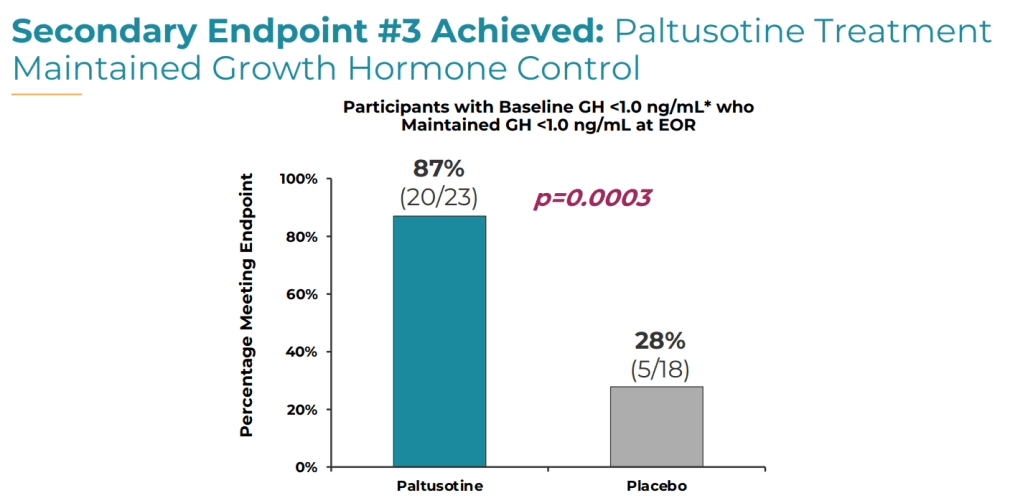


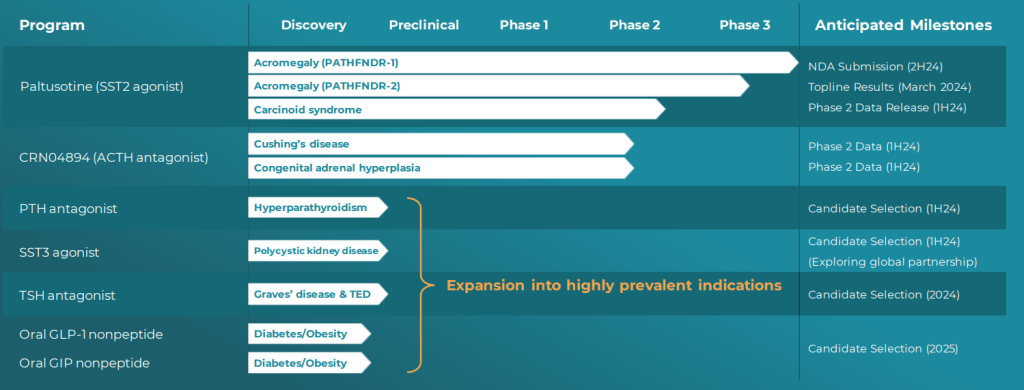


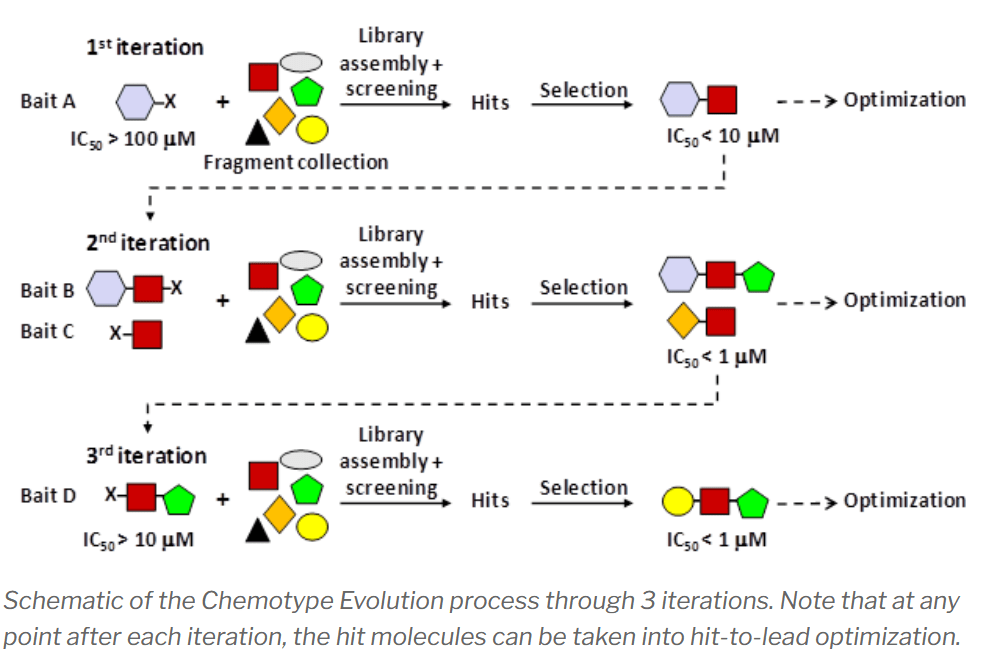
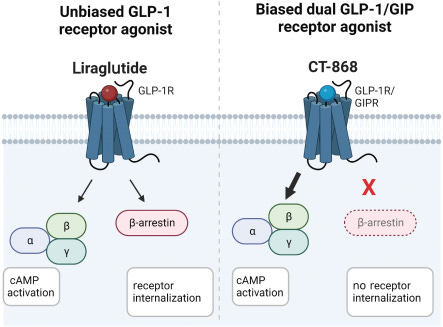
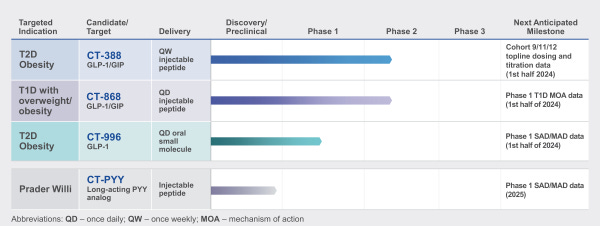
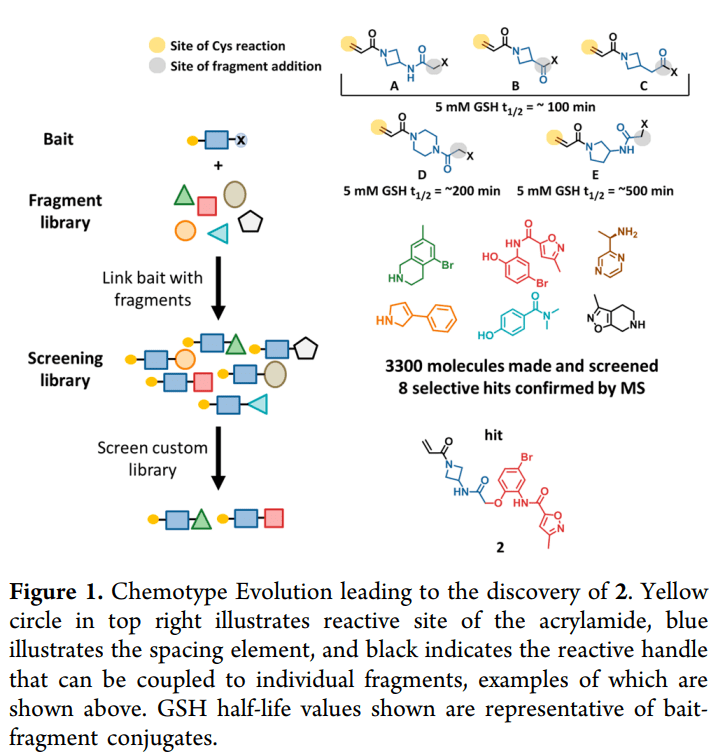

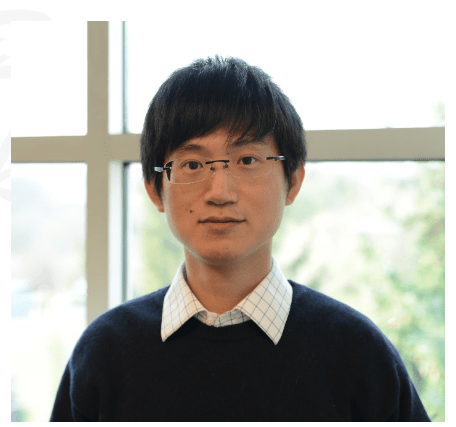
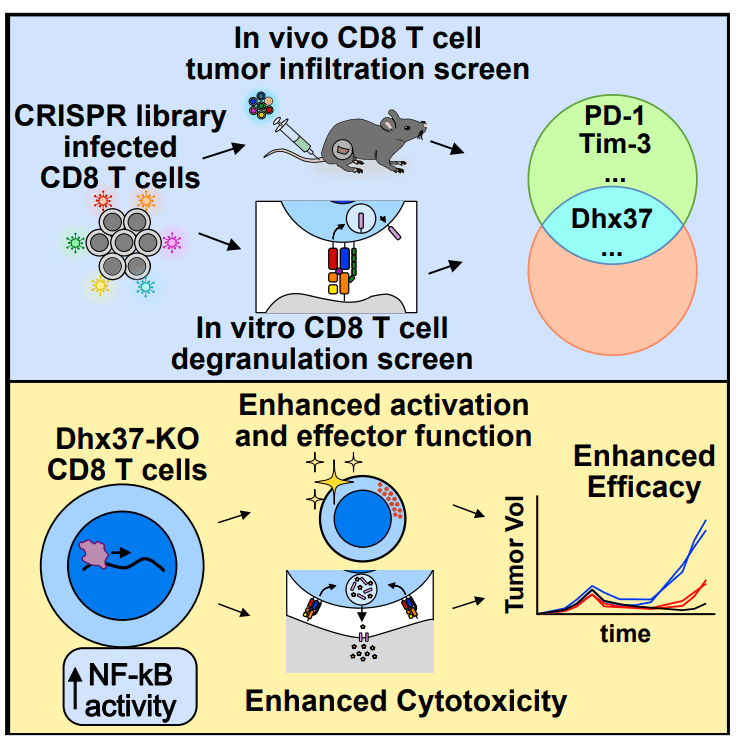
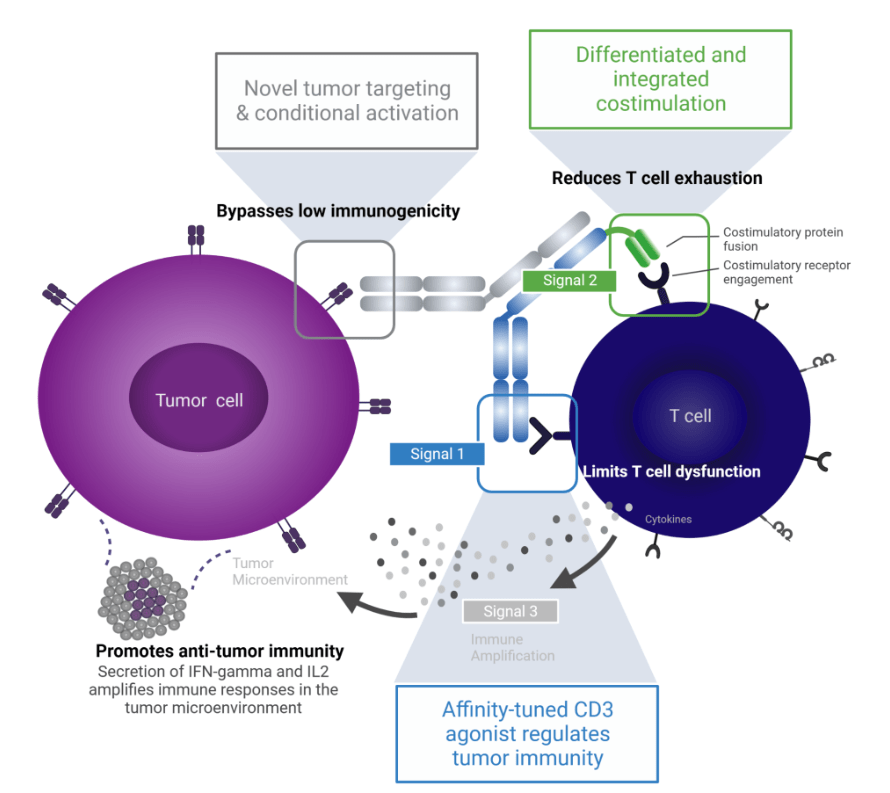
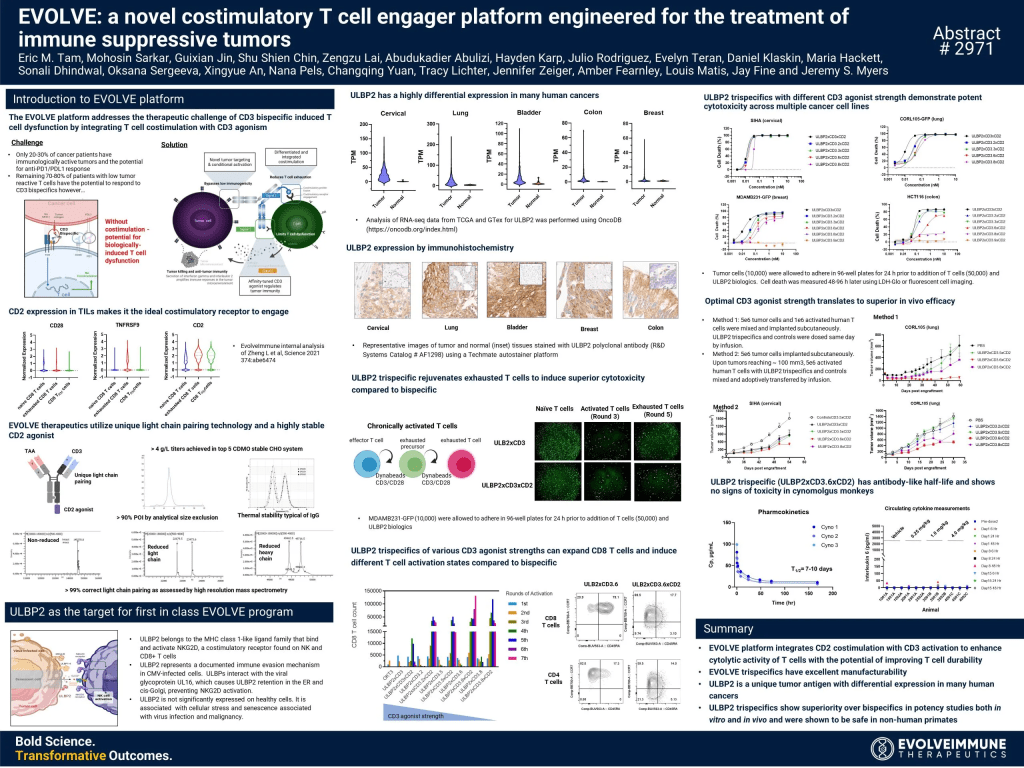
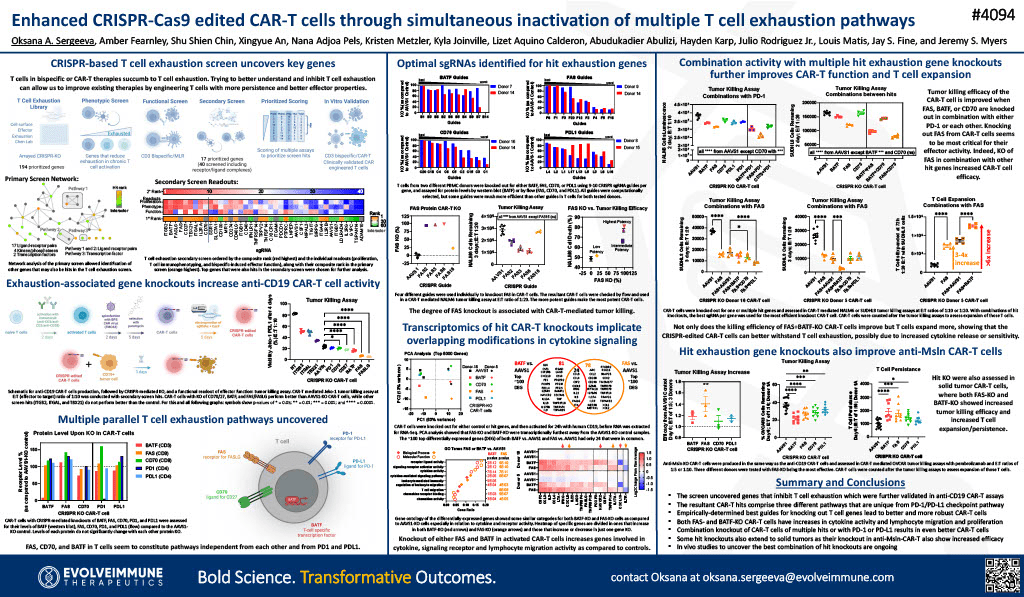
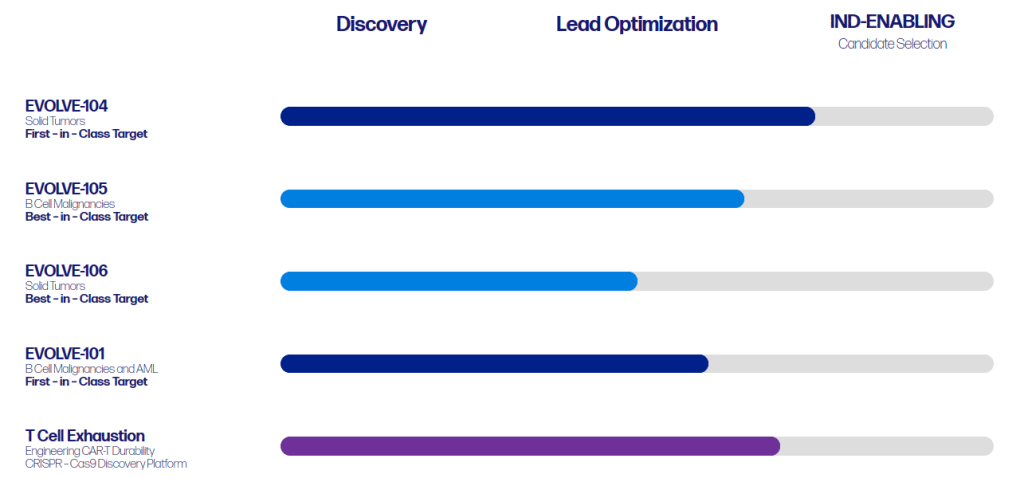

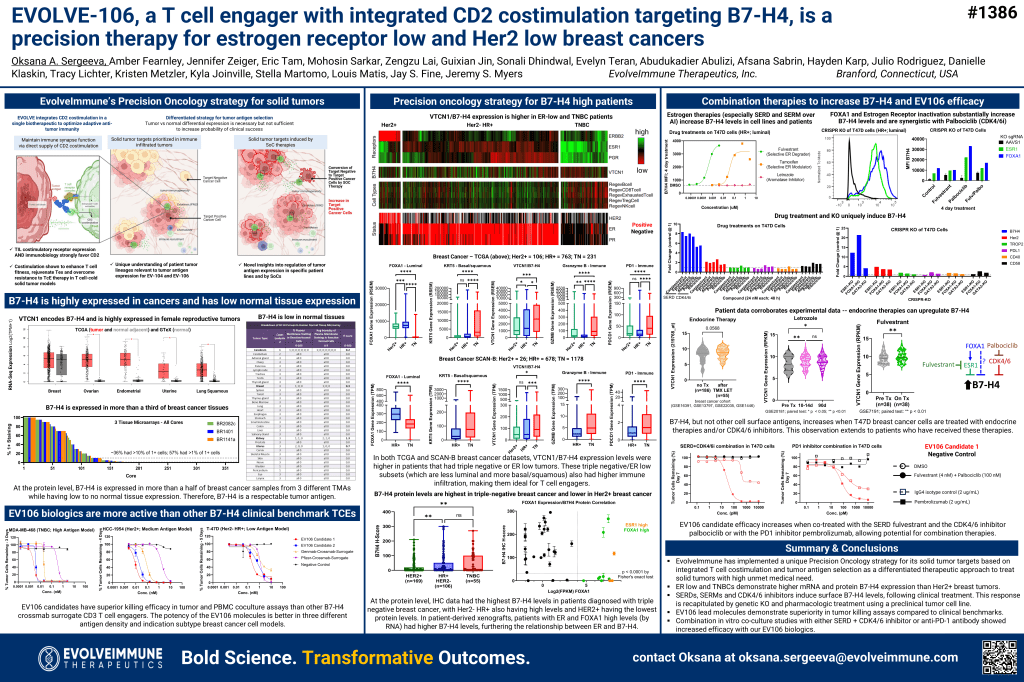

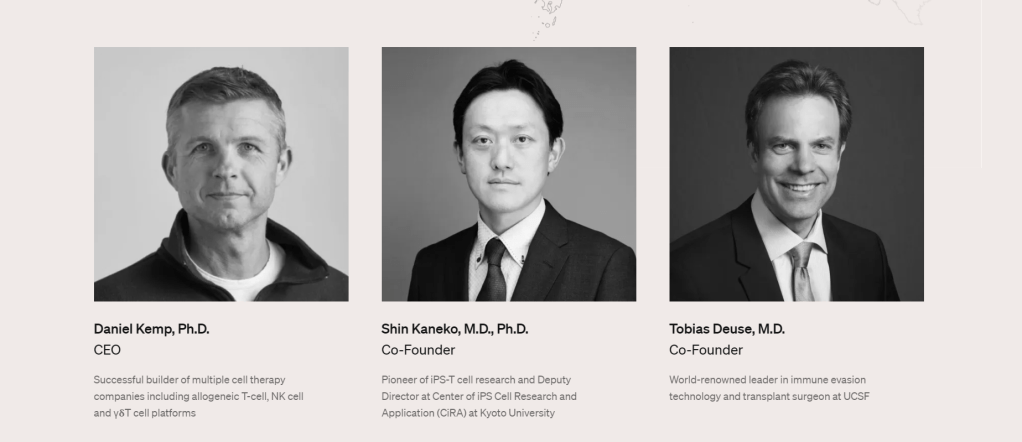
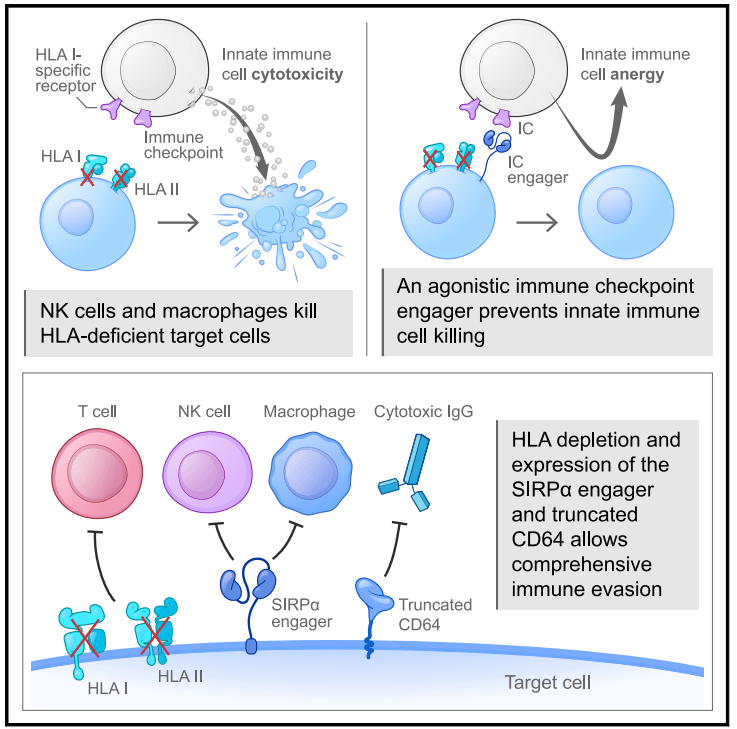
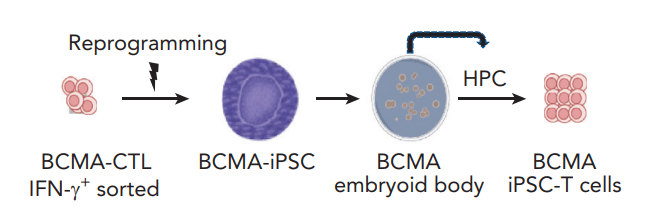
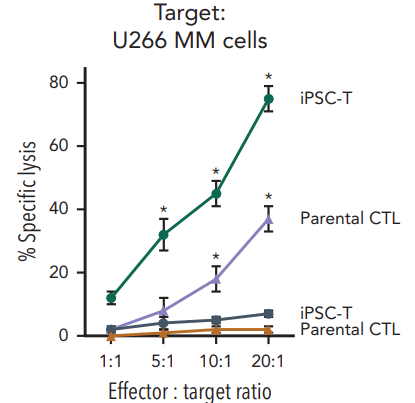
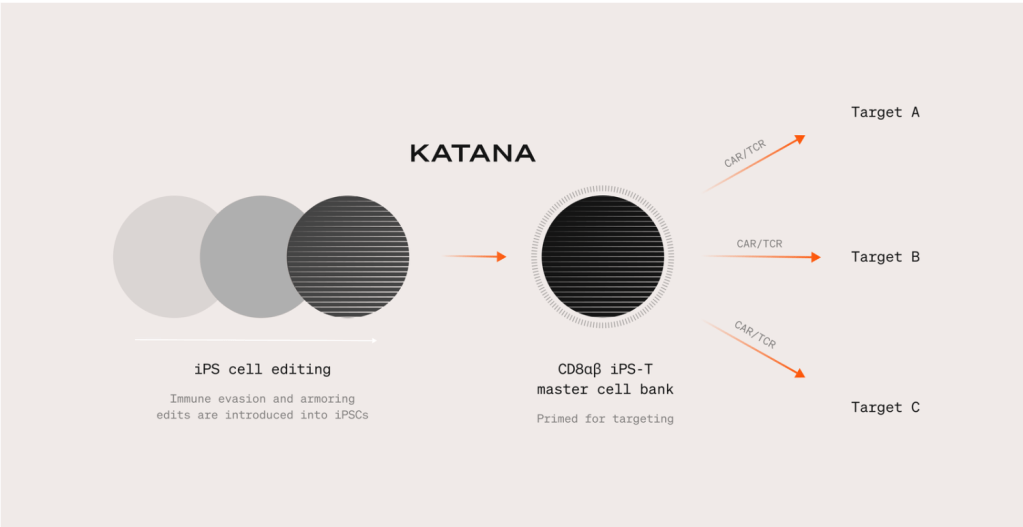
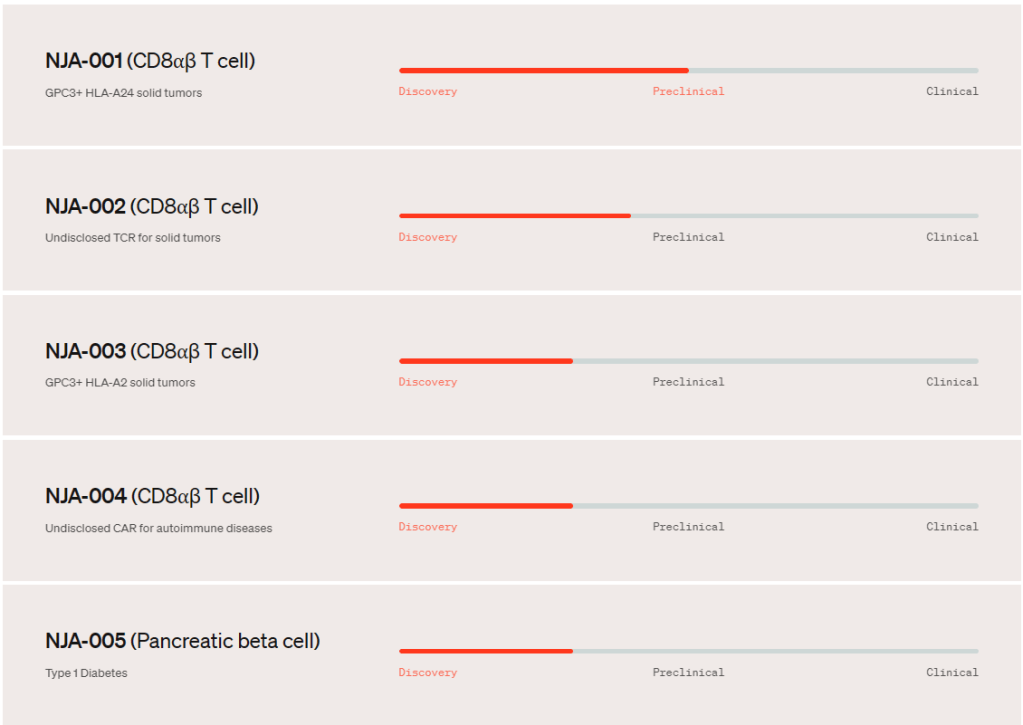


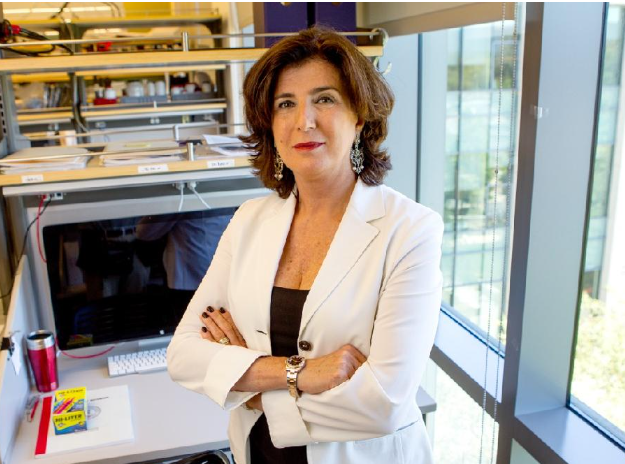


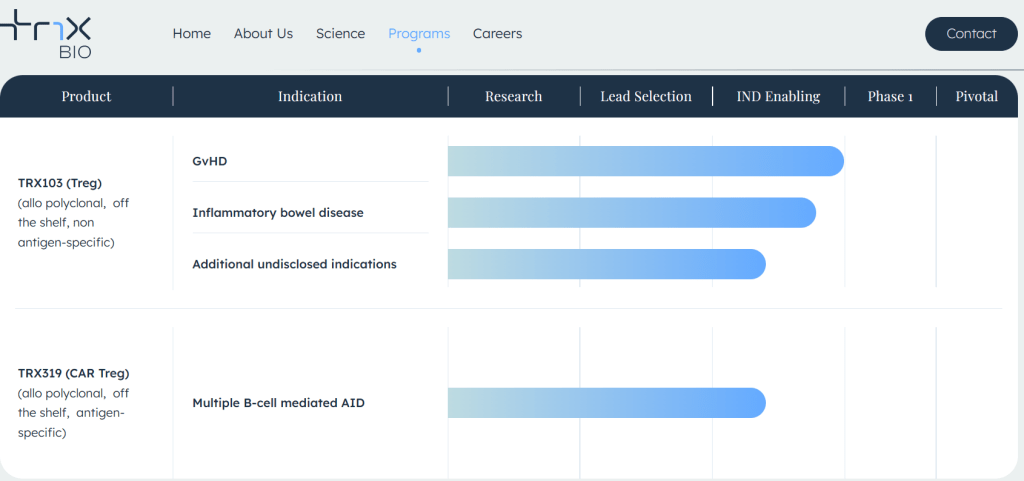
 BOSTON DR LIM